
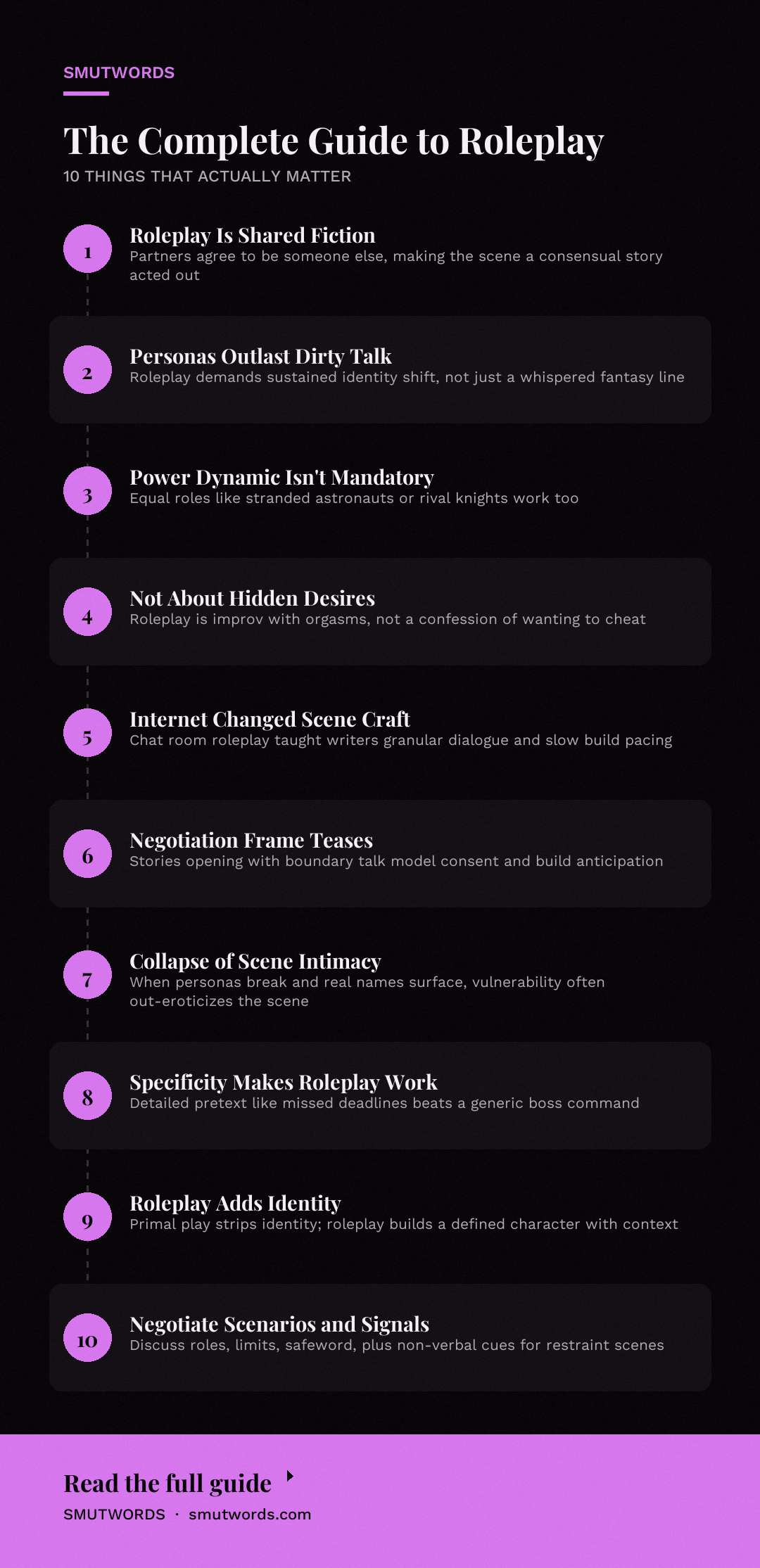
Roleplay is the kink where you and your partner agree to be someone else for a while, the delivery man and the lonely housewife, the stern professor and the student who “didn’t do the reading,” the monster and the human who wandered into the wrong cave. It is consensual fiction acted out in the body, a shared story where the costume, the setting, and the script are all part of the foreplay. Unlike a fantasy that stays safely in your head, roleplay puts that fantasy in a room with you, giving it a voice, a scent, and a pulse, which is precisely why it can hit harder than almost any other kind of scene.
Because roleplay is a container rather than a single act, it shows up across nearly every other kink on the map. It is the scaffolding that lets you safely explore consensual non-consent (CNC), the story that gives a monster cock kink its context, and the script that makes a spitting kink land as a moment of humiliation rather than an isolated act. In the real world, it requires a clear agreement about boundaries and a safeword before the scene begins, and a check-in after to make sure everyone is comfortable with what was acted out. On the page, it requires the exact same commitment to consent and clarity, or the fiction falls apart.
What Roleplay Actually Means
Roleplay means both partners deliberately take on personas that are not their everyday selves, then interact according to the logic of the scenario they have agreed to. The roles usually carry an implicit or explicit power differential, the boss over the employee, the captor over the captive, the alpha wolf over the lone camper, which is what gives the scene its charge. But the power dynamic is not mandatory. Two astronauts stranded on a station, two strangers meeting in a hotel bar, or two rival knights who surrender to each other can all be roleplay without anyone holding the upper hand.
What separates roleplay from a simple fantasy or a one-off line of dirty talk is the sustained commitment to the fiction. In dirty talk, you might whisper, “I want you to fuck me like I’m your boss,” and the scene continues while that idea hangs in the air. In roleplay, you actually become the boss. You put on the blazer, you use the tone, you give the assignment, and the other person calls you “Ms. Chen” for the next hour. The identity shift has to stay alive for the whole scene or the spell breaks.
Common misconceptions abound. Roleplay is not the same as a one night stand, where the persona is often just a lightly exaggerated version of yourself. It is not inherently about age play, which is one specific and heavily negotiated subset. And it is not a sign that the relationship is unsatisfying or that the partners secretly want to cheat. Roleplay is a shared creative act, more like improv theater with orgasms than a confession of hidden desires. The fantasy is the point, not the hidden truth underneath it.
What counts as roleplay is broad enough to include scenarios where the “role” is minimal. A scene where one partner simply speaks with a different accent or adopts a dominant tone after agreeing to a patient/doctor dynamic is roleplay, as is a full costume-and-setpiece production with a script and lighting. The defining feature is the mutual, stated agreement to pretend, together.
Where Roleplay Comes From
The impulse to act out sexual scenarios is as old as human storytelling, but the modern understanding of roleplay as a named kink has a more recent lineage. Early sexological writings from the late 19th and early 20th centuries discussed “scenes” and “costume play” mostly as curiosities or pathologies, often framed as immature escapes from adult sexuality. It was not until the mid-20th century, with the rise of psychotherapy and later the sexual revolution, that acting out fantasies began to be understood as a healthy expression rather than a disorder.
The publishing history of roleplay in erotica tracks closely with the rise of the mail-order and paperback erotic novel in the 1960s and 1970s. Early erotic paperbacks leaned heavily on scenarios where a woman is coerced or tricked into a situation, which we would now recognize as dubious consent at best. As the romance and erotica genres matured through the 1980s and 1990s, and as the feminist sex-positive movement pushed back against narratives of female passivity, published roleplay erotica shifted toward stories where the woman is an active participant in setting the scene. She is not the victim of a scheme, she is the one who arranges to be “caught” by the groundskeeper.
The internet changed the kink dramatically. Online roleplay spaces, from early chat rooms to modern Discord servers, let people practice the craft of building a scene with text before ever taking it into the bedroom. This had a profound effect on written erotica. Authors who came up in those spaces write roleplay scenes with a granular attention to dialogue, setting, and pacing that older published erotica often lacked. The scene on the page became less about a quick setup and more about the delicious long build of trading lines back and forth, exactly the way two strangers in a chat room would.
Another notable shift is the mainstreaming of “acting out” as a healthy couples’ activity. Advice columns and sex therapy resources have promoted roleplay for decades, but the language around it has changed from “spice up your marriage” to “explore your fantasies in a safe container.” That framing, which emphasizes boundaries, safewords, and aftercare, has filtered directly into contemporary erotica. Modern roleplay stories are more likely than their predecessors to include an explicit negotiation scene at the start, where the characters agree on the terms before the fiction begins.
How Roleplay Shows Up in Erotica
The strongest roleplay erotica does not just describe bodies colliding, it builds a world and then lets the reader live in it long enough to feel the shift when the scene tips from acting to arousal. The craft lies in the setup, the slow establishment of the persona, and the moment when the role becomes more real than the people playing it.
Most published roleplay erotica falls into a few recognizable structural patterns.
The first is the negotiation frame. The story opens with the couple or partners discussing what they want to try, often over dinner or while undressing, and the negotiation itself becomes part of the tease. They trade ideas, one partner hesitates before confessing a fantasy, and the other agrees to play along. This frame does double duty, it models enthusiastic consent for the reader while also building anticipation. The best versions make the negotiation as charged as the sex that follows.
The second is the cold open. The story drops the reader directly into the middle of the scene, the professor is already at the lectern or the intruder is already in the bedroom, and the context comes later through dialogue and internal monologue. This pattern is common in short-form erotica and serialized online fiction, where the reader wants the fantasy to start immediately. It creates a disorienting, immersive effect that mirrors how it feels to be swept up in a scene once the roles have taken over.
The third is the collapse of the scene. This is the moment, often near the end or at the climax itself, when the fictional personas break and the real partners surface. The professor calls the student by her actual name. The captor asks, “Is this okay?” The monster pulls off its mask. This collapse can be a beat of profound intimacy, a reminder that underneath the fantasy is a real, trusted person. Many readers find the collapse more erotic than the scene itself, because it reveals the vulnerability underneath the play.
What separates a flat roleplay scene from a strong one is specificity. A scene where a man says, “I’m the boss, do what I say” and then immediately fucks her is hardly roleplay at all. A scene where she walks into the office on a Saturday to find him waiting in a suit, where he asks her to explain why she missed the deadline, where he makes her repeat the words “I’ll do better, Mr. Hale” before he touches her, that is roleplay. The rules of the fictional world have to be stated and then enforced. The more detailed the pretext, the more room the author has to generate tension before anyone undoes a button.
Enjoyed this? Get a free book.
Join the list and we will send a complete free story straight to your inbox, plus new releases every week after that. No credit card, no catch.
Dialogue is the engine of roleplay erotica. The characters are speaking as other people, which means the author can use register, vocabulary, and formality to signal the power dynamic. A doctor using clinical terms, a knight using archaic speech, a stranger using unnervingly direct language, all of these choices build the scene faster than any physical description. Internal monologue also matters. Erotica written in close third person or first person can show the gap between what the character is saying in role and what they are really thinking, which creates a delicious dramatic irony. The cleaning woman says, “Yes, sir,” while her inner voice marvels at how wet she is. The reader gets both truths at once.
Common variants in erotica include the femdom hotwife romance pattern, where the wife takes on a staged persona for her husband’s enjoyment, and the stranger encounter, where partners pretend they do not know each other and pick each other up in a bar. Fantasy creature roleplay, where one partner plays a monster or supernatural being, overlaps heavily with monster romance and often permits dynamics that would be too dark between two ordinary humans. Interrogation scenes, where one partner plays captor and the other captive, are a fixture of darker erotica and demand the most careful negotiation, both between the characters and from the author.
The best roleplay scenes hold the line between fantasy and reality without breaking it too soon. They keep the reader suspended in the fictional frame long enough to get lost, then offer a landing back into the real relationship that feels soft and safe. The erotic charge comes from the distance between who the characters are pretending to be and who they actually are, and from the knowledge, held by the reader, that the whole thing is an act they are choosing, together.
Roleplay vs Primal Play
The line between roleplay and primal play is genuinely blurry, and readers often confuse the two. Primal play is a kink focused on stripping away human social conditioning to access a more instinctual, animalistic state. It often involves chasing, wrestling, growling, and predatory energy, but it does not necessarily require a distinct persona. A primal scene might just be two people who agree to stop using words and let instinct take over, with no costume, setting, or character involved.
Roleplay, on the other hand, is fundamentally about the persona and the scenario. The professor and the student, the cop and the robber, the alien and the abductee, these are characters with a context and a script. Primal play can be folded into a roleplay scene, the werewolf persona in a supernatural roleplay might justify a predatory chase, and roleplay can certainly include primal energy. But the core of each is different. Primal play subtracts identity, roleplay adds one.
A useful shorthand for the reader is to ask what is doing the work. If the charge comes from being treated like prey, that is primal play. If the charge comes from being treated like a specifically defined someone else, the grumpy billionaire’s new assistant, that is roleplay. The two often combine, and many of the hottest published scenes deliberately layer them, but they are distinct enough that a reader with a strong preference for one can be unsatisfied by the other.
(Note: feral play, as covered elsewhere in the SmutWords glossary, is a related but separate spin, focused on animalistic behavior without the predatory framework of primal play.)
Frequently Asked Questions
Is roleplay the same as dressing up and pretending?
Costumes help many people get into character, but the costume is not the kink. The kink is inhabiting a different identity and interacting with your partner from inside that identity. Two people in their regular clothes having a scene where they are strangers in a waiting room is roleplay. Two people wearing elaborate costumes who have not agreed to act out a scenario are just wearing costumes.
What if my partner wants to roleplay a fantasy that feels wrong or uncomfortable to me?
You are allowed to say no to any scenario, and a partner who respects you will accept that immediately. That said, there is a difference between a hard no and a “that makes me nervous.” If the scenario is not a hard limit, you can negotiate a softened version, change the setting, or alter the power dynamic so you feel safer. The fiction is infinitely adjustable. The only non-negotiable is your genuine comfort.
Do I have to be good at acting to enjoy roleplay?
No. The person you are playing with is not your audience, they are your co-actor, and they want you to succeed. A simple scenario with a few repeated lines and a clear power dynamic is far more effective than an elaborate performance where you are worrying about your delivery. The goal is mutual arousal, not a theater review.
Is roleplay in erotica a sign the author condones the real-world behavior?
No. Erotica is fiction, and roleplay is a consensual frame. A story about a captive and a captor is not an endorsement of kidnapping, just as a story about a teacher and a student is not an endorsement of actual abuse of power. The fictional container matters, and readers should always check the content warnings if they are concerned about a specific scenario.
What is the difference between roleplay and a cuckold scene?
A cuckold scene can be a form of roleplay if the partners are staging it, but when it appears in a specific subgenre of erotic fiction, it is usually written as a real dynamic within the story rather than an act the characters are putting on. For a detailed breakdown of how the two narrative modes differ, the SmutWords editorial team’s article on the two types of cuckold stories is worth reading.
How much negotiation is enough before a roleplay scene in real life?
At minimum, discuss the scenario, the specific roles, the power dynamic, what each partner is and is not willing to do, and the safeword or gesture that will end the scene. If the scenario involves restraint, darkness, or any element where one partner cannot easily speak, agree on a non-verbal signal. After the scene, check in to share what worked and what you might change next time. Negotiation is not a mood killer, it is part of the build.
Final Thoughts
Roleplay is the rare kink that is simultaneously an escape hatch and a trapdoor into deeper intimacy, and the best erotic fiction knows how to work both doors. When it is done with a clear frame and a hot scenario, roleplay gives readers permission to explore dynamics they would never touch in real life, from the taboo to the absurd to the deeply tender. Start with a marking kink story that doubles as a teacher/student scene, where the professor’s “grade” is written on the student’s skin in hickeys, to see how cleanly the persona frame can multiply the charge of another kink entirely.






Loading comments…