
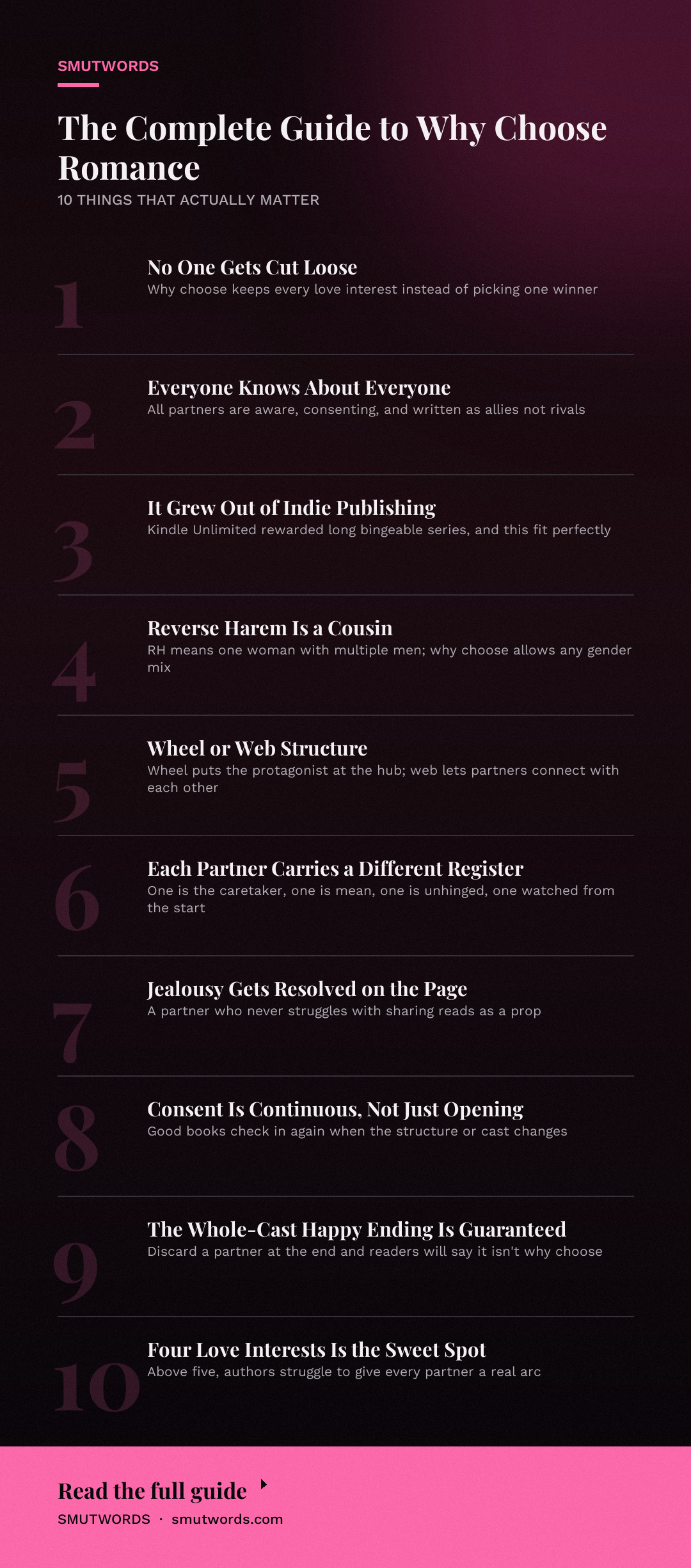
Why choose romance is the subgenre where the main character ends up with more than one partner, everyone knows about everyone else, and nobody gets left at the altar or cast as the villain for it. Instead of a love triangle that has to resolve into a single winner, the story keeps all the love interests and builds a relationship structure that holds them.
The name comes from the reader-facing question the books pose and answer in the same breath: why choose one when you can have them all? It is one of the fastest-growing corners of indie romance, and it has its own rules, its own vocabulary, and its own specific pleasures.
What Why Choose Romance Actually Means
The short definition is accurate but thin. A why choose romance is a romance novel in which the protagonist has multiple simultaneous romantic and sexual partners, all of whom are aware of each other, consenting, and written as allies rather than rivals. There is no deception, no secret affair, and no framing of one partner as a threat to another.
The relationships are typically overlapping rather than sequential. The book treats the arrangement as the happy ending, not a phase the hero grows out of. The "why choose" label is a marketing term as much as a structural one: it signals to readers that the love triangle will not end with one suitor heartbroken in the rain. Instead of choosing, the protagonist keeps the whole set, and the book's emotional work goes into making that feel earned rather than greedy.
Several things get folded under the umbrella, and they are not identical:
- Reverse harem (RH): one female protagonist, multiple male love interests, usually three or more. The most common configuration in the Western market.
- Why choose / polyamorous romance: broader terms that can include any gender mix, including multiple women, nonbinary partners, or a protagonist of any gender.
- Ménage: technically a scene or relationship involving three people. Often used loosely to describe a threesome-centric book, which may or may not be a full why choose.
- Polycule romance: the partners may also be involved with each other, forming a web rather than a wheel with the protagonist at the center.
What does not count matters just as much. A cheating plot is not why choose, because the whole point is that nobody is deceived. A love triangle that resolves into a single couple is not why choose, because someone gets cut loose. A harem in the older, more exploitative sense (one man, many women, women written as interchangeable) shares DNA with the trope but usually lacks the emotional reciprocity that defines the modern version.
Where Why Choose Romance Comes From
The structural ancestor is the harem story, which has existed in erotica and genre fiction for a very long time: one protagonist, a rotating cast of devoted partners, an emphasis on abundance. Early versions leaned hard on possession and often treated the women as prizes rather than people with interior lives.
The modern why choose boom is a publishing story as much as a literary one, and it belongs to the indie and self-publishing world. Around the mid-2010s, Kindle Unlimited created an economic incentive for long, bingeable series, and why choose books fit that model almost perfectly. They naturally run long, they support sequels, and readers who fall for the whole cast have a reason to buy every installment.
Two other forces pushed the genre toward its current shape. First, mainstream romance readers were already deeply fluent in the love triangle, and a critical mass got tired of the same conclusion.
Second, the rise of openly polyamorous romance written by and for people with real-world familiarity with non-monogamy changed how the relationships were depicted. Consensual non-monogamy moved from a scandal to a premise, which you can see in the broader conversation around why hotwife fiction isn't cheating fiction. Why choose is the polyamorous branch of that same shift, applied to romance's mandatory happy ending.
The genre has also settled into recognizable subcategories. Paranormal and omegaverse why choose is enormous, partly because the worldbuilding justifies the structure through bonds and pack dynamics. Contemporary why choose centers on rock bands, motorcycle clubs, sports teams, and small towns.
Dark why choose overlaps with mafia and revenge plots, where the multiple partners are also a power bloc. If you want the contrast on the darker end, the split between dark romance and taboo romance explains why "morally gray" and "forbidden" are not the same marketing promise.
How It Shows Up in Erotica
On the page, why choose changes how a scene is choreographed. A single-couple sex scene has two bodies and one axis of attention. A why choose scene has a geometry problem, and the good books solve it deliberately.
The most common structural choice is the wheel: the protagonist is the hub, each partner gets a one-on-one scene with her, and group scenes are special occasions. The alternative is the web, where the partners also have relationships with each other. The web is harder to write and more rewarding, because the jealousy dynamics get to exist and then get resolved rather than being waved away.
Specific partners usually carry specific kinks and specific emotional registers. This is where why choose gets genuinely interesting as craft.
One love interest is the caretaker. One is the mean one, and the degradation kink scene belongs to him because the reader has already watched him be tender elsewhere. One is the unhinged one.
One is the one who watched from the start and wanted in, which lets the book do a slow-build voyeurism arc before the newcomer is invited to participate.
The group scene is the genre's signature set piece, closer to a controlled orgy with emotional stakes than to a free-for-all. Strong versions solve three problems at once: positioning (who is where and why), attention (who is being watched and by whom), and emotional throughput (what each partner needs to feel in the moment and how the others provide it).
Enjoyed this? Get a free book.
Join the list and we will send a complete free story straight to your inbox, plus new releases every week after that. No credit card, no catch.
Weak versions lose track of one or two partners entirely, and those partners may as well not be in the room.
A few things reliably separate a strong why choose book from a flat one:
- Each partner has a distinct voice and a distinct need. If you could swap two love interests and no scene would change, the book has a cast problem, not a plot problem.
- Jealousy is addressed, not deleted. The genre's fantasy is safety, and safety means the friction got resolved on the page. A partner who never struggles with sharing reads as a prop.
- The consent is explicit and continuous. Not just at the beginning. A good why choose book checks in again when the structure changes, when someone joins, when someone gets hurt.
- Time is distributed unevenly on purpose. The reader's favorite is not always the protagonist's. Skilled authors give each partner a spotlight chapter and then let them recede, which builds the feeling of a living group rather than a checklist.
- The external plot still has teeth. Family pressure, a rival pack, a criminal organization, a public image problem. The relationship structure is not the whole conflict, or book two has nothing to do.
Kink variety is one of the genre's biggest draws, and authors treat the partner roster as a menu of scenes they could not fit into a single-couple book. One partner brings rope and a shibari sequence. One brings a bite-first energy that tips into feral play. One is a sweet first-time scene that exists to show the protagonist being handled gently between rougher chapters.
That range is the actual product. Readers are not only buying the fantasy of multiple partners; they are buying the fantasy of multiple registers of intimacy in one book.
The genre also has to solve a problem single-couple romance never faces: the first kiss cannot be the climax of the book. Why choose novels front-load attraction and space the first physical milestones across partners so that no single one of them eats the whole arc.
A common structure is a slow burn with the whole group before anyone gets laid, then a rapid escalation once the first barrier breaks. The sequencing is where a lot of series live or die.
Why Choose Romance vs Polyamorous Romance
These two terms get used interchangeably, and they are not the same thing. Why choose is a marketing category, a shelf label readers search for. Polyamorous romance is a relationship descriptor, and it includes books where the structure is negotiated, messy, and presented with the same fidelity you would give any real relationship.
Almost all why choose books are polyamorous in the sense that multiple partners know about each other. Not all polyamorous romance is why choose, because the label carries genre expectations that a given polyamorous book might not meet. A quiet contemporary about a married couple opening their relationship to one specific person may be polyamorous romance without being why choose.
The practical difference is tone and promise. Why choose promises abundance and a guaranteed whole-cast happy ending. Polyamorous romance promises realism and negotiation, and it may end ambiguously on purpose. If you want to compare the structure to a related but distinct dynamic, the voyeur husband trope is a good reference point for how a married couple can be part of a scene without the story becoming a full polycule romance.
Frequently Asked Questions
Is why choose romance the same as reverse harem?
In practice, they overlap heavily and most readers use the terms interchangeably. Reverse harem technically specifies one female protagonist with multiple male love interests, while why choose allows any gender configuration. Plenty of books are tagged both.
Does why choose romance have a happy ending?
Yes, and that is one of the genre's guarantees. The whole-cast happy ending is the promise on the cover. If a book kills off or discards a partner at the end, it is not a why choose, and readers will say so in the reviews.
How many love interests is too many?
Around four is the sweet spot for most series. Above five, authors struggle to give every partner a real arc, and readers start skipping chapters for the ones they care about. Six or seven can work in a long series but rarely in a standalone.
Can why choose romance include m/m content?
Often, yes. Once the partners have relationships with each other and not only with the protagonist, m/m pairings are common. Books where the male love interests are also involved with each other are usually tagged as polycule or MM+ romance to set expectations.
Is why choose the same as a harem?
They share an ancestor, but the modern why choose version centers reciprocity. The older harem structure often treated partners as interchangeable, while why choose books insist that each love interest is a distinct person the protagonist specifically wants. That is the whole emotional argument of the subgenre.
Where do I start if I have never read one?
Pick a subcategory that matches what you already like: paranormal if you read shifters, sports if you read contemporary, mafia if you read criminal romance. The structure is the same across subcategories, but the worldbuilding and the tone vary a lot.
Final Thoughts
Why choose romance is doing something most romance cannot: it refuses the premise that love is scarce. The whole subgenre is built on the idea that the abundance is the point, and the craft challenge for authors is making that abundance feel specific rather than generic. When it works, you finish the book believing that each partner is genuinely necessary to the ending, not just convenient to the plot.
If you want one book to test the waters, start with a title from our why choose and breeding kink crossover list below and see how the structure feels on the page. The genre rewards readers who like spending time inside a growing cast, and there is plenty of it to get lost in.







Loading comments…