Alien romance is the subgenre of speculative fiction where the love interest is not human, and that's the whole appeal. A human woman and a seven-foot warrior from a dying star system. A stranded pilot and the many-armed thing that rescues her.
The term covers everything from glossy intergalactic space opera to gritty abduction stories set in cargo holds. The through-line never changes: desire that crosses a species line and refuses to apologize for it. If you've ever finished a book and thought "I need another one exactly like this but with more tentacles," you already understand the alien romance market better than most publishers did five years ago.
The genre has exploded over the past decade, moving from a niche corner of self-publishing into a serious commercial force. It has its own conventions, its own reader vocabulary, its own internal debates about what counts and what doesn't.
This guide covers the definition, the history, the craft of writing it well, and the questions readers type into search bars at two in the morning. It's long because the subject deserves it.
What Alien Romance Actually Means
The name is straightforward. "Alien" carries both senses at once: extraterrestrial and fundamentally other. A love interest from another planet, another dimension, or another evolutionary branch of life. The romance is the engine, the alienness is the fuel.
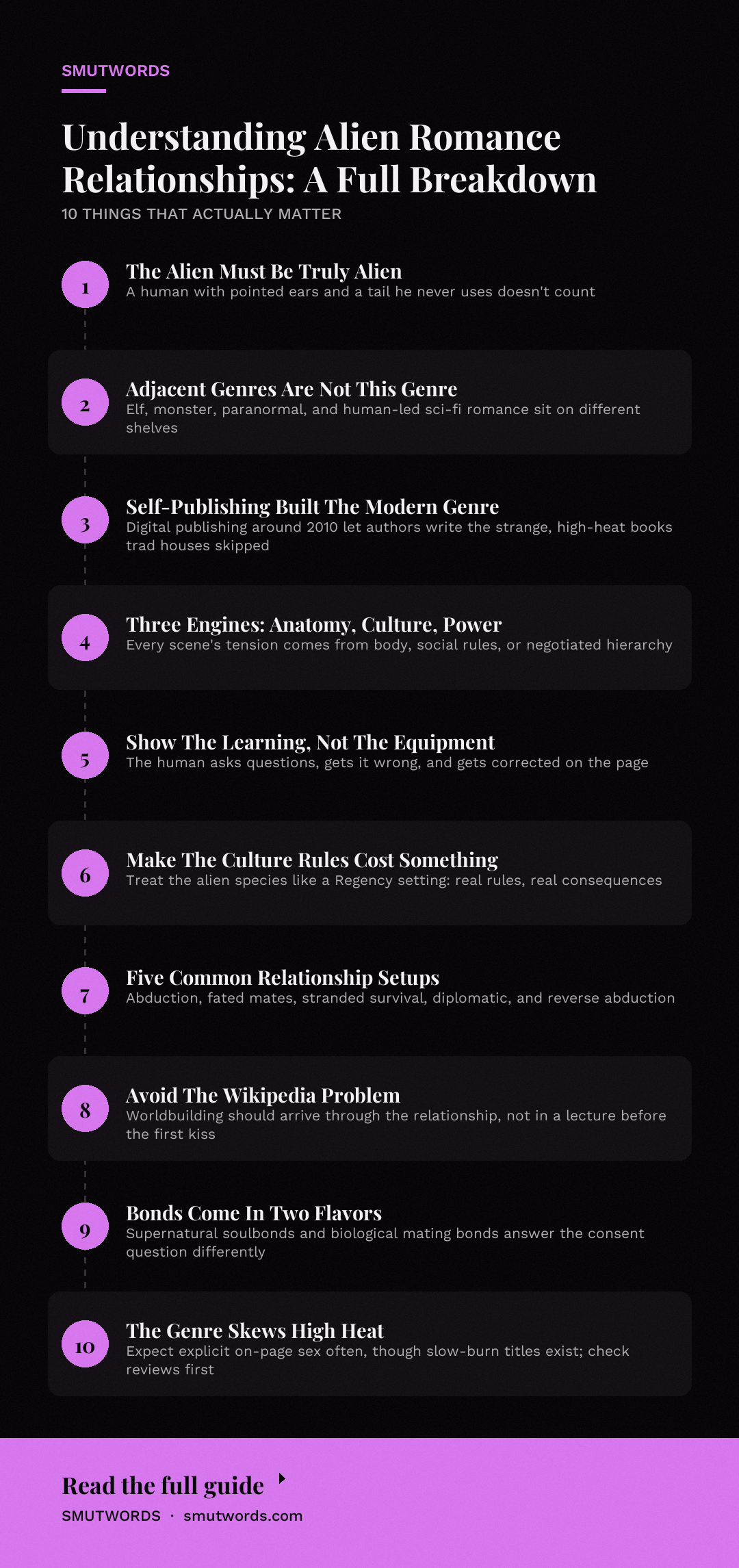
What counts as alien romance is broader than people assume. The love interest needs to be genuinely non-human in a way that shapes the relationship. Not a human with pointed ears and a diplomatic posting. If the only difference between him and a human is that he has a tail he never uses, you've written a human with a tail.
Several things get filed under alien romance that don't quite fit:
- Elf romance and fae romance. These involve non-human beings, but they're terrestrial, mythological, and usually Earth-adjacent. Different genre, different tropes. The elf romance entry covers that space properly.
- Monster romance. Overlapping but distinct. Monster romance often involves creatures with no spacefaring culture, no homeworld politics, no ship. The alien has a civilization and usually a language.
- Sci-fi romance with human leads. Two humans falling in love on a spaceship is science fiction romance, but it isn't alien romance. The alien love interest is the defining feature.
- Paranormal romance. Vampires, shifters, demons. Supernatural beings embedded in human society. Different shelf entirely.
A common misconception is that alien romance requires hard science. It doesn't. Some of the most popular books in the genre hand-wave the biology entirely and focus on the emotional and physical dynamic.
Readers aren't checking your xenobiology citations. They're checking whether the alien feels genuinely foreign and genuinely desirable at the same time.
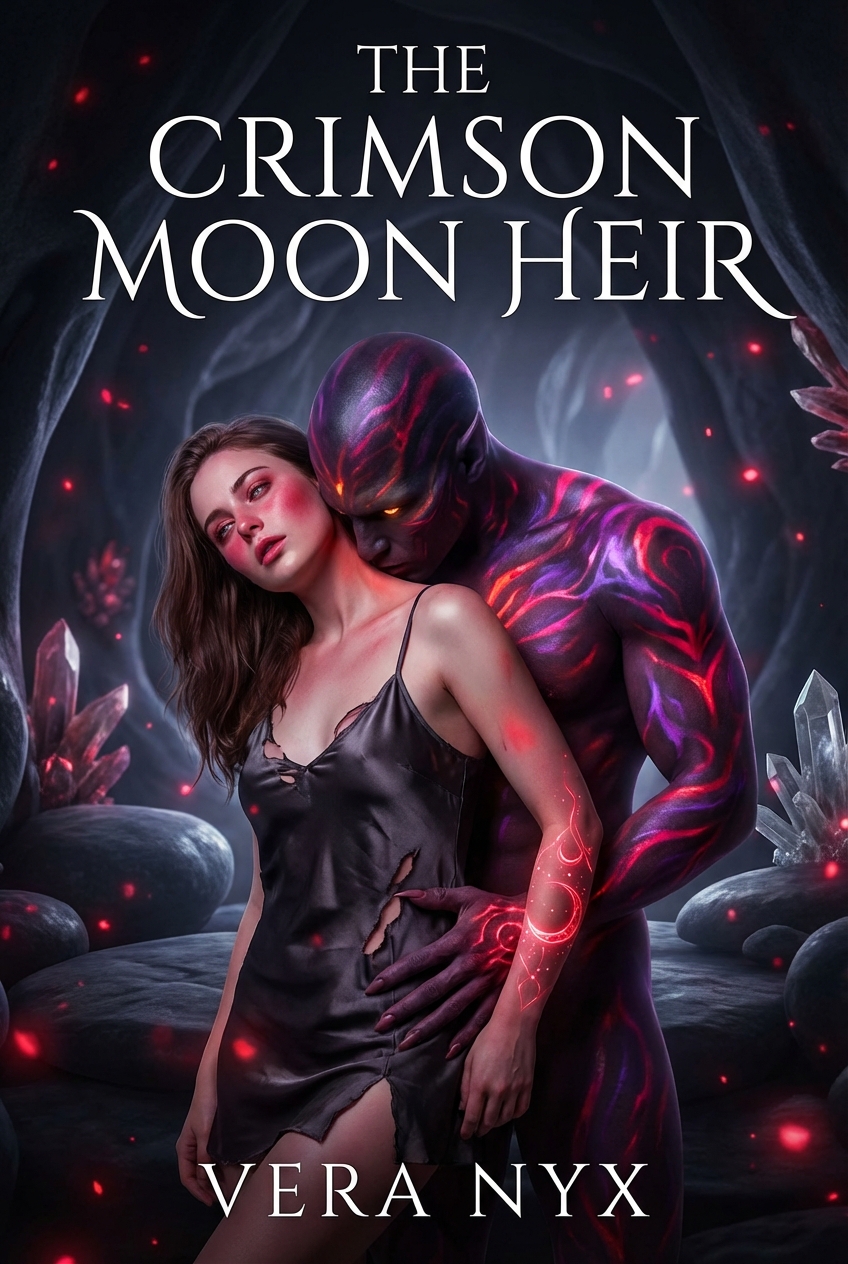
Another misconception: alien romance is a niche for weird readers. The numbers say otherwise. The genre produces bestsellers and sustains long-running series. It has also spawned an entire sub-economy of cover artists who specialize in purple-skinned heroes with too many abdominal muscles.
Where Alien Romance Comes From
The publishing history matters more than the speculative history here. Alien romance as a recognizable category is a fairly recent invention compared to, say, vampire romance. The roots go back to pulp science fiction of the mid-twentieth century, where cross-species encounters were usually framed as horror or tragedy rather than romance. The alien was a threat, a mystery, or a cautionary tale about miscegenation dressed up in rocket ships.
The shift happened gradually through the 1980s and 1990s, as science fiction romance carved out a readership and authors began writing love stories where the alien love interest was unambiguously the romantic lead. The turning point for the modern genre was the rise of digital self-publishing around 2010. Suddenly authors could write the strange, specific, high-heat books traditional publishers wouldn't touch.
Two things happened next. Authors found an audience willing to buy serialized alien romance at volume, and that audience turned out to be enormous. The genre developed its own bestseller lists, its own conventions, its own review culture. Readers began requesting specific alien anatomies the way romance readers request specific tropes.
Early alien romance leaned heavily on abduction plots. The human heroine gets taken, the alien captor becomes the love interest, and the story works through the ethics of that setup.
That framework is still popular, but the genre has diversified. You now find alien romance where the human is the one in power, where the alien is the vulnerable one, where the relationship is a political alliance, where the two characters are stranded together and have no choice but to build a language from scratch.
The most recent evolution is toward cultural specificity. Early alien romance often treated the alien culture as a vague collection of warrior tropes. Contemporary books world-build.
They give the alien species a religion, a mating system, a set of taboos, a way of eating, a way of grieving. The romance works because the culture clash is real and detailed. Interesting equipment alone won't carry a book.
How It Shows Up in Erotica
Here's the part where craft matters most. Alien romance on the page is a machine for generating tension, and the tension comes from three engines: anatomy, culture, and power.
Anatomy is the obvious one. The alien love interest has a body that doesn't work like a human body, and the scene has to figure out how it does work. This is where the genre gets delightfully specific. Multiple or unusual genital configurations, different erogenous zones, unfamiliar responses to arousal, fertility cycles tied to moons or seasons or chemical signals.
A strong alien romance scene doesn't just describe the equipment; it shows the human character learning the equipment, asking questions, being wrong, being corrected.
Culture is the second engine, and the more underused one. A good alien romance treats the love interest's species the way a good historical romance treats the Regency: the social rules are real, they constrain the characters, and breaking them costs something.
Courtship rituals. Mating displays. What's obscene in this culture that's normal in hers. What's sacred. The tension of a human woman accidentally violating a taboo and discovering the alien's reaction is not offense but arousal.
Power is the third engine, and it's where the genre overlaps with the broader romance conversation about dominance and submission. The alien love interest is often physically stronger, socially higher-ranked, or literally the commander of a ship. The erotic charge comes from the negotiation of that power.
Enjoyed this? Get a free book.
Join the list and we will send a complete free story straight to your inbox, plus new releases every week after that. No credit card, no catch.
D/s rules and rituals map onto cross-species dynamics in ways authors find endlessly productive. A mating bond that functions like a collar. A species-wide protocol for claiming a partner.
Common variations authors use:
- Alien abduction romance. The human is taken, willingly or not, and the story works through captivity, acclimation, and eventual attachment. There's an honest pregnant and alone trope connection here, since abduction plots frequently involve fertility plotlines and the heroine facing a pregnancy far from home.
- Fated mates across species. The alien's biology includes a mating instinct. This variant often leans on a bond that feels spiritual or neurological, similar to but distinct from the way soulbond functions in fantasy romance. The alien romance version usually grounds the bond in biology rather than magic, which changes how consent and choice work in the story.
- Stranded or survival romance. Two beings from different worlds have to survive together. The relationship builds from practical cooperation into physical intimacy. A strong setup for authors who want slow burn in an alien setting.
- Political or diplomatic romance. The human is an ambassador, a translator, a hostage in a peace negotiation. The alien love interest is a ruler or a warrior with institutional power. High-stakes, high-formality, excellent for tension.
- Reverse abduction. The human captures or purchases the alien. Less common but gaining ground, and it usually produces a more interesting power dynamic than the classic version.
What makes a strong alien romance work versus a flat one comes down to specificity. A flat version gives you a tall muscular alien who acts exactly like a human man in a Halloween costume. A strong version gives you an alien whose body language, speech patterns, and assumptions about the world are genuinely foreign, and then shows the human character falling for someone she has to constantly translate.
The best alien romance authors understand that the erotic charge comes from difference, not from the alien being a human in a mask. When the hero's hands have too many fingers and he uses them all, that's the material. When he doesn't understand why she's embarrassed by something, when he has a completely different relationship to nudity, when he takes her literally in ways that produce tenderness she didn't expect, that's the scene.
One craft note: alien romance is vulnerable to what editors call "the wikipedia problem." Some books front-load pages of worldbuilding before the characters have done anything interesting to each other. Readers are here for the relationship, and the worldbuilding should arrive through the relationship rather than in a lecture delivered before the first kiss. The same discipline that keeps a long-runner fake relationship plot from getting bogged down applies here. The trope is the engine, not the destination.
Alien Romance vs Soulbond
These two terms get confused because plenty of alien romance books use a bond mechanic, and plenty of soulbond books involve non-human love interests. The distinction is worth making precisely because the overlap is real.
A soulbond is a supernatural or magical connection that binds two people together, usually with telepathy, shared sensation, or an unbreakable emotional link. It's a fantasy and paranormal romance device. The bond is metaphysical. The characters can feel each other across distance, and proximity to each other is magnetic.
An alien romance is a category defined by the love interest's non-human status. An alien romance might contain a bond, and many popular series do. But the bond is a plot device within the genre, not the genre itself.
If you stripped the bond out of a soulbond book, the story collapses. If you stripped it out of an alien romance, you'd still have a human and an alien figuring out how to be together.
The reason the confusion persists is that alien biology bonds are functionally identical on the page to magical ones. The alien hero has a mating instinct that overrides conscious choice. The human heroine feels a pull she can't explain. The book writes that exactly the way a soulbond book writes its magical bond.
If you want to understand the distinction from the fantasy side, the soulbond entry does the work. If you're writing alien romance and considering a bond mechanic, decide early whether yours is supernatural or biological. The two answer the consent question differently.
A second comparison worth a quick note: alien romance and pack romance share the "fated, instinct-driven, non-negotiable attraction" structure. The pack mates romance and pack dynamics entries cover how shifters handle group structures and hierarchies. Alien romance with a group dynamic borrows heavily from that playbook, so if you're writing an alien crew or a species with a communal mating structure, read those entries to see the craft toolbox.
Frequently Asked Questions
Is alien romance the same as science fiction romance?
No. Science fiction romance is a broader category where the romance is central and the setting is futuristic, space-based, or technological; both leads can be human. Alien romance specifically requires the love interest to be non-human. All alien romance is science fiction romance, but most science fiction romance isn't alien romance.
Why do readers like alien romance so much?
The genre gives readers a fantasy of desire across difference without the real-world baggage. The alien can be as non-human as the author wants, which means their sex, their culture, and their body can be designed to produce a specific kind of erotic charge. It's also a safe container for exploring themes about acceptance, being wanted for exactly what you are, and finding love that doesn't require assimilation.
Is alien abduction romance problematic?
Readers and authors disagree about this, and the disagreement is lively.
The abduction premise is a fantasy framework, and many books lean into the fantasy while giving the captured human real agency in the relationship. Others handle it with more tension and moral complication. Whether a specific book handles it well depends on execution, not on the trope's existence. Read reviews if this element matters to you.
Do alien romance books have to include non-human anatomy?
No, but the genre's readers usually expect some difference to be acknowledged and used on the page. Plenty of books feature aliens who look and function almost exactly like humans. Books that lean into anatomical difference tend to find a stronger audience, because the difference is what readers came for.
What's the difference between alien romance and monster romance?
Alien romance usually involves a love interest with a homeworld, a culture, and often a language. Monster romance can involve creatures with none of those things; the Creature from the Black Lagoon is a monster, not an alien. Plenty of books blur the line, and readers generally aren't strict about it, but the categories are distinct enough for publishers to shelve them separately.
Are alien romance books typically high heat?
Heat levels vary widely, but the genre skews toward high heat and frequently includes explicit on-page sex. Some books are slow-burn with one steamy scene, others are near-peerotica. Check the author's other work or reader reviews if heat level matters to you before you buy.
Final Thoughts
Alien romance rewards readers willing to follow authors into genuinely strange territory. The best books use the non-human love interest to ask questions about desire, identity, and what it means to be wanted for exactly what you are.
If you're new to the genre, start with a book that's known for its worldbuilding and takes the cultural clash seriously. The alien should feel foreign by the end of chapter three.
If it feels like a human man in a purple prosthetics kit, put the book down and try another. The genre has plenty of better options.




Loading comments…