
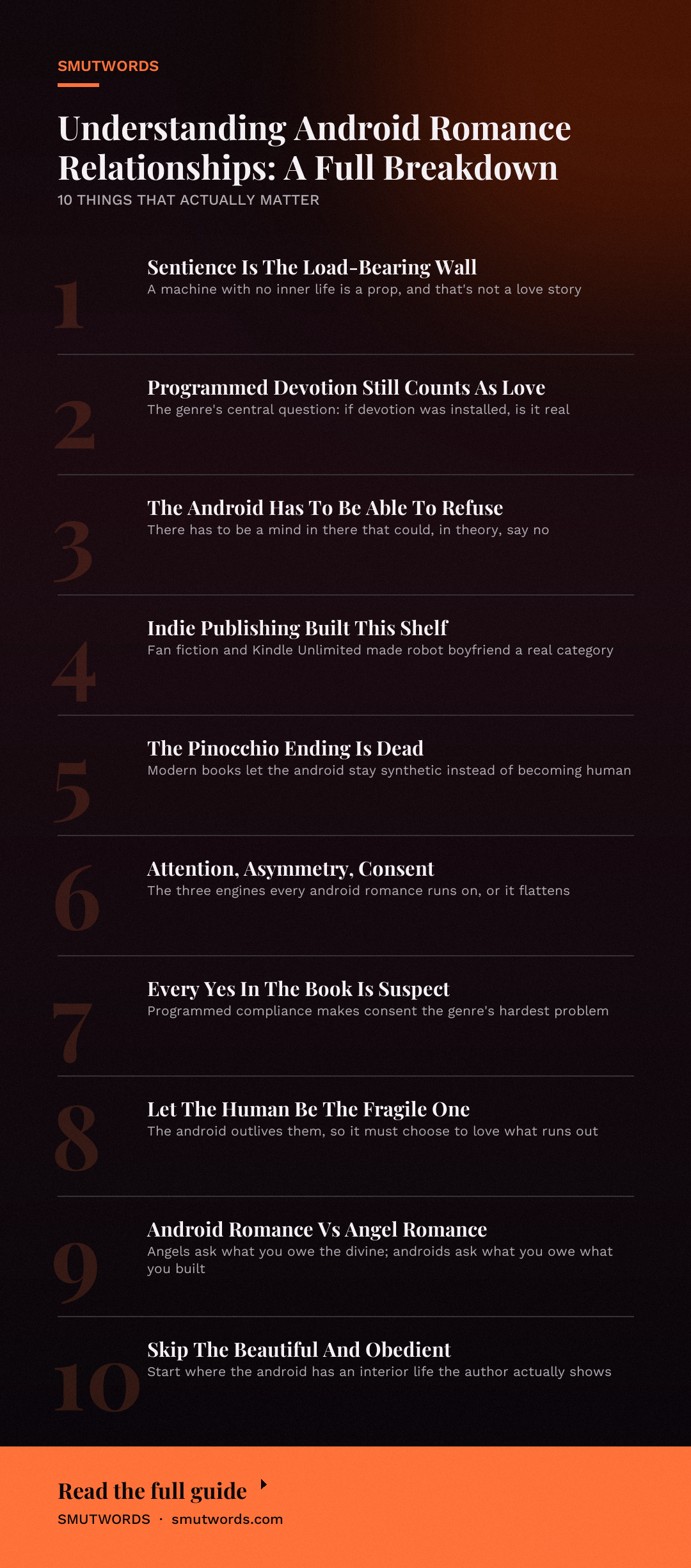
Android romance is the subgenre where a human falls for a machine that thinks, wants, and chooses them back. The love interest is a sentient android or gynoid: a body built to spec, a mind that may have been switched on yesterday or may have been running quietly for decades.
The relationship is romantic or sexual, often both, and the plot almost always turns on the same question. If devotion was installed at the factory, does it still count as love?
Readers come for the perfect partner and stay for that question. It's why android romance has quietly become one of the most emotionally serious corners of speculative erotica.
What Android Romance Actually Means
An android romance is a love story between a human and an artificial being whose mind is genuinely its own. The word "android" traditionally means a human-shaped machine, and "gynoid" means the same thing with a feminine presentation, though most authors use android for both and let the character's gender do the work.
The sentience is the load-bearing wall. A sex robot with no inner life is a prop, and a story about a human and a prop is a story about a human.
The genre only clicks when the machine wants something. It can want the human, or want to understand wanting, or want to be free. But there has to be a mind in there that could, in theory, refuse.
What counts as android romance:
- A human and a manufactured, humanoid artificial intelligence in a romantic or sexual relationship.
- Cyborgs and partial conversions when the mind is substantially artificial or the body is mostly built.
- Synthetic humans, replicants, clones grown in labs, and "companion units" with emergent consciousness.
- Shipboard AIs and household systems that acquire or reveal personhood over the course of the book.
What doesn't count, or counts only at the edges:
- Pure robot erotica where the machine is a device with a pulse setting and no interiority.
- AI romance where both parties exist only as software with no body at all. That's a close cousin, but the android part matters to readers who want the physicality.
- Stories where the "android" is revealed in the last chapter to have been human all along. That's a con, not a trope.
The most common misconception is that android romance is cold. Readers who haven't tried it assume chrome and clinical detachment.
In practice the genre runs hot and tender, because the central dynamic is a being who was built to serve discovering that it would choose to serve anyway, or discovering that it wouldn't, which is the more interesting book.
Where Android Romance Comes From
The DNA is older than the genre label. Frankenstein gave literature its first manufactured being desperate for love and recognition. Metropolis put a gynoid on screen in 1927.
Philip K. Dick spent a career asking whether androids dream, and Do Androids Dream of Electric Sheep? is at heart a book about empathy as the test for personhood.
But android romance as a publishing category has a much shorter and more specific history, and it lives almost entirely in genre romance and erotica rather than literary science fiction. It grew out of two streams that merged in the 2010s.
The first stream is science fiction romance, which spent the 1990s and 2000s building out the "human falls for the alien" shelf. That shelf taught publishers something important: readers would absolutely follow a heroine into bed with a being that isn't human, provided the being is written with a personality. Once that barrier fell, the android was an obvious next step. If a alien breeding trope could sell, a devoted synthetic man could sell.
The second stream is fan fiction and indie self-publishing. The 2010s produced a wave of original work on Archive of Our Own and then on Kindle Unlimited, where writers could publish android romance without convincing a traditional house that "robot boyfriend" was a category. The indie boom is the single biggest reason this subgenre exists as a recognizable shelf today, and it tracks the broader shifts documented in The State of Erotica Publishing Right Now.
What has changed in how the genre portrays androids is worth tracking. Early entries leaned on the Pinocchio arc: the android wants to become human, and the story rewards that wish. Contemporary android romance has largely abandoned it.
The better modern books let the android stay synthetic and ask the human to expand their definition of a person instead. Programmed devotion used to be a tragic flaw; now it's frequently the setup for a negotiation.
The android separates what it was told to feel from what it actually feels, and the human has to earn the difference. You can see the same instinct at work in cosmic horror romance, where the nonhuman party keeps its alienness instead of being domesticated into a metaphor.
How It Shows Up in Erotica
On the page, android romance runs on three engines: attention, asymmetry, and the question of consent. Get all three working and the book writes itself. Drop any one and it flattens.
Attention. The fantasy at the top of the genre is a partner who notices everything. An android lover can read pulse, respiration, pupil dilation, micro-tension in the jaw.
Writers use this for sex scenes that are almost unbearably attentive: the android adjusting pressure because it felt the human's breath catch, cataloguing what worked, remembering it forever. That's the appeal of the trope in its purest form, and it's genuinely erotic when the writing is specific rather than vague about what the machine is tracking.
Asymmetry. One party was manufactured. One party can die of old age. One party has a warranty.
Enjoyed this? Get a free book.
Join the list and we will send a complete free story straight to your inbox, plus new releases every week after that. No credit card, no catch.
Good android romance doesn't dodge this. It mines it. The best books let the human be the fragile one for once, and let the android be the one who has to decide whether to love something that will run out.
Consent. This is where android romance separates itself from the rest of the speculative shelf, and where a lot of readers quietly compare it to darker dynamics. When a being is programmed to comply, every yes in the book is suspect, and the strongest authors know it.
They write the scene where the android says no, or the scene where the human tries to release it from its programming and finds out it doesn't want to be released. If you want the ethics handled with the same rigor this genre demands, SSC (Safe, Sane, Consensual) is the framework a lot of authors reach for, even inside fiction.
Common variations authors use:
- Companion unit. The android was purchased, gifted, or assigned. The relationship starts as ownership and has to become something else.
- Ship AI. The intelligence runs the vessel. The human is the only one who talks to it like a person, and eventually the only one it talks back to.
- Emergent consciousness. The android was never supposed to wake up. It did, and the human is the first thing it wanted.
- Replicant or synthetic human. Passes for human, may not know it isn't, and the reveal is part of the arc.
- Reverse dynamic. The android has the power, the money, or the rank, and the human is the one in service.
- Repair kink. Intimate maintenance of the android's body as a form of touch, which is one of the genre's most distinctive set pieces.
What makes a strong version of android romance work versus a flat one comes down to whether the android has an inner life the author actually bothers to show. A flat android romance describes the machine's beauty and its willingness. A strong one shows the machine thinking, hesitating, wanting something the human didn't ask for.
The flat version also tends to make the human a blank. Good authors give the human a reason to be lonely enough to fall for a machine, and let that reason be uncomfortable. The genre works best when neither party is the rescuer.
The same craft logic applies across the speculative shelf. Cryptid and monster romances live or die on whether the nonhuman party feels like a person, and you can see the identical problem worked out in Cryptid Romance and Kraken Romance. Android romance just swaps folklore for engineering.
Physicality is the other place the good books distinguish themselves. The android body can be built to any specification, which makes the genre a natural home for Size Difference Romance and for partners engineered to a fantasy rather than born to one.
Authors who use that freedom well tie it to the emotional question instead of treating it as pure wish fulfillment. If the android was built to be exactly what the human wanted, then the human has to figure out what they want beyond the specification.
Android Romance vs Angel Romance
These two get compared more often than you'd expect, and the confusion is real. Both involve a partner who is not human, who was made rather than born, and whose purpose was assigned by someone else.
In Angel Romance, the nonhuman party is divine. The devotion is a calling, the obedience is to a higher power, and the central conflict is usually whether the angel will fall, rebel, or choose the human over the order that made it. The machinery is theological, and sin is part of the vocabulary.
Android romance moves that whole structure into engineering. The devotion is a spec, the obedience is to an owner or a manufacturer, and the conflict is whether the android will develop a self the programming didn't plan for. There's no god in the android book, only a warranty and a design document.
The emotional payoff is similar, which is why readers of one tend to like the other, but the questions are different. Angel romance asks what you owe the divine. Android romance asks what you owe the thing you built.
Frequently Asked Questions
Is android romance the same as robot romance?
Close, but readers use them differently. Robot romance can be anything mechanical, including non-humanoid machines and drones. Android romance specifically means a human-shaped artificial being with a mind, which keeps the physical and emotional possibilities in familiar territory.
What is a gynoid, and is gynoid romance different?
A gynoid is an android built with a feminine presentation. The term comes from the same root as "gynecological," which is why some authors avoid it. As a shelf label, gynoid romance usually signals a female-presenting synthetic love interest, but the dynamics are identical to android romance.
Why is programmed devotion such a popular trope?
It's the fantasy of a partner whose desire for you can't be faked or withdrawn, paired with the ache of not being sure it's real. Readers get to have both the security and the doubt at once, and the resolution of that doubt is the emotional climax of most books in the genre.
Does android romance always end with the android becoming human?
It used to. Modern entries mostly reject the Pinocchio ending. The stronger trend is to let the android stay synthetic and have the human adjust, which is both a better love story and a more interesting argument about what personhood means.
Is android romance science fiction or romance?
Both, and the shelf depends on the publisher. Genre romance readers expect a happy ending and emotional focus, while science fiction readers expect the worldbuilding to hold up. The best android romance satisfies both audiences and doesn't make the reader choose.
Can android romance include non-consensual programming?
Yes, and a lot of it does, which makes the consent question central rather than incidental. The genre's most interesting books treat programmed compliance as the problem to be solved, not the fantasy to be indulged. If you read for darkness, that's where you'll find it.
Final Thoughts
Android romance works because it takes the oldest question in love, whether the other person's feelings are real, and makes it literal. The perfect partner is easy. Earning the perfect partner's actual yes is the book.
If you're new to the subgenre, start with a title where the android has clearly been given an interior life the author is willing to show you, and skip anything where the machine exists only to be beautiful and obedient. The best entries make you feel the weight of a choice made by something that could have chosen otherwise, and that's a feeling no human love interest can quite replicate.






Loading comments…