
Penny Pepper's free use books share a setup more than they share a plot. Somebody walks into a place that runs on its own rules, the rules say anyone can touch them, and the next two hundred pages sell that arrangement as the most natural thing in the world.
If you're hunting for a free use series reading order, the honest answer is that there isn't a locked chain you have to follow. But some entries work better as a first taste than others, and a couple will land wrong if you open with them cold.
So here's how to sequence them, plus what each one does differently and which ones pair well back to back.
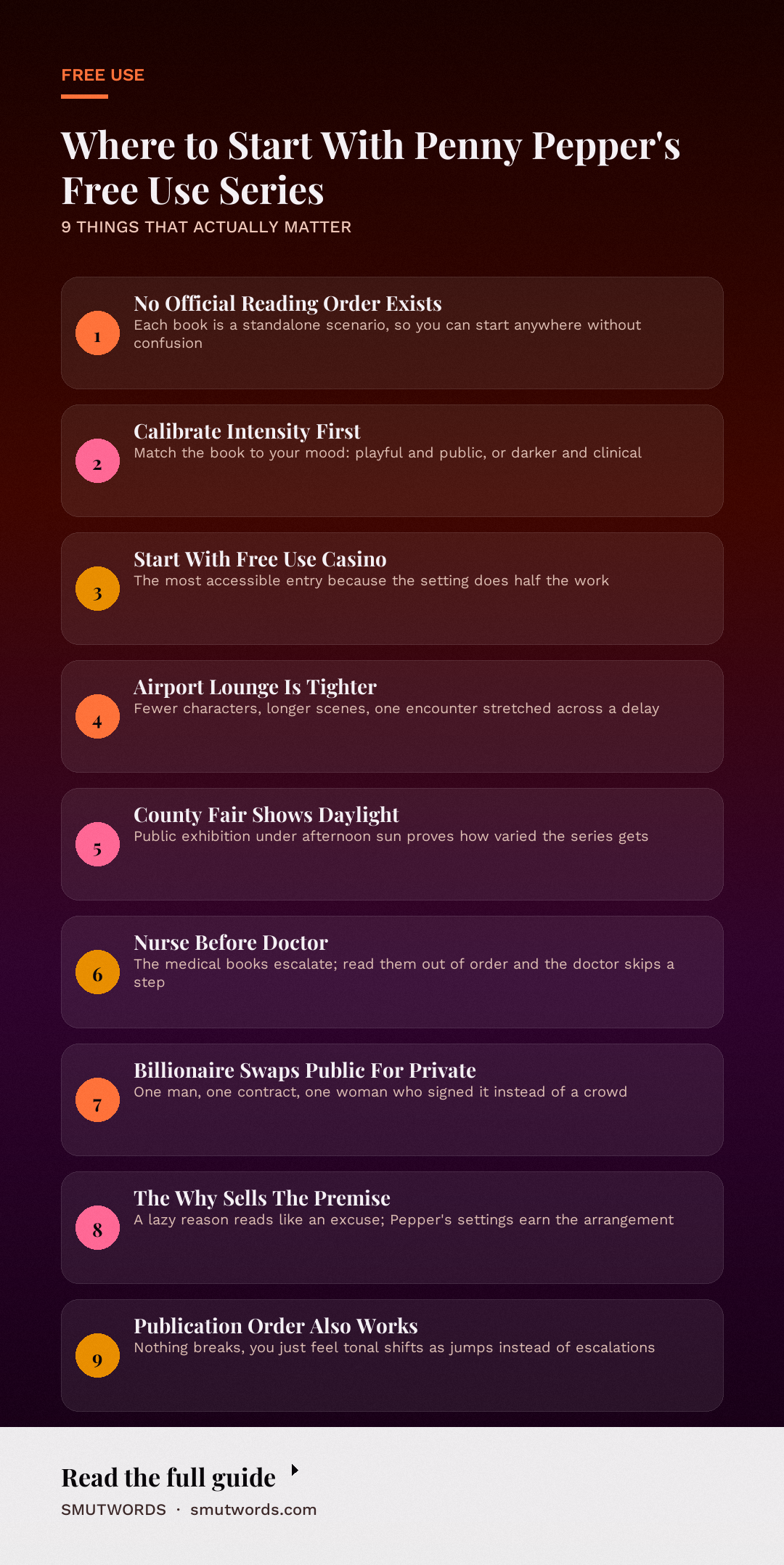
There's No Official Reading Order (And That's Fine)
Penny Pepper doesn't build these as chapters of one saga. Each book is a standalone scenario with its own setting, its own cast, and its own reason the free use arrangement exists. You can start anywhere without confusion.
What you do want to consider is intensity calibration. Some of these are playful and public, built around the thrill of being watched or passed around in a crowd. Others are darker, more clinical, and lean harder into the loss of control. Reading those out of step can make a book feel like more than you signed up for, or less.
The other thing to consider is how the author explains the "why." That's the engine of any free use story. Some settings wave a hand at it. Some build an entire institutional logic.
If you care about that part, start with the books that put real work into it. If you don't, start with whichever scenario sounds hottest to you.
The Best Starting Points, In Order
1. Free Use Casino
Start here if you want the purest version of the trope. A casino floor, cocktails, low lighting, strangers who've been told the house rules and follow them. Free Use Casino is the most accessible entry because the setting itself does half the work: casinos are already places where people behave differently than they do at home, so the free use premise slides in without much resistance.
The pacing is generous. Pepper gives you the room, the noise, the carpet, the way a hand on your hip from a stranger reads as just part of the night. It's a good test case for whether you like how this author handles a crowd scene.
2. Free Use Airport Lounge
Same energy, tighter container. Free Use Airport Lounge traps everyone in a liminal space where they're already bored, already anonymous, already waiting. The lounge format is a neat trick because nobody there knows each other and nobody's staying.
If the casino felt too sprawling, this one is more claustrophobic in a good way. Fewer characters, longer scenes, more focus on a single encounter stretching out while a flight gets delayed.
3. Free Use County Fair
The daylight version. Free Use County Fair takes the fantasy outdoors, into a crowd that's there for funnel cake and demolition derby. Public exhibition is the whole point here, and the book leans into the awkwardness of it: the heat, the dust, the families walking past ten feet away.
This is a good third read because it shows you the trope under a completely different light source. Nighttime anonymity is one thing. Afternoon sun with a crowd watching is another. If you want to understand how varied this series gets, three books in is the right time to notice it.
Where to Go Once You've Got Your Bearings
Free Use Nurse
The hospital setting shifts the tone from "strangers who want you" to "professionals who are supposed to be helping you." Free Use Nurse: A Hospital Free-Use Fantasy runs on the gap between clinical care and what's actually happening. The scrubs, the fluorescent lights, the chart at the foot of the bed. It's a different kind of exposed.
This is where the series starts asking you to sit with some discomfort about who has authority in a room. Not in a heavy-handed way. Just enough that you notice it.
Free Use Doctor
The darker sibling. Free Use Doctor: A Dark Medical Free-Use Fantasy pushes the medical premise further into the loss-of-control territory, and it's the one I'd save for after the nurse book. Read them out of order and the doctor book can feel like it skipped a step.
Read them in order and the escalation makes sense. Same setting family, more pressure, less warmth.
Billionaire's Breeding Toy
Not a free use book in the strictest sense, but it shares a lot of DNA and it's the natural next move if the "someone else decides what happens to your body" thread is what you're actually here for. Billionaire's Breeding Toy swaps the institutional setting for a private one: one man, one contract, one woman who signed it.
If you want the breeding kink angle that some of the free use books gesture at without committing, this is where it lives.
Enjoyed this? Get a free book.
Join the list and we will send a complete free story straight to your inbox, plus new releases every week after that. No credit card, no catch.
Quick Comparison: Which Book for Which Mood
- Want the trope at its most classic? Free Use Casino.
- Want one long, contained scene? Free Use Airport Lounge.
- Want public exhibition in daylight? Free Use County Fair.
- Want care and control tangled together? Free Use Nurse.
- Want it darker and more clinical? Free Use Doctor.
- Want a private contract instead of a public rule? Billionaire's Breeding Toy.
You can also read them in publication order if you'd rather just move through the catalog linearly. Nothing breaks. You'll just notice the tonal shifts as jumps instead of escalations.
What Makes the Free Use Premise Work at All
There's a version of this trope that falls apart immediately. If the "why" is lazy, the whole book reads like an excuse, and every scene after that feels like the author is stalling. A free use story only lands when the world gives you a reason to believe the arrangement exists and everyone in it agreed to it, even the ones who didn't say yes out loud.
That's a specific craft problem, and it's worth understanding before you pick a starting point. Our breakdown of free use world-building and how authors explain the "why" covers exactly this, including the difference between a setting that sells the premise and one that just announces it.
Pepper is better at this than most. The casino has house rules. The lounge has a corporate policy, implied.
The fair has a whole town that's in on it. The hospital has staff who've normalized it.
There's also an important distinction between free use and its closest cousin. Both involve a character who doesn't resist, but the reasons are completely different, and reading them as the same thing flattens what's actually happening in each. Free use vs somnophilia: two different "no resistance" fantasies digs into that gap, and it's worth a read if you're trying to figure out which of the two you actually want to spend money on.
Do You Need to Read Them in Order to Enjoy Them?
No. Every book stands alone. No recurring protagonist, no ongoing plot, no cliffhangers.
The only reason to sequence them is your own experience of intensity. Start softer, escalate. Start public, move clinical. Start crowd, move private.
Two things will tell you whether you're reading these in the right order for you:
- You finish one and immediately want the same setting again. Go back to that one's sibling.
- You finish one and want the opposite. If a public crowd scene felt like too much, jump to Billionaire's Breeding Toy and reset.
If the free use premise itself starts to feel repetitive after two or three books, branch into the related tropes rather than keep mainlining the same shape of story.
The household version of the fantasy, where the arrangement comes from who lives together rather than who happens to be in a room, plays very differently, and our piece on free use households and the roommate version of the trope is the natural next stop if the public settings are wearing thin.
Similarly, if the workplace-adjacent books (the nurse and doctor ones, sort of) hit harder than the crowd books, the version of this trope that lives entirely inside an office is worth pulling next. Workplace free use: the office version of the fantasy covers how that version changes the power math.
One More Thing Before You Start
Free use is a fiction about consent that's been arranged in advance, usually by an institution rather than by the character saying yes on the page. If the appeal for you is the appearance of non-consent even though everyone agreed to the premise beforehand, there's a whole framework for that. Our explainer on CNC in erotica lays out what consensual non-consent means in this kind of fiction and how authors signal it without breaking the fantasy.
Knowing that framework won't ruin anything. It'll just make you notice which books handle it cleanly and which ones fumble it. Pepper mostly handles it cleanly.
The county fair book is the clearest case. Everyone in that town knows the rules. That's the version of consent the story runs on, and it never has to say the word out loud for you to feel it.
Final Thoughts
If you're going to read one, read Free Use Casino first.
It's the cleanest introduction to how Pepper builds a setting that sells the premise without overexplaining it, and it tells you fast whether the crowd-focused version of this fantasy is your thing.
From there, move to the airport lounge for a tighter version, then let your taste decide: public with the county fair, or clinical with the nurse. The reading order isn't a rule. It's just a way to keep the intensity climbing instead of starting at the top and working backward.







Loading comments…