
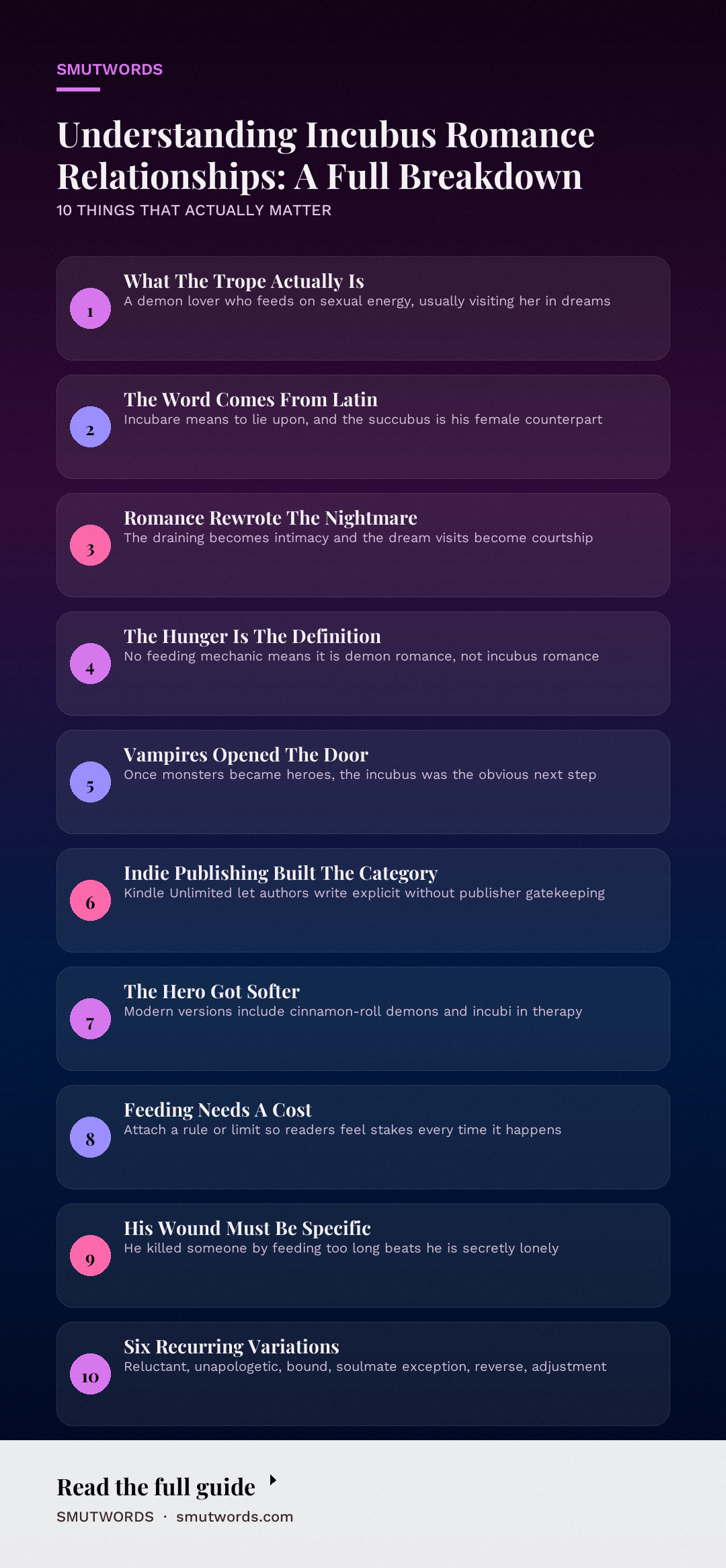
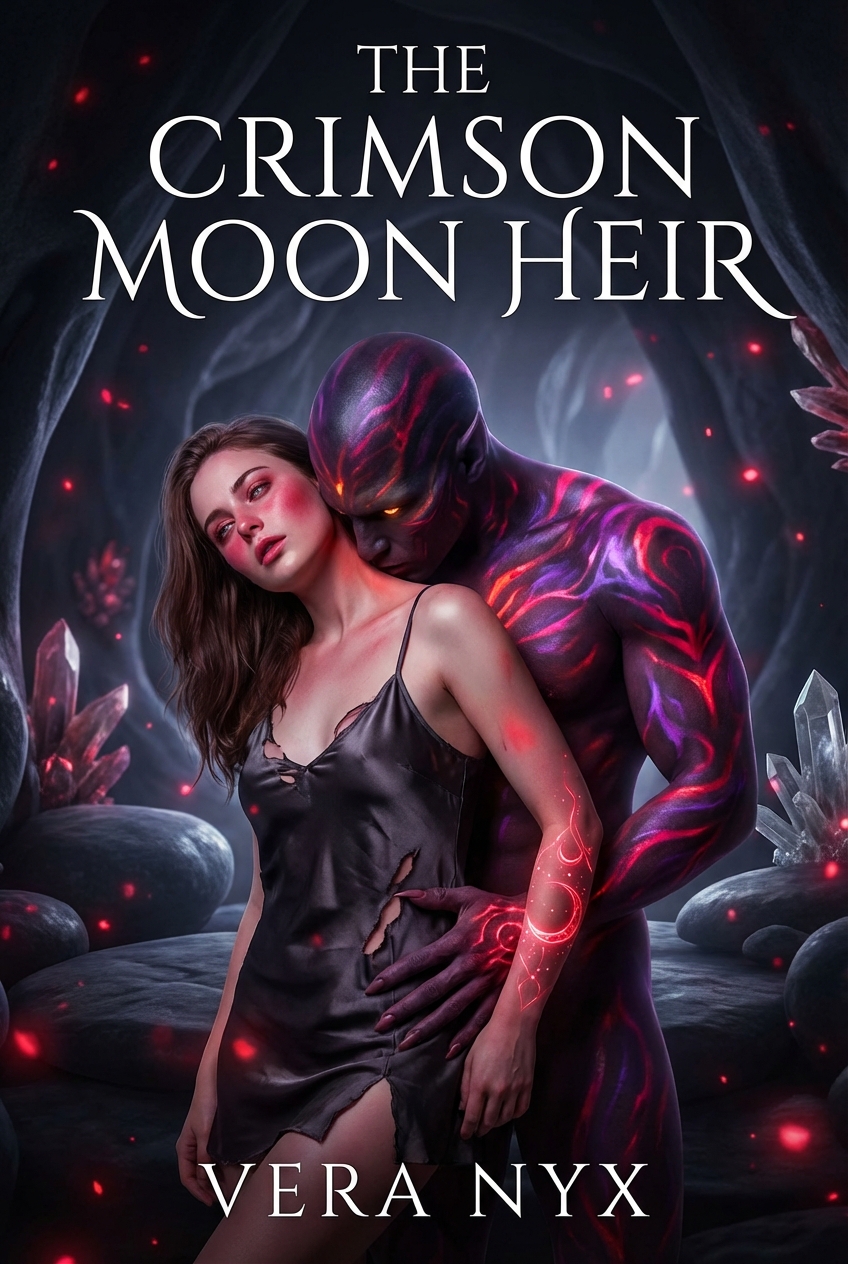
An incubus romance is a love story built around a demon lover who feeds on sexual energy, usually by visiting his partner in dreams or drawing her into supernatural encounters before the relationship turns into something neither of them planned. The incubus is the male version of the nocturnal sexual demon, and in romance he is almost always the love interest: seductive, dangerous, older than humanity, and secretly starving for one person who sees past the hunger.
The incubus romance formula runs on that tension. He needs her energy to survive. She needs him to stop haunting her dreams. Neither of them is supposed to catch feelings, and both of them do.
The trope has exploded in the last two decades across paranormal romance, monster romance, and dark romantasy, and it now rivals vampires and shifters for shelf space. What keeps readers coming back is the combination of sexual danger and buried vulnerability: a hero who is unapologetically dominant in bed and quietly terrified of being loved.
This guide covers what the term means, where it came from, how authors actually build these books, and what separates the ones that work from the ones that fall flat.
What Incubus Romance Actually Means
The word "incubus" comes from the Latin incubare, meaning "to lie upon." In medieval European demonology, an incubus was a male demon believed to visit women at night and have sex with them while they slept, often draining their health in the process. Its female counterpart was the succubus, from succubare, "to lie beneath."
The Church treated both as serious threats, and the folklore blamed them for everything from nightmares to unexplained illness to pregnancies with no human father.
Romance took that nightmare and rewrote the ending. In an incubus romance, the draining is still real, but it becomes intimacy instead of violation. The dream visits become the courtship. The hunger becomes the thing that ties him to her rather than the thing that destroys her.
The demon gets a personality, a backstory, a reason for what he is, and eventually a happily ever after.
What counts as an incubus romance:
- A demonic male lead with a sexual feeding mechanism. He takes energy, life force, pleasure, or some version of it from sexual contact or proximity.
- The feeding is central to the plot. It shapes the relationship, creates conflict, or drives the couple together.
- Mutual desire, eventually. Even when the setup starts non-consensual in the dream-visitation sense, published romance resolves into a bond both parties choose.
- Romantic arc with a happy ending. Incubus romance is a romance subgenre, so the couple ends up together.
What doesn't count, or sits at the edge:
- A villain who happens to be an incubus. If he never becomes the love interest, that's horror or urban fantasy, not romance.
- Succubus leads. A female demon feeding on men is usually filed under succubus romance, a sibling category with different dynamics. Some books use the terms interchangeably when the demon can shift sex or gender, which blurs the line.
- Generic demon love interests. A hot devil with no feeding mechanic is demon romance. The hunger is what makes it incubus specifically.
The most common misconception is that incubus romance is purely a dark, non-consensual fantasy with no emotional payoff. Readers who try one book expecting wall-to-wall nightmare energy are often surprised by how tender these stories get. The best ones use the feeding as a metaphor for need itself: how frightening it is to want someone that much, and how much better it feels when they want you back.
Where Incubus Romance Comes From
The incubus as a supernatural seducer has been in Western literature for centuries, from medieval theological tracts to Romantic-era poetry, but the incubus as a romance hero is a much newer development. For most of publishing history, the incubus was a monster to be defeated. He shows up in gothic fiction, in Victorian ghost stories, in horror films, and in pretty much every era's version of the story where a woman's sexual desire is punished by something demonic.
The shift happened alongside the broader paranormal romance boom of the 1990s and 2000s. Once vampires became romantic leads, once werewolves got pack politics and soulmates, the reading public had already accepted that a monster could be the hero. The incubus was the obvious next step because his entire premise is already about desire. Authors started writing him as a loner with a curse rather than a predator with a victim.
By the 2010s, indie publishing and Kindle Unlimited had turned incubus romance into a full subcategory. The freedom to write explicit sex without publisher gatekeeping meant writers could lean all the way into what the trope promises: dream sex, feeding scenes, supernatural stamina, and an emotional bond built on something humans can't offer. Series foundings exploded in that decade, and reader appetite has only grown since.
Two more recent changes are worth noting. First, the incubus has gotten softer and funnier. Modern versions include cinnamon-roll demons who hate feeding, incubi in therapy, and heroes whose entire arc is learning to ask for what they need instead of stealing it.
Second, the succubus and the incubus are increasingly written as fluid categories. Some authors treat the terms as job descriptions rather than genders, which has opened the trope up to queer romance in a big way.
If you want a sense of how authors sustain a trope this hungry across dozens of books, the Penny Pepper interview on building a 65-book free use series is a useful look at how writers keep a single high-concept premise feeling fresh release after release, which is exactly the problem an incubus series has to solve.
How It Shows Up in Erotica
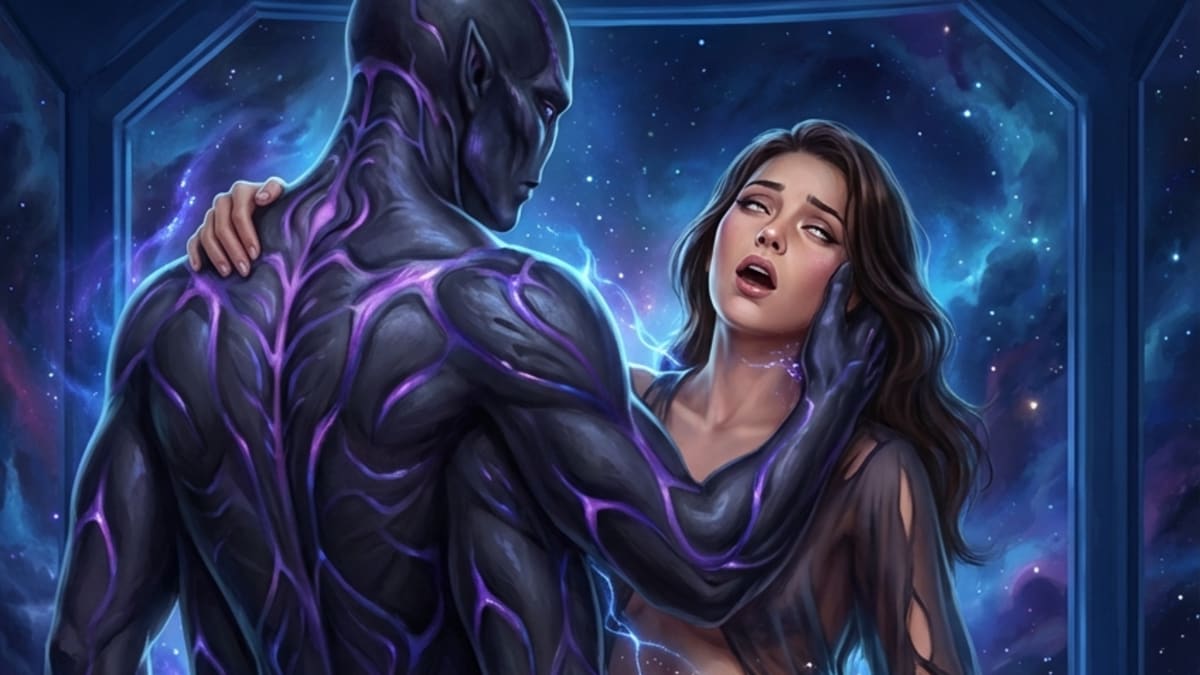
On the page, incubus romance has a recognizable toolkit. The dream sequence is the signature move: he arrives while she's asleep, the setting is slightly off, everything feels more vivid than waking life, and she wakes up wet, exhausted, and certain it wasn't a dream. Authors use these scenes to establish the connection before either character has agreed to anything in daylight, which creates a built-in conflict about consent, power, and whether the dream was real.
The feeding scene is the second pillar. Some books write it as pure pleasure, with the draining rendered as intensifying sensation and a cozy afterglow. Others write the cost honestly: he takes too much, she wakes up weak, and the relationship has to deal with the fallout.
The strongest versions make feeding reciprocal in some way. He doesn't just take. He gives back, whether that's pleasure, protection, or a piece of himself that he can't get back.
Common variations you'll see across the subgenre:
Enjoyed this? Get a free book.
Join the list and we will send a complete free story straight to your inbox, plus new releases every week after that. No credit card, no catch.
- The reluctant incubus. He hates what he is, feeds as little as possible, and resists the heroine because he's afraid of hurting her.
- The unapologetic predator. He enjoys what he is and makes no excuses, and the heroine has to decide whether she can live with that.
- The bound demon. He's cursed, enslaved, or contractually obligated, and the romance is partly about freeing him.
- The soulmate exception. She's the one human whose energy doesn't drain him or who makes him feel something other than hunger. Classic fated-mates logic, applied to a demon.
- The reverse-feeding dynamic. She starts taking something from him too, whether that's power, immortality, or emotional access he has never given anyone.
- The human-world adjustment. He tries to live like a person, gets a job, learns to date, and fails at all of it in ways that are either funny or heartbreaking depending on the book.
What makes an incubus romance work versus what makes it flat comes down to two things. First, the hunger has to mean something. If feeding is just an excuse for a lot of sex scenes with no consequence, the book loses its engine. The best authors attach a cost, a rule, or a limit to the feeding so the reader feels the stakes every time it happens.
Second, the hero's vulnerability has to be specific. "He's secretly lonely" is not enough. The books that land give him a concrete wound: he killed someone he loved by feeding too long, he can't remember his human life, he's been used by other demons for centuries, he's never been chosen by anyone who knew what he was. That specificity is what turns a sexy monster into a love interest.
The dream-visitation premise also creates a natural structure for slow burn. He can have her every night and still not have her at all, because none of it counts in daylight. Authors use that gap to build tension for hundreds of pages, which is a big part of why the subgenre supports long series so well.
Where it overlaps with other monster romance categories matters too. Incubus books often borrow the possessive intensity of the territorial shifter trope, the otherworldly elegance of fae romance, and the hidden-world logic of hybrid shifter romance. If the heroine gets pulled into a nonhuman society with its own rules, the demon-lover setup starts to look structurally similar to a lot of shifter and fae series, just with a different monster at the center.
And if the book leans into the reproductive angle, which plenty of them do, the feeding mechanic often doubles as a magical explanation for something impossible. The guide to monster breeding romance is worth reading if that's the flavor you're looking for, since incubus books use the same conventions around inhuman pregnancy and what it means for a human body to carry something that isn't fully human.
Consent on the Page and Off It
Here's the honest part. In the fantasy, the incubus can visit you in a dream before you've agreed to anything, and part of what makes that hot is the loss of control.
In real life, the dynamic people are actually reaching for when they read this trope is intense persuasion in an intimate context, and that only works with clear, ongoing consent and open communication. Nobody wants a partner who assumes. The fantasy of being wanted that badly lands because the reader knows, underneath it, that she gets to say yes.
Books that forget this lose readers fast. The authors who handle it well usually build in an explicit moment where the heroine names what she wants out loud.
Incubus Romance vs Angel Romance
These two get compared constantly because they're mirror images, and readers who like one often binge the other. The angel romance love interest is divine, restrained, usually bound by rules about chastity or duty, and his arc is about falling. The incubus is infernal, indulgent, bound by hunger, and his arc is usually about being redeemed or accepted.
One is about a being learning to want. The other is about a being learning that wanting isn't the same as ruining.
If you want a deeper look at the heavenly side of that comparison, Angel Love Interest 101 covers how those heroes are built, and the contrast makes the incubus framework easier to see. In practice, a lot of series pair the two, with angel and demon love interests as competing options, which is basically catnip for readers who like their supernatural men with opposing moral alignments.
Frequently Asked Questions
Is incubus romance the same as succubus romance?
Not exactly. Succubus romance centers a female demon who feeds on sexual energy, and the dynamic usually plays differently because the heroine is the supernatural one. The terms overlap in books where the demon can shift form or gender, and plenty of authors treat incubus and succubus as two labels for the same species.
Do incubus romances have happy endings?
Yes, if they're marketed as romance. The genre contract requires the couple to end up together, and incubus books satisfy it in a few standard ways: the demon gets a way to feed without harming her, she becomes something other than fully human, or they find a bond that sustains him better than feeding ever did. Darker books may stretch the definition, but the ending is still an ending together.
Are incubus romance books always explicit?
Most are on the steamy-to-explicit end because the feeding mechanic is inherently sexual, but heat level varies widely. Some are closed-door paranormal romances where the dream visits are sensual rather than graphic. Check the content notes if heat level matters to you, since the subgenre runs the full range.
Can the heroine be the one with the power?
Increasingly, yes. A popular modern variation gives the human woman something the demon needs beyond energy, like a specific bloodline, a rare ability, or the simple fact that she's immune to his usual charm. Her leverage is what makes the power dynamic interesting rather than one-sided.
Why do so many incubus books involve dream sex?
The dream is the folklore's original setting, and it solves a craft problem. It lets the characters be intimate before the relationship has earned it in the waking world, and it creates a persistent question of whether any of it was real. That unresolved tension is what drives the first act of most books in the subgenre.
Where should a new reader start with the trope?
Start by deciding what you want: cozy demon-next-door comedy, dark captive fantasy, or a long series with fated mates and worldbuilding. The three tones lead to very different books, and reading a sample chapter is the fastest way to tell which one an author is writing.
Final Thoughts
Incubus romance works because it takes the oldest nightmare in the book and asks what happens if the monster is the one who's scared. He's starving, he's ancient, and he has no idea how to be loved without taking something.
Watching him figure it out, one dream visit at a time, is the whole appeal. If you're ready to pick one up, start with a series opener that sets up a long arc, since the slow burn between a demon and the woman who won't let him feed on her forever is best savored across multiple books.






Loading comments…