
Lingerie fetish is a sexual fixation on underwear, hosiery, and the garments worn closest to the body, where the clothing itself becomes the main source of arousal. Not the person wearing it. Not the act that follows. Someone with this fetish can get off on a silk chemise in a drawer, on the slow roll of a stocking down a thigh, on the specific weight of a garter clasp against skin.
In erotica, a lingerie fetish is one of the most reliable engines there is. It gives a scene something to delay, something to describe in close detail, and something to finally take off.
What Lingerie Fetish Actually Means
The word carries a whole category of specific interests underneath it. Lingerie fetish is an umbrella term for arousal tied to intimate apparel: bras, panties, corsets, garters, stockings, tights, slips, chemises, bodysuits, robes, and the accessories that hold them in place. The garment is the erotic object, not a decoration on the way to sex.
That distinction matters. Plenty of people enjoy seeing a partner in something lacy.
A fetish goes further. The lingerie is the point. A scene can be entirely satisfying with the bra still on and nothing else happening. The arousal lives in the material, the construction, the fit, the removal, the smell of fabric that has been worn.
Textures matter enormously. Silk, satin, lace, mesh, sheer nylon, velvet, leather, PVC, cotton, chiffon. Each one produces a different physical sensation and a different kind of scene.
Lace is scratchy and see-through at once. Silk slides. Mesh shows everything while covering it. Satin has that cold first touch that warms against skin.
Specific garments carry their own charge. A garter belt and stockings read as old-fashioned and deliberate. A plain cotton bra and panties can be more intimate than something elaborate, because it implies the person was not performing.
A corset implies restriction, structure, and hours of lacing. A silk chemise implies ease and access.
What does not count: a general appreciation for a partner looking attractive in anything. That is just desire with good lighting. A lingerie fetish requires that the clothing occupy a central role in the fantasy, that removing it or watching it stay on produces a distinct thrill, and that the fetish persists across partners and situations.
Common misconceptions
The first is that this is a mild, entry-level kink. It isn't. Lingerie fetishists can build entire relationships to clothing: collecting, wearing it themselves, requiring it during sex, or fixating on one specific garment to the exclusion of others.
The second is that it's always about women's underwear. Men's lingerie and fetish wear exist, and plenty of women have a lingerie fetish focused on what their partner wears or on wearing it themselves. The category is broader than the catalog photos suggest.
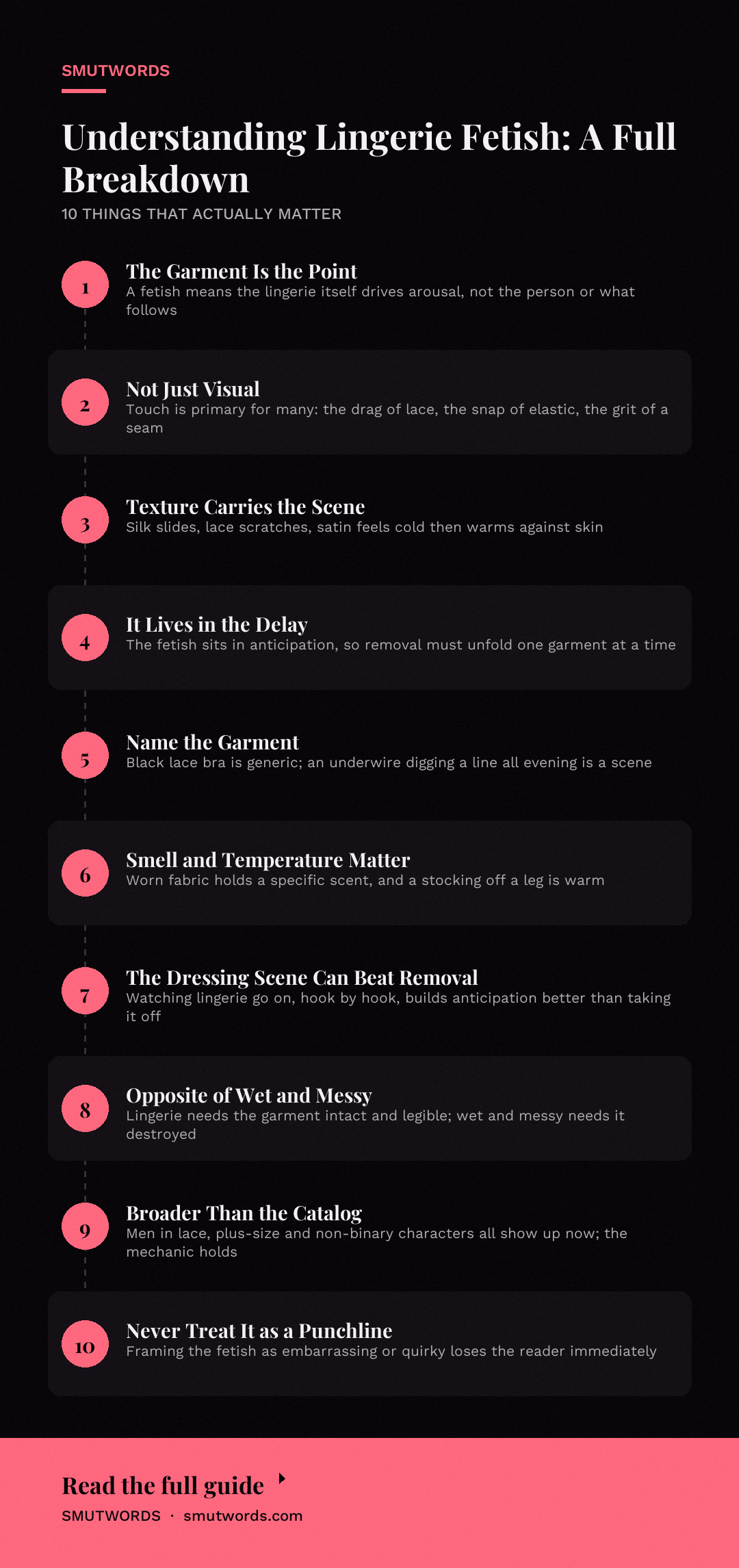
The third is that it's purely visual. Many people with this fetish describe touch as primary: the drag of lace across the palm, the snap of an elastic waistband, the grit of a seam under a thumb during a slow removal.
Where Lingerie Fetish Comes From
As a publishing phenomenon, lingerie has been doing erotic work in print longer than any glossary term has existed to describe it.
Victorian and Edwardian fiction leaned heavily on corsets, stockings, and the mechanics of undressing a woman who was laced, buttoned, and hooked into half a dozen separate garments. The underground erotic novels circulated privately in Britain are the best examples. The erotic charge came from sheer logistics. Getting someone out of a proper 1890s outfit was a project, and writers knew it.
The twentieth century changed the garments and the genre at the same time. Nylon stockings arrived in 1940 and sold out almost immediately. Pin-up art turned garter belts and seamed stockings into a visual shorthand for desire. Pulp paperbacks in the 1950s and 60s put lingerie on their covers because it sold copies, and the scenes inside began to describe the clothing with the same attention they gave to bodies.
Playboy and the men's magazine era normalized a specific relationship to lingerie: the reveal as a staged event, the half-slip as a recurring prop, the idea that under everyday clothes there was something else waiting. That framing carried straight into the erotic romance boom.
The 1980s and 90s added the lingerie catalog as a private object. Victoria's Secret catalogs functioned as softcore material for an enormous number of teenagers and adults, and a generation of readers learned to associate glossy pages and folded garment photography with arousal.
Online erotica shifted the term into common use. By the 2000s, "lingerie fetish" was a stable tag on every major fiction archive, and writers had started to differentiate it from adjacent interests. The genre history matters here more than any real-world kink history, because lingerie fetish is largely a fetish of representation. Most people with it developed the interest partly through images and text.
How the portrayal has shifted
Older erotica treated lingerie as a prelude and a prop. The clothing appeared, got admired in a sentence or two, and came off. The scene's real business was elsewhere.
Modern writing gives the garments their own scenes. A contemporary story might spend a full page on the process of putting lingerie on: the hook-and-eye closure, the adjustment, the checking in a mirror. That shift tracks with a broader move in the genre toward slowing down and making anticipation the main event.
The internet also broadened who gets written about. Lingerie fetish content now includes men in lace, plus-size characters, and non-binary characters in garments that were historically coded as women's only. The core mechanic stayed the same: fabric, skin, delay, reveal. The bodies wearing it got more varied.
How It Shows Up in Erotica
On the page, lingerie fetish is a pacing tool before it is anything else. The garment gives the writer something to describe while the scene builds. It creates a physical barrier with a known removal method, and that lets a scene stretch the tension without stalling.
Strong versions of this trope do three things. They name the garment precisely. They describe sensation, not just appearance. They treat the removal as a series of events rather than one motion.
Weak versions do the opposite. "She was wearing sexy lingerie" is a dead sentence. It tells the reader nothing about the fabric, the color beyond a lazy category, the fit, or how it feels against the person wearing it. The scene then moves to sex and the fetish never actually shows up on the page.
Precision is the whole game. "Black lace bra" is generic. "A black lace bra with an underwire that had been digging a line under her ribs all evening, and she had been thinking about taking it off since the second drink" is a lingerie fetish scene.
Enjoyed this? Get a free book.
Join the list and we will send a complete free story straight to your inbox, plus new releases every week after that. No credit card, no catch.
Common variations authors use
- The reveal. Everyday clothes come off to expose something underneath that was planned. The thrill is in the gap between what was visible all day and what was hidden.
- The slow removal. The scene's center of gravity is one garment at a time. A stocking rolled down from the thigh to the ankle can carry a whole chapter.
- Worship. A partner handles the fabric deliberately: kissing the lace edge, running a thumb along the seam, pressing their mouth to the band of a garter. The garment gets the attention usually reserved for skin.
- The dressing scene. The person puts the lingerie on for themselves or for a partner, and the ritual itself is erotic. This variation leans into anticipation and often works better than the removal.
- Worn all day. The garment becomes a private secret under work clothes, sometimes with a partner who knows it's there. The tension comes from the gap between public and private.
- Wearing it themselves. A character discovers they like how the fabric feels, and the scene follows that discovery. This overlaps with crossdressing and gender-play stories without being the same thing.
- Ripped or ruined. The garment is destroyed in the scene, which adds cost and irreversibility. This works best when the story has established the object's value.
- Fixation on one garment. A stocking fixation or bra-and-panty worship scene narrows to a single item and stays there. The specificity is the kink.
The possessive register shows up constantly in these scenes. Lingerie is chosen by one person and worn for another, and that act can carry a claim.
Our piece on possessive sex covers how that dynamic plays out in dialogue and narration, and it pairs well with lingerie scenes where a character insists on a specific garment for a specific reason. If the fetish tilts toward a partner who decides what gets worn and when, soulbond dynamics push that same instinct much further.
Texture, sound, and the senses beyond sight
The amateur version of a lingerie scene photographs the garment with adjectives and moves on. The strong version gives the reader sound and touch.
Elastic snaps. A zipper on a corset takes a full breath to pull. A silk slip makes almost no noise coming off, while nylon stockings make a small rasp that a character can hear.
Smell is the underused sense in this trope. Fabric holds scent, and a garment worn through a full day has a smell that is specific to the person who wore it. Writers who include this detail move the fetish from visual appreciation into physical fixation.
Temperature is the other one. Satin feels cold for the first second. A corset that has been on for hours is warm.
A stocking pulled from a drawer is room temperature and a stocking peeled off a leg is not. Small physical facts like these do more work than any amount of description of how pretty something looks.
What makes a lingerie scene flat
The most common failure is treating lingerie as set dressing. If the scene would be identical with a plain cotton bra, the fetish isn't operating. The garment has to change what the characters do and how they feel.
The second failure is rushing the removal. A lingerie fetish scene that strips the character in one motion has thrown away the entire mechanism. The fetish lives in the delay, and the delay has to be written in real time.
The third failure is judgment. Scenes that frame the fetish as embarrassing or treat the fetishist as a punchline lose the reader immediately. Lingerie fetish is common, and erotica should treat it as a legitimate source of pleasure rather than a quirk to be explained away.
Dialogue matters here too. A scene where one character asks for the stockings to stay on can carry more heat than pages of description, though the line has to land right. Our guide to talking dirty without feeling ridiculous is useful for anyone writing that exchange.
Lingerie Fetish vs Wet and Messy Fetish
These two get grouped together sometimes because both are fetishes where a substance or material on a body is the erotic focus, and both appear in scenes where the garment or substance is more important than the sex. The mechanics are close to opposite, though.
Lingerie fetish depends on the garment staying intact and legible. The lace edge, the seam, the specific cut. A wet and messy fetish depends on the material being applied, spilled, or destroyed. The visual interest is in the mess, not the garment's construction, and in the loss of control that comes with it.
A scene can combine them: lingerie that gets ruined is a recognizable subcategory, and that overlap with sploshing shows up in plenty of erotica. But the reader's attention is in a different place. In one, they are tracking the garment. In the other, they are tracking what is happening to it and to the person wearing it.
There's also a practical difference in how a writer paces the scene. Lingerie fetish is built on delay, and delay means restraint: the garment is still on, still on, still on.
Wet and messy scenes tend to move toward a single irreversible moment, and the tension comes from how much has already been lost. If you want slow, withholding tension, lingerie. If you want a sudden point of no return, mess.
Frequently Asked Questions
Is a lingerie fetish the same as a clothing fetish?
Clothing fetish is the broader category and covers any garment: shoes, gloves, uniforms, outerwear. Lingerie fetish sits inside it, focused on underwear, hosiery, and intimate apparel specifically. Someone can have both, and many people with a lingerie fetish also have a narrower fixation on one garment type such as stockings or corsets.
Is it common?
Extremely. Lingerie is one of the most widely represented fetishes in commercial erotica and adult media, which both reflects and reinforces how many people have it. It's also one of the easiest to incorporate into a relationship without negotiation, since the garments are already culturally coded as sexy.
Can you have a lingerie fetish without wearing it?
Yes. Plenty of people are aroused by lingerie on a partner, or by images of it, without any interest in wearing it themselves. Others are aroused specifically by wearing it, and some by both. The fetish attaches to the garment, not to a fixed position in the scene.
What's the difference between a lingerie fetish and a stockings fetish?
A stockings fetish is a narrower version focused on hosiery: nylon, silk, seams, garter belts, the specific feel of the fabric on a leg. Lingerie fetish is the umbrella. Someone with a stockings fetish may have no interest in bras or corsets, and someone with a general lingerie fetish may not care about hosiery specifically. Both show up constantly in erotica, and writers often treat them as one interest with different focal points.
Why does the removal matter so much in these scenes?
Removal is where the barrier disappears and the promise gets kept. The garment has been standing between the characters for the whole scene, and taking it off is the moment the tension resolves. Writing the removal in stages, one garment or one clasp at a time, lets the writer control exactly when that resolution lands.
Does lingerie fetish overlap with other kinks?
Regularly. It pairs with power exchange (choosing or requiring a garment), with possessiveness (wearing something for one person), with exhibitionism (a secret under work clothes), and with gender play. It's less a standalone kink than a layer that can sit on top of almost any dynamic, which is part of why it's so widely written.
Final Thoughts
Lingerie fetish rewards attention more than almost any other trope in the genre, because the whole mechanism is detail. The specific garment. The specific fabric. The specific second when a clasp comes undone.
Writers who slow down and give the clothing its own paragraph, its own senses, and its own timing get scenes that hold tension for pages and resolve hard. Readers who know they have this fetish are in good company; it's one of the most consistently written and consistently popular interests in erotica, and the best versions never treat the clothing as a warm-up.








Loading comments…