
Long-lost love romance is the trope where two people who were once deeply in love get separated by circumstance, time, or one catastrophic misunderstanding, then find each other again years later and have to decide what to do with everything still burning between them.
It is the second-chance story in its purest form: the history is already there, the chemistry has already been proven, and all the author has to do is make the reunion hurt in the right places before it heals.
Readers come for the ache and stay for the payoff. The best long-lost love romance novels understand that the space between the two people is the actual story.
What Long-Lost Love Romance Actually Means
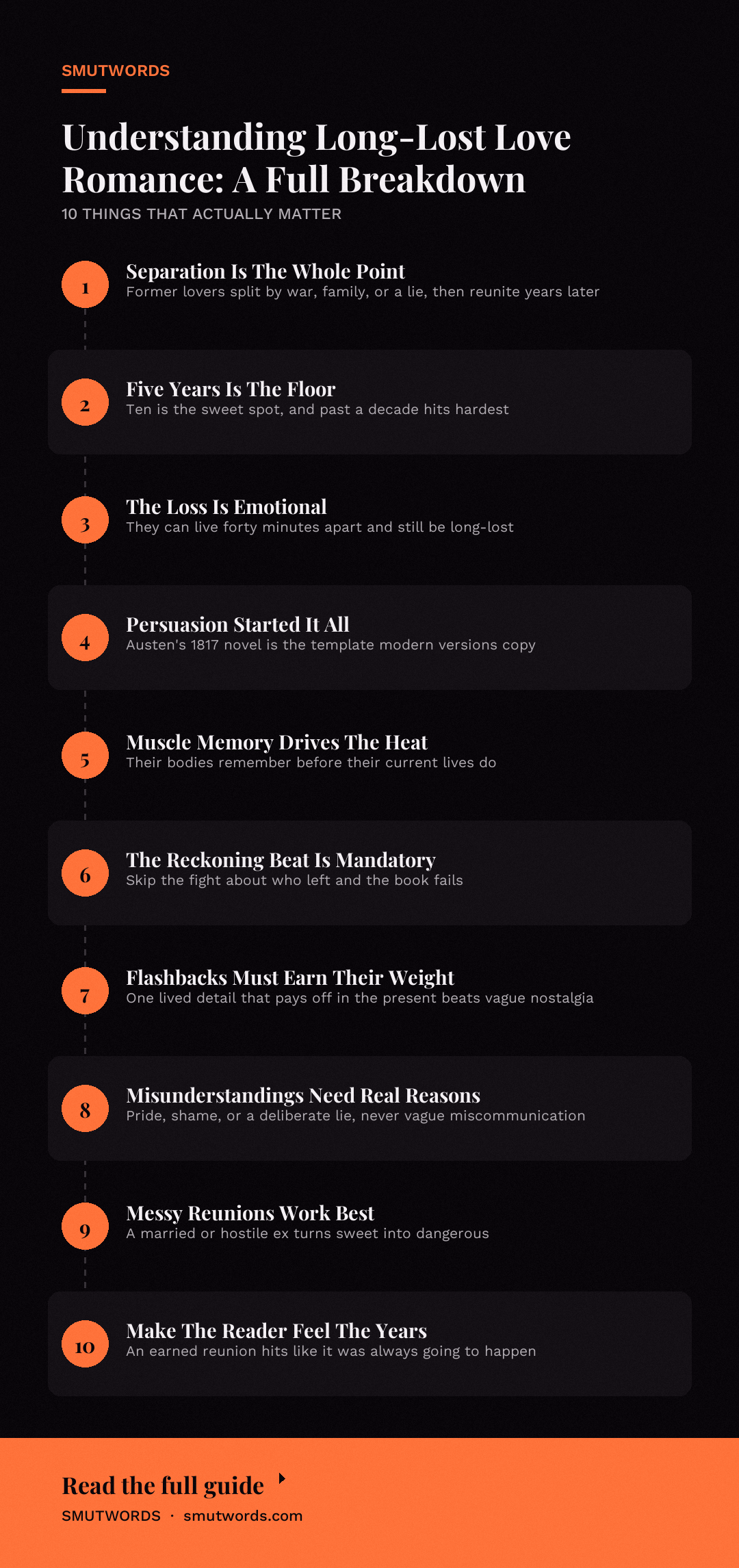
The term covers a specific shape of second-chance story. The couple has a shared past that was genuinely romantic, not just a crush or a one-night stand, and that past ended against at least one of their wills. A war, a family move, a forced marriage, a letter that never arrived, a lie someone told. The separation is the engine.
Without real time apart, you do not have this trope. You have a couple who briefly broke up.
What does not count is looser than readers assume. A reunion between former friends who never dated is a different trope entirely. A couple who split last month and reconcile over coffee has not lost anything long enough for the term to fit.
The "long" in long-lost love romance is doing real work. Five years minimum, ten is the sweet spot, and the strongest examples usually stretch past a decade so that entire adult lives have been built and lived without the other person in them.
Here is the part that trips people up: the lost love does not have to be dead, missing, or literally unfindable. The phrase borrows from the older sentimental tradition of the "long-lost" relative or the "long-lost" sweetheart, where the emphasis lands on the length of the absence and the emotional distance traveled, not on a mystery to be solved.
Two people who live forty minutes apart and have avoided each other for twelve years are a long-lost love romance. The loss is emotional, not geographic.
It also is not the same as a couple who never got together in the first place. That is closer to unrequited or friends-to-lovers territory. Long-lost love requires a real relationship, consummated or at least mutually acknowledged, that both people remember as one of the defining things that ever happened to them. The reunion only lands if the flashback sections earn their weight.
Where Long-Lost Love Romance Comes From
The trope has roots older than the novel itself. Penelope waiting twenty years for Odysseus is a long-lost love story with a body count. Jane Austen built an entire subplot around it in Persuasion, where Anne Elliot and Captain Wentworth spend eight years apart after she is talked out of marrying him. That 1817 book remains the template almost every modern version is quietly copying.
What changed is the publishing landscape, not the appeal. In the twentieth century, the trope was mostly a historical romance staple, fueled by wars and the transatlantic crossings that separated people for years at a time. Wartime separation became its own recognizable subgenre, and the trope picked up the emotional grammar it still uses: the letter, the last night before deployment, the telegram that never came.
The contemporary shift happened in the 2000s and 2010s as small-town romance and second-chance romance exploded in popularity. Authors realized the trope did not need a war. A divorce, a career move, a family obligation, or simply being twenty-two and stupid could do the same job.
The real evolution is in how the separation gets framed. Older versions treated the lost years as tragedy, something done to the couple by fate. Modern long-lost love romance treats those years as consequence, something the characters either chose or failed to prevent, which gives the reunion an edge of accountability. Someone has to answer for the decade.
That shift is why the trope now sits comfortably next to adult contemporary stories full of therapy, custody schedules, and small businesses. It is also why it pairs so naturally with heavier arcs like a redemption arc romance when one party was the one who left.
How It Shows Up in Erotica
On the page, long-lost love romance runs on a very specific engine: muscle memory. The characters know each other's bodies before they know each other's current lives. That is the erotic gift of the trope.
A first-time scene has to build familiarity from zero. A reunion scene can open with a hand on a hip and a low laugh, because the body remembers what the brain has spent years trying to file away.
Strong versions lean hard into that dissonance. She knows exactly what he sounds like when he is close, and she hates that she still knows. He can tell she is nervous from the way she holds her shoulders, the same tell she had at twenty-two. Good authors make the physical familiarity a source of both heat and discomfort, and the best ones let the discomfort feed the heat until the two are indistinguishable.
Here is what the trope actually does in a scene, broken down by the beats that keep showing up:
- The recognition moment. A first glimpse across a room, a voice on a phone, a name on a contract. Every detail of the intervening years gets measured against a single look.
- The first touch after years. Usually accidental or brief, and it lands harder than any explicit scene that follows because it breaks the seal.
- The inventory scene. The conversation where they trade the facts of their lives since the split, and the reader learns the cost of the absence along with them.
- The flashback intercut. The original relationship told in fragments, usually placed right before a present-day scene so the two timelines hum against each other.
- The re-consummation. First sex since the reunion. The trope's signature set piece, and the one the whole book is building toward.
- The reckoning. The fight about who left, who lied, who could have called first. Mandatory. The book fails without it.
Authors who do this well understand that the flashbacks are not filler. A flat long-lost love romance keeps the original relationship vague and asks the reader to take the depth on faith.
Enjoyed this? Get a free book.
Join the list and we will send a complete free story straight to your inbox, plus new releases every week after that. No credit card, no catch.
A strong one gives you one or two specific, lived moments from the past, ideally scenes with a detail that pays off in the present. The fight they had on a specific pier, the song that was playing, the jacket she never gave back. That callback is what separates a trope execution from a book you re-read.
The misunderstanding variant is the one authors handle worst. If the entire twelve-year separation hinged on a single overheard sentence, the reader has to buy that neither adult ever once clarified it.
The fix is not to make the misunderstanding smaller. It is to make the reasons for not clarifying character-driven and specific: pride, shame, a class gap, an abusive parent who lied. Vague miscommunication reads as lazy. A lie someone told with intent reads as tragedy.
Heat level is where the trope becomes genuinely versatile. It works at slow-burn, where the couple circles each other for two hundred pages before anything happens, and it works as a fast, filthy reunion where they are on each other within the first chapter and spend the rest figuring out whether it means anything.
The one thing that reliably kills the trope is a couple who reunite and immediately slide back into a pleasant, conflict-free relationship. No reckoning, no book. The possessiveness that makes 'mine' land only works when both people have spent years being someone else's, or no one's.
Wartime separation deserves its own note because it has a distinct craft problem: the external world has to do the work of keeping them apart, but that can make the characters passive. The fix most authors use is to give one character a decision inside the separation that complicates the reunion. He chose to reenlist. She chose not to open the letter.
That choice is what the couple has to get past, and it gives the present-day conflict teeth. The trope also shades easily into a soldier romance when the reunion involves someone home from deployment and not entirely the same person who left.
Where the trope gets genuinely darker is when the reunion is not welcome. If one party has built a life, married, has kids, and the other arrives wanting to collect, the story slides toward obsession. That version borrows a lot from the stalker romance playbook: the familiar face that refuses to accept the passage of time.
Done well, that is one of the most unsettling versions of the trope and one of the most effective. Done badly, it reads as the author not noticing what they wrote.
The trope also plays beautifully against fantasy and speculative settings, where the separation can be literal decades or centuries. That is where the mechanics of a magical bond sometimes do the heavy lifting.
It is worth knowing how a soulbond changes the math when one half of the pair ages and the other does not. For more on how these reunion arcs scale in secondary-world settings, the broader guide to fantasy romance covers where the trope bends and where it breaks.
Frequently Asked Questions
What is long-lost love romance?
It is a trope where two former lovers are separated for years by circumstance, war, family pressure, or a lie, then reunite and have to work through the history between them. The separation is the defining feature: it has to be long enough that both characters built whole lives without each other. The reunion is the payoff and the present-day story.
How long do the characters have to be apart for it to count?
Five years is the practical floor, and ten or more is where the trope hits hardest. Anything shorter reads as a bad breakup rather than a lost love. The exact number matters less than the weight of what happened in between, which the book has to show rather than summarize.
Is second chance romance the same thing as long-lost love romance?
Long-lost love is a specific subtype of second chance romance, defined by the length of the separation and the depth of the original relationship. Second chance romance also covers couples who split last year or whose marriage is failing right now. The long-lost version is the one with the flashbacks to a shared past that predates most of the book.
Why do readers find this trope so satisfying?
The emotional payoff is front-loaded with history, which means the author does not have to spend chapters convincing the reader the couple belongs together. That freed-up space goes into the ache of the lost years and the tension of the reunion. It is one of the most reliably cathartic setups in the genre.
Is it always a misunderstanding that keeps them apart?
No, and the strongest versions often avoid a misunderstanding entirely. Forced separation by war, immigration, class difference, family pressure, or one character's deliberate choice all do the job. When a misunderstanding is used, it needs a real reason neither person cleared it up, because readers will ask.
Does the trope work with an unhappy or messy reunion?
Yes, and some of the best books lean into that. If one character is married or hostile or genuinely moved on, the story stops being sweet and starts being dangerous, which is exactly where the reunion-driven revenge romance overlaps with it. The book just has to be honest about the mess it created.
Final Thoughts
The trope lives or dies on one thing: whether the author makes you feel the years. A reunion that reads as convenient is just a couple who happened to run into each other. A reunion that reads as earned makes every flashback, every withheld detail, every familiar gesture a small bomb, and the payoff hits like it was always going to.
If you want the definitive modern version of that, start with Persuasion and then watch a contemporary author try to top it. Most of them are still trying, and the ones who get close are the reason this trope never leaves the bestseller lists.







Loading comments…