
A mate bond is the supernatural romance trope where two characters are fated to belong to each other, usually sealed by a physical or psychic link that neither can switch off once it's switched on. The mate bond is destiny with teeth: pheromones, a shared pulse, the ability to feel the other person's arousal or fear or rage from across a room.
It shows up across paranormal romance, shifter romance, and romantasy, and it answers the genre's central question (will they end up together?) before the first chapter even ends. The interesting part is watching two people decide what to do about an answer they didn't choose.
Readers who mainline this trope are not there for slow-burn uncertainty. They want the friction between a connection that cannot be denied and characters who try to deny it anyway. The bond raises the sexual temperature instantly and the emotional stakes permanently, because once it locks in, walking away stops being an option and starts being a wound.
What Mate Bond Actually Means
The term covers a family of related ideas rather than one fixed rule. At its core, a mate bond is an involuntary, reciprocal tie between two characters that pushes them toward each other on a level below conscious choice. It usually comes with a physical tell: a scent that only they can detect, a mark that appears after contact, a heat that flares when they're close, or a psychic thread that lets each one sense the other's emotions.
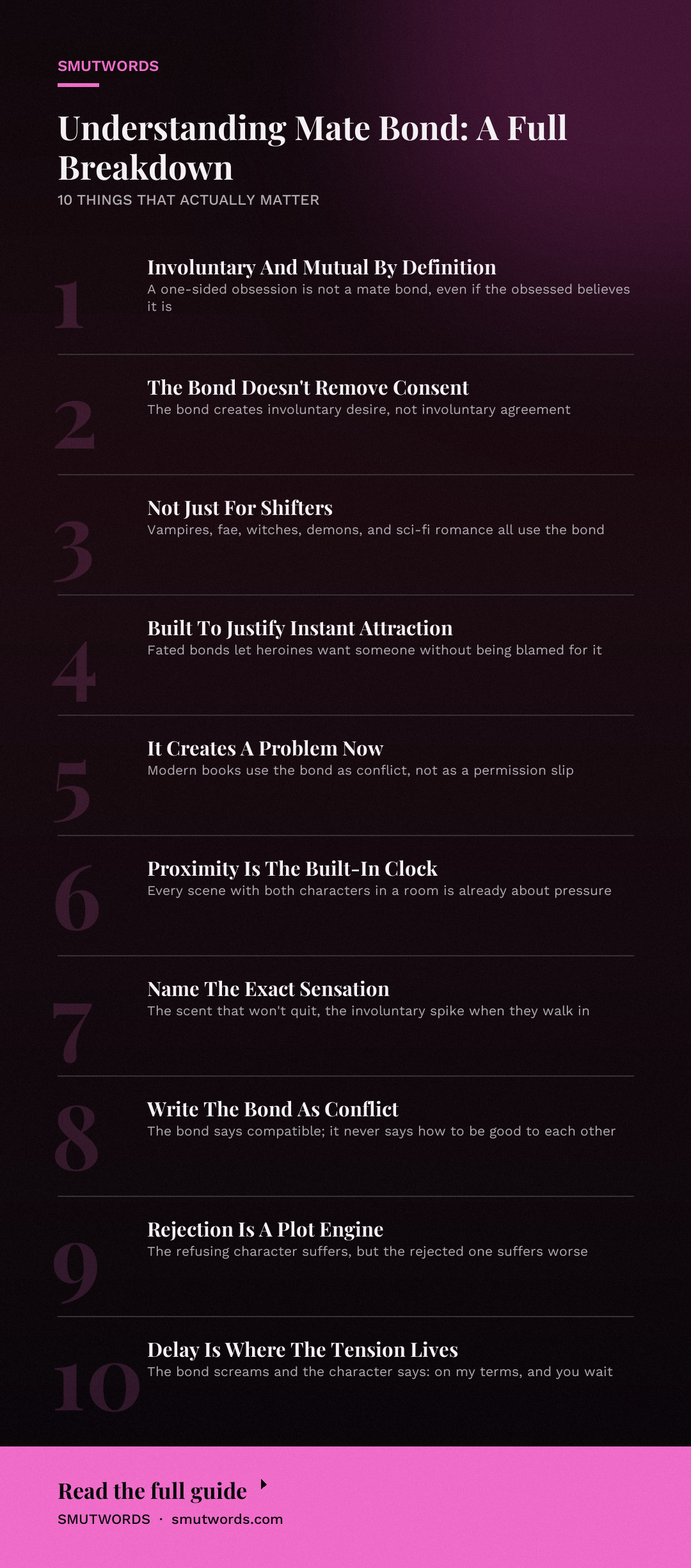
The bond is mutual by definition. A one-sided obsession is not a mate bond, even if the obsessed character believes it is. That distinction matters, and a lot of the trope's best tension comes from characters discovering the difference between wanting someone and being fated to them.
Some books let a predator fake a bond to trap a victim; the reveal that the real bond was elsewhere all along is one of the reliable gut-punches of the subgenre.
It is also distinct from a soulbond in emphasis, though the two get used interchangeably. A soulbond tends to be spiritual and permanent, often existing before either party meets. A mate bond tends to be biological and embodied, activated by proximity and consummated through a physical act. The mate claim is the ritual that finalizes it: a bite, a vow, a shared marking, sometimes sex that closes the circuit.
What Does Not Count
- Instant attraction with no supernatural mechanism. Chemistry is chemistry; a mate bond has a cause.
- A one-sided fixation the bonded character doesn't return. That is a stalker plot wearing a wolf suit.
- A relationship the characters freely choose with no compulsion behind it. Choice is great, but the trope runs on the opposite.
- A purely political alliance, even an arranged marriage with heat. The bond has to be felt, not just agreed to.
Common Misconceptions
The biggest one is that a mate bond removes consent from the story. It doesn't, and the strong books know it. The bond might make two people feel pulled toward each other, but it does not make the decision for them, which is exactly the space where the good scenes live. A mate bond that skips the decision reads as flat, and readers notice.
Another misconception: that the trope is only for shifters. It shows up in vampire fiction, fae romance, witch books, demon and angel pairings, and lately in sci-fi romance with alien biology doing the work instead of magic. The machinery changes; the emotional engine doesn't.
Where Mate Bond Comes From
The mate bond is a publishing phenomenon before it is anything else. Its roots run through 1970s and 1980s paranormal romance and the vampire boom that followed, but the modern version crystallized in the 1990s and 2000s with the rise of the mass-market shifter romance.
Those books needed a device that could justify immediate, overwhelming sexual attraction inside a genre still bound by the expectation that heroines not simply fall into bed with strangers. A fated bond solved that problem cleanly. The attraction wasn't want; it was biology.
From there the trope spread outward. Wolf packs gave it teeth and hierarchy. Vampire books made it a blood thing. Fae romance made it a bargain and a curse.
By the 2010s, indie publishing had turned the mate bond into one of the most commercially reliable devices in the category, with entire series built on the promise that the bond would hit in book one and the claiming would happen somewhere around chapter twelve.
The shift worth noting is what the bond is for. Early versions used it to explain why the heroine can't help herself. Contemporary versions increasingly use it to create a problem the characters have to solve.
Same-sex mate bonds, rejected-mate plots, and bonds that turn out to be false have pushed the trope from a permission slip into a source of conflict. It went from a way to let the sex happen to a way to make the sex mean something.
The alt names track the evolution. "Fated mates" is the umbrella phrase. "Imprinting" came through shapeshifter fiction and carries a whiff of youth and inevitability that some readers love and some avoid. "Blood bond" pulls the mechanism into vampire territory.
"True mate" signals a hierarchy, implying there are false ones. Each label promises a slightly different flavor of the same pull.
How It Shows Up in Erotica
On the page, the mate bond does three jobs at once. It explains the attraction, it raises the stakes, and it gives the author a built-in clock. Because the bond intensifies with proximity, every scene where the two characters share a room is already a scene about pressure. That is a gift for pacing, and it's why the trope pairs so easily with just about any other heat source in the catalog.
The strongest version of the trope treats the bond as a physical fact the characters must cope with, not a feeling they simply enjoy. The scent that won't quit. The involuntary spike of arousal when the other person walks in. The way one character's fear lands in the other's chest like a splinter.
Concrete, sensory detail is what separates a mate bond scene from a paragraph that just announces they're soulmates.
This is also why the trope sits so comfortably next to hate to love. If two characters despise each other and the bond won't let them stay apart, every argument is foreplay and every insult lands on a body already flooding with want. The hatred doesn't disappear; it becomes fuel. Books that lean into that friction get a scene dynamic where the characters are furious at the exact thing that's making them wet.
Common Variations Authors Use
- Rejected mate. One character refuses the bond, often publicly, and the other has to survive the severance. Huge in contemporary shifter fiction because it front-loads a wound.
- Forced proximity bond. The bond activates and now they cannot be apart without physical pain. Confinement, cohabitation, road trips.
- Enemies with a bond. Rival packs, rival houses, rival species. The bond is a liability to both sides and a scandal to their families.
- Fated but arranged. The bond is political, and the couple has to perform a happy union for an audience while genuinely figuring out whether they like each other.
- Supernatural heats and ruts. The bond syncs with cycles, so a monthly or seasonal window carries the story's hottest scenes.
- Same-sex bonds in repressive worlds. The bond contradicts pack or court law, which makes the claiming an act of defiance as much as desire.
- False or manufactured bond. A villain fakes one, or the bond turns out to be a spell. Used to blow up the middle of a series.
Variation is where the trope stays alive. A bond that only ever means "they're supposed to be together" gets boring by the third book. A bond that means "they're supposed to be together and one of them is going to make the other beg for it anyway" has legs.
What Makes It Work, and What Makes It Flat
A strong mate bond is written as a conflict, not a conclusion. The bond tells the characters they're compatible; it does not tell them how to be good to each other. Books that get this right spend most of their word count on the gap between fate and behavior.
Enjoyed this? Get a free book.
Join the list and we will send a complete free story straight to your inbox, plus new releases every week after that. No credit card, no catch.
She feels him wanting her and still has to decide whether she trusts him. He knows she's his and still has to earn it.
The flat version does the opposite. It uses the bond as an excuse, skipping the courtship because destiny already did the work. The sex is hot for a chapter and then the story has nowhere to go, because there is no unanswered question left. If the bond resolves everyone's doubts the moment it activates, the book is over before it starts.
Craft-level, the difference comes down to specificity. A strong bond scene names the exact sensation and the exact fear. It gives the character a body that reacts before their brain catches up, and then it makes them reckon with that. It's the same discipline that separates a good dark romance vs taboo romance scene from a tacked-on one; the taboo or the bond has to be doing narrative work, not just decorating the heat.
The trope also plays well with existing power dynamics. A bond between a soldier and a civilian, a soldier and an enemy officer, or two people on opposite sides of a war turns intimacy into a security risk. If you want the bond to cut deeper, give one of them a soldier romance backstory and let the bond come up against duty, orders, and the fear of being used.
Redemption arcs are another natural fit. A character who has done real damage and now has a mate bond has to decide whether they're worthy of the person fate handed them. That's a redemption arc romance with a supernatural deadline, and it's one of the most reliable emotional structures in the category.
Heat, Consent, and the Line Readers Draw
Readers who love the mate bond will forgive a lot, but they will not forgive a bond that makes the characters stop having agency. The best versions keep the bond as pressure and the characters as choosers.
The bond says you want this. The character says I'm going to want it on my terms, and I'm going to make you wait. That delay, even when the bond is screaming, is where the erotic tension lives.
This is also why the trope reads beautifully against non-monogamous setups. A bond that makes two people inseparable doesn't automatically tell you what their sex life looks like, and books have gotten a lot of mileage out of a bonded pair who are faithful to each other and still sleep with others. The dynamics are not the same as jealousy plots, and the difference is worth understanding; that's the territory explored in Married But Not Monogamous.
Mate Bond vs Motorcycle Club Romance, and Other Comparisons
Mate bond gets confused with a few tropes that share its intensity but not its mechanism. The useful comparisons are about what's doing the pulling.
An MC romance runs on loyalty, hierarchy, and the promise of protection inside a violent family structure. It can feel fated, and it can absolutely include a possessive "you're mine" tone, but the tie is chosen and enforced by the club, not by biology. The bond in a mate book happens whether anyone wants it. The bond in an MC book happens because someone decided to wear the patch.
A celebrity romance gets its pull from visibility and power. Everyone wants the star; the book's tension is whether the star wants them back and whether the relationship can survive the public eye. There's no fate involved, just fame. If you're after a pull that can't be turned off by a publicist, that's the mate bond's job.
Hate to love is the closest cousin, and the one most often blended with the bond rather than mistaken for it. Hate to love is about the turnaround. Mate bond is about the tie. You can have one without the other, and you can have both, which is a very popular combination for a reason.
For a darker variation on the same "chosen by force" logic, the criminal underworld runs on obligation rather than fate. See A Comprehensive Guide to Criminal Romance for how that pressure gets built without a single supernatural element.
Frequently Asked Questions
Is a mate bond the same as a soulbond?
Close, and often used as synonyms, but the emphasis differs. A soulbond usually means a spiritual predestination that exists before the characters meet. A mate bond tends to be biological and activated in the moment, often through contact or proximity. Many books blur the two on purpose.
Can a mate bond be rejected?
Yes, and rejection is one of the trope's most popular plot engines. The refusing character often suffers physical or psychic consequences: pain, illness, a snapping sensation in the chest. The rejected character suffers worse, which is the emotional hook.
Does a mate bond take away consent?
It shouldn't, and good books don't let it. The bond creates involuntary desire, not involuntary agreement. The characters still have to decide what to do about it. Readers are quick to flag books that use the bond to skip that step.
What is imprinting?
A variation from shapeshifter fiction where the attachment forms suddenly and often in youth, sometimes before either party can do anything about it. It's usually permanent, and it often comes with a protective instinct that reads as intense possessiveness.
Can two people of the same sex share a mate bond?
Constantly, and it's one of the trope's richest areas. Same-sex bonds often carry an extra layer of conflict in repressive pack or court settings, which makes the claiming both a sexual event and an act of defiance.
Is the mate bond only for shifters?
Not exactly. Vampires have blood bonds. Fae have bargains and curses. Witches have soul threads. Sci-fi romance uses alien biology or neural sync. The mechanism changes with the subgenre, but the mandate is the same.
Final Thoughts
The mate bond endures because it does something no other trope does quite as efficiently: it makes desire inevitable and then makes the characters earn it anyway. The best books in this vein treat the bond as a burden and a gift at once, then spend the whole page count holding the two people apart just long enough for the reunion to wreck you.
If you want a starting point, look for a rejected-mate book with a genuinely furious heroine and a hero who has to work for it. The bond will do its part on page one. The rest is craft, and the good ones never make you wait long for the payoff.







Loading comments…