
A one night stand is a single sexual encounter between two people who share a bed for one night and wake up with no plan to do it again. No relationship contract, no follow-up brunch, no expectation beyond the moment.
In romance and erotica, that clean break rarely holds. The whole engine of the trope is what happens when a night that was supposed to mean nothing refuses to stay contained. Whether you're writing one, reading one, or trying to work out why the one night stand keeps showing up in every romance subgenre from small-town contemporary to dark mafia, this guide covers the definition, the history, the craft, and the specific ways authors make it land.
What One Night Stand Actually Means
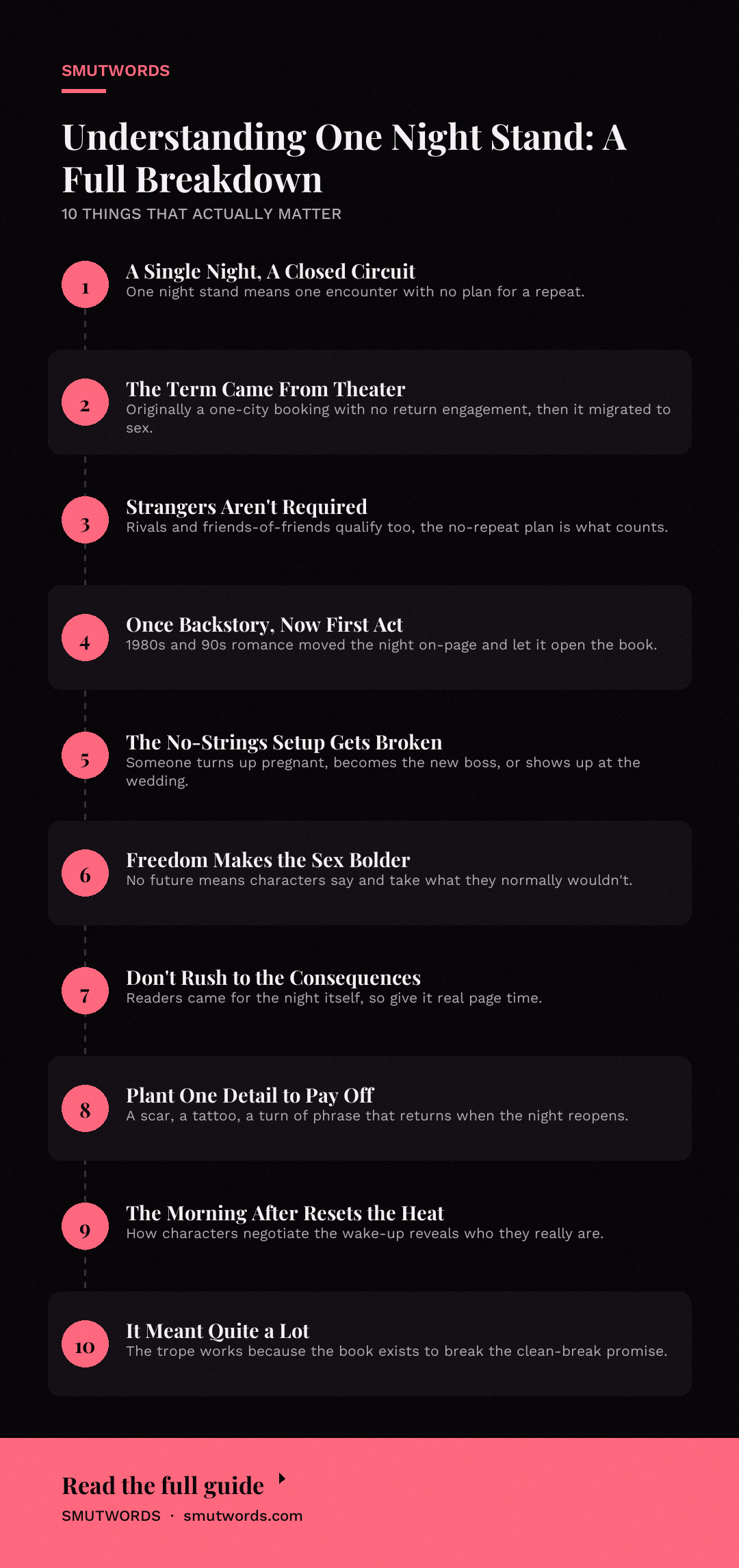
The term comes from the performing arts, not from sex. A "one-night stand" was originally a theater or music booking: a single performance in a single city with no return engagement. By the mid-twentieth century the phrase had migrated into common use to describe a single sexual encounter with no repeat.
The theatrical origin explains something useful about the trope. A one night stand is a performance with a clear curtain call: beginning, middle, definitive end. The drama lives in what happens after the curtain falls.
The sexual definition is narrow. Two people meet, connect, have sex once, and part. What qualifies: a stranger from a bar, a hookup app match, a vacation fling, a wedding guest, a coworker at a conference. What doesn't: a friends-with-benefits arrangement (ongoing), a booty call (recurring but casual), a paid encounter (different dynamic), or a first date that goes well, where the sex is part of something building rather than a closed circuit.
The "one" in one night stand is doing structural work. It signals the encounter is complete in itself.
The common misconception is that a one night stand requires strangers. It doesn't. Some of the strongest versions of the trope involve people who know each other well (a best friend's brother, a rival, a boss) and use the single night as a pressure valve they both intend to close afterward. The lack of a plan to continue is the defining feature, not the lack of a prior relationship.
Another misconception: that one night stands in fiction are always casual or low-stakes. In erotica, the single night is often the most consequential event in the book.
Where the One Night Stand Comes From
The trope's publishing history is trackable, which makes this section easier than most. In twentieth-century mass-market romance, the one night stand existed mostly as backstory: the night before the hero shipped out, the convention hookup, the Vegas mistake. It was something characters recovered from rather than something they chose. The encounter happened off-page or in a brief prologue, and the book proper began with the consequences.
That shifted in the 1980s and 1990s as category romance and early contemporary romance started giving the night itself on-page real estate. Authors figured out that a single night of high-chemistry sex could function as a first act, not just a footnote. The stranger hookup became a legitimate opening move for a full novel.
This is also when the genre began exploiting the dramatic potential readers actually want: the night was never really one night. Someone turns up pregnant. Someone turns out to be the new boss. Someone's name is on the wedding invitation.
The 2010s pushed the trope further with the rise of indie romance and explicit erotica publishing. The "Vegas wedding" variant and the "woke up married" variant became their own subcategory, and hookup apps gave contemporary authors a believable modern entry point. The stranger sex scene itself got longer, filthier, and more central. Where a 1990s category romance might give the hookup three pages, a contemporary indie romance gives it a full chapter, and explicit erotica often gives it several.
The last decade has arguably been the trope's peak. Readers now expect the night to be rendered in detail, and they expect the aftermath to be as hot as the encounter. The one night stand has moved from plot catalyst to a full erotic event with its own architecture. The "no strings attached" promise is a setup the entire book then violates on purpose.
How It Shows Up in Erotica
The craft of a one night stand scene rests on a specific tension: the characters are free of the future. No meeting-the-parents, no relationship resume, no careful management of what this means. That freedom makes the sex bolder.
People say the filthy thing they wouldn't say to a partner they plan to see again. They take the risk. The scene should feel like a closed room where the usual rules are suspended because the door is already marked EXIT.
Strong versions of the trope exploit the anonymity. The encounter can lean into a use kink dynamic, where one character is clear they're taking what they want from the night with no intention of commitment, and the other is very much there for it. It can lean into degradation kink if the characters are the type to talk mean precisely because it costs them nothing.
The single-night frame licenses behavior the characters would never sustain, and the erotic charge comes from that very temporariness.
Authors who write a flat version of the trope make the same mistake every time: they treat the night as a plot step and rush the temperature. The hookup happens in two paragraphs and the rest of the book is the consequences. This works, but it wastes the best material. The night itself is where readers who came for the erotica want to be.
A strong one night stand scene does at least three things. It establishes why these two people are exactly each other's type, fast. It lets the sex escalate in a way their daytime selves wouldn't permit.
And it plants at least one detail that will pay off when the night refuses to stay closed: a scar, a name, a strange tattoo, a specific turn of phrase. The reader clocks it and files it away.
Enjoyed this? Get a free book.
Join the list and we will send a complete free story straight to your inbox, plus new releases every week after that. No credit card, no catch.
Common variations authors use:
- The stranger hookup. Meet, want, leave. The classic, and the version that leans hardest on anonymity and app-culture realism.
- The enemy night. Rivals or rivals-adjacent characters who agree to one night as a détente and pick up the fight in the morning. Works especially well with a tutor/student romance or professional-rival setup where the power dynamic is already threaded through the encounter.
- The vacation fling. The night has a physical container (a trip, a wedding, a conference) and a built-in goodbye. Low expectations, high exposure.
- The accidental marriage. Vegas weddings, impulsive I dos, waking up married. The one night stand with a legal document attached.
- The consequence hookup. Surprise pregnancy, a shared friend group, a workplace complication. The night that follows them home.
- The anonymous encounter. No names exchanged. Often the most explicit variant and the one that leans furthest into fantasy.
- The reunion stand. Exes who agree to one last night. The closure that doesn't close.
- The group variant. A night that involves more than two people, closer to a group or orgy scenario. Rare as a full standalone trope but popular in the first act of harem romance and shared-partner books.
The "woke up together" chapter is its own craft problem. The morning after is where the erotic tension resets. The characters have to negotiate what just happened, and their negotiation reveals them.
A scene that lingers on awkward fumbling and half-dressed exits has a different temperature than one where the second round starts before anyone reaches for their phone. Both are valid. The choice should match the book's overall heat and tone.
If the book has a kink-forward dynamic that starts in the one night stand and continues afterward, authors often use the night to establish the character's signature. A rope-tied wrist from a hotel encounter pays off later if the book is heading somewhere near shibari. A display of raw physicality with a stranger sets up a primal play arc. The night becomes the kink's audition.
Themes of shared or witnessed sex can also surface. A one night stand that turns into a scenario where each partner watches the other with someone new borrows from sharing kink territory.
If the book leans into partner-swapping or couples opening a relationship, the pre-negotiation language matters, and there's a useful SmutWords piece on couple swapping that handles the conversation side properly. For breeding-oriented one night stand plots that later involve a third party, the distinction between cuckold breeding and cuckold pregnancy is a worthwhile read.
What separates a book that uses the trope well from one that doesn't: consent is explicit even in the heat, the chemistry is specific rather than generic, and the aftermath earns its length. The night is the setup. The book's real question is whether two people who agreed to no strings can actually cut them.
One Night Stand vs Random Hookup
These terms are close and often used interchangeably, but they carry different connotations in romance and erotica. A random hookup is broader and more casual: any sexual encounter between people who don't have a prior relationship. A one night stand is specifically the single night with no follow-up, and the "stand" framing carries a bit more theatricality. In publishing, "random hookup" usually describes the sex itself, while "one night stand" describes the whole unit of encounter-then-separation.
Authors use "random hookup" more often for supporting characters and side plots. The primary romance almost always gets the "one night stand" label because the term implies an ending worth reversing. A random hookup in the background keeps its promise. A one night stand in the foreground has to break its own rules.
Neither should be confused with a friends-with-benefits setup or a long-term casual partner, where the sex is ongoing and the emotional stakes play out across repeated encounters. The one night stand is a single occurrence, and its whole dramatic value depends on that singularity.
Frequently Asked Questions
What is a one night stand in romance?
A single sexual encounter between two characters who have no plan to continue the relationship. In romance, it functions as a high-chemistry opening that gets complicated when the night produces consequences the characters can't ignore: a pregnancy, a workplace overlap, a shared social circle, or a stubborn refusal to stay casual.
Is a one night stand the same as casual sex?
Casual sex is a broader category that includes ongoing hookups, friends with benefits, and repeat no-strings arrangements. A one night stand is specifically one night, one encounter, with an expectation on both sides that there will be no repeat. The single occurrence is the defining feature.
Why do people like reading about one night stands?
Readers get the thrill of instant chemistry without the negotiation of a relationship, plus the dramatic payoff of the night refusing to stay contained. The "oh no, we're in the same wedding party" or "he's my new boss" beat is engineered into the setup, and readers who love it come for that exact collision.
How do you write a good one night stand scene?
Slow the night down and don't rush to consequences. Let the characters be braver than they would be with a partner they plan to see again. Plant one detail that will pay off in the morning, and make the consent explicit even in the heat. Then make the morning after earn its place.
What is the "woke up married" variant of the one night stand trope?
A subtype where the single night also produces a legal consequence, usually an impulsive wedding in Vegas or another jurisdiction. It combines the stranger hookup with a forced-proximity setup, since neither character can simply walk away without a divorce or an annulment process.
Can a one night stand lead to a full relationship in fiction?
In romance, it usually has to. The trope is structured to make the clean break impossible: shared workplaces, surprise pregnancies, mutual friends, reappearances. Books that leave the night truly isolated are rare, and when they exist they're usually written as drama or literary fiction rather than romance.
Final Thoughts
The one night stand works because it promises something the book is designed to break. Two people agree the night means nothing, and the whole story is the slow, filthy proof that it meant quite a lot.
If you've never sought out a book built on that premise, start with a contemporary romance structured around a stranger hookup that reverses itself in the second act. Look for one where the night gets real page time and the morning after gets even more. That's the version that shows why the trope has outlasted every fad that should have killed it.
If elves or fire play or tantra are more your speed, we've got full breakdowns on those too, but that's a different night entirely.





Loading comments…