
Stranger roleplay is a consensual scene in which two people who already know each other pretend to be meeting for the first time. Then they play out whatever happens next: a pickup at a hotel bar, a wrong-room mixup, a one-night stand with a person whose name they never learn.
It strips a real relationship down to raw first contact and rebuilds the charge of the unknown on purpose. In erotica, stranger roleplay is one of the most flexible setups a writer can reach for, because it converts familiar partners into unpredictable ones without changing the cast.
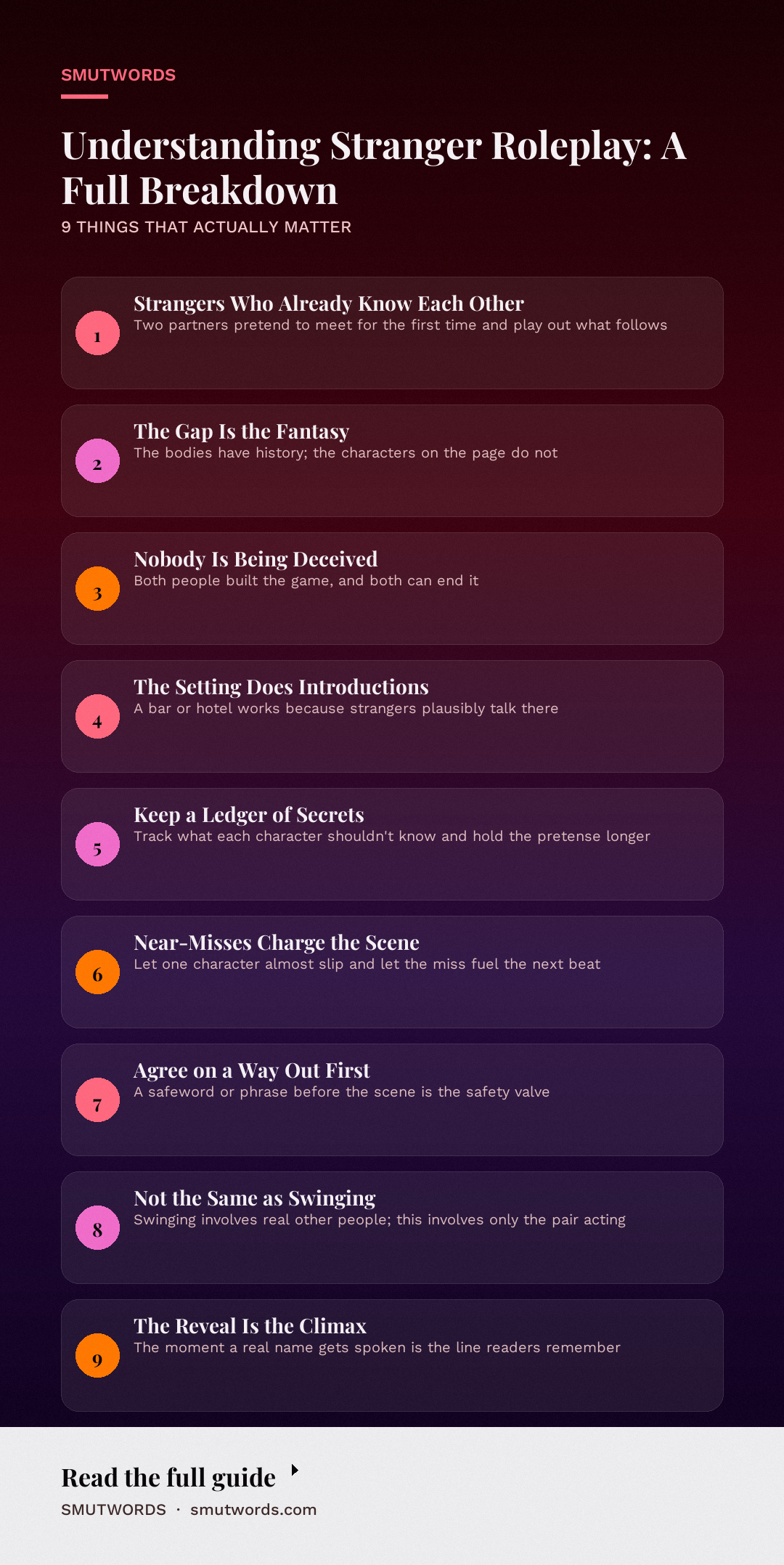
The fantasy depends on manufactured unfamiliarity. The bodies in the room have history; the characters on the page do not. Everything that follows comes from that gap.
What Stranger Roleplay Actually Means
The term describes the scenario, not a specific act. It can be a five-minute flirtation before partners drop the pretense and laugh, or an entire evening conducted in character with fake names, fake jobs, and a hotel room booked under neither of their real ones. The common thread is the deliberate erasure of shared context.
What counts: an agreed pretense that you and your partner are unacquainted, sustained long enough to change how you talk to each other. What doesn't: actually meeting someone new, or a costume change with no premise behind it. The name matters less than the mutual agreement to treat each other as fiction for a while.
People confuse stranger roleplay with cheating scenarios or pickup-artist games. It's neither. Nobody is being deceived. Both people built the game, and both can end it.
The scene usually needs one piece of architecture: a reason the characters would speak to each other at all. A bar works because strangers talk in bars. A hotel lobby works because travelers are bored.
A train car, a wedding, a laundromat at midnight, all work for the same reason. The setting does the introductions so the characters don't have to.
Where Stranger Roleplay Comes From
As a published trope, the anonymous encounter is older than the paperback. Victorian-era erotic writing leaned hard on masked balls and darkened carriages, where the whole point was that the lovers could not be certain who they were touching. The premise sold because it let authors write explicit desire while technically keeping respectable people unnamed.
Twentieth-century pulp and men's magazines ran the "chance meeting" story so often it became a genre fixture: the bar, the business trip, the wrong hotel room. Category romance adopted the same engine and scrubbed it clean. Harlequin's one-night-stand openings became a reliable formula because a single night of stranger sex can launch an entire book of consequences.
The roleplay version, where established partners act it out, arrived in erotic fiction later, once the genre started writing openly about long-term couples looking for novelty. That shift tracks with how sex manuals and advice writing began recommending scene-play between partners in the seventies and eighties.
Online erotica accelerated everything. Tags made the distinction between "stranger sex" (characters genuinely don't know each other) and "stranger roleplay" (characters pretend) legible to readers searching for one or the other. That tagging split is the biggest change in the last two decades, and it changed how authors write the reveal.
The recent swing is toward emotional intimacy hiding inside the anonymity. Modern readers want the disorientation of the unknown and the safety of the known in the same scene, and the best current writing delivers both.
How It Shows Up in Erotica
On the page, a strong stranger roleplay scene runs on information control. The writer decides what each character gets to know and when, and every beat of heat comes from that withholding.
Here are the variations authors use most, and what each one does mechanically:
- The bar pickup: The classic. Two people negotiate attraction in public, with the thrill of being watched by strangers who have no idea the couple is married. The dialogue carries everything.
- The mistaken identity: One character pretends not to recognize the other. The power sits with whoever holds the secret, and the reveal becomes its own sex scene.
- The wrong room: A hotel mixup forces proximity between "strangers." The setup does the work of justifying why two people who clearly want each other are sharing a bed.
- The conference fling: Fake names, fake job titles, a shared understanding that this ends Sunday. Good for writing characters who say things they'd never say at home.
- The blindfold or mask night: Familiarity removed through a physical barrier. Often paired with rough sex when the writer wants the anonymity to carry urgency.
- The reversal: Partners agree in advance that whoever breaks character first loses. Turns the whole scene into a game of chicken, which is enormous fun to read.
What makes a flat version: the writer forgets the pretense after the first paragraph. The characters slip into their real dynamic, use their real pet names, and the scene becomes an ordinary encounter wearing a fake mustache. The heat leaks out the moment the fiction stops being maintained.
What makes a strong version: the writer keeps a running ledger of what each character "shouldn't" know. The fictional stranger notices something about the fictional stranger's body that only a long-term partner would notice, and can't say why. That tension between knowledge and pretense is the engine.
Dialogue does the heaviest lifting. Strangers have to ask questions that partners never do. Simple things like "What do you do?" or "Do you come here often?" become loaded when both people know the answers. The most effective scenes let at least one character almost slip, and let the near-miss charge the next beat.
The physical writing benefits too. First touches between "strangers" get described differently than touches between spouses. The writer slows down, notices hands, notices breathing, treats the body as unknown territory. Several of the fundamentals of scene writing covered in our guide to alphahole characters apply here, particularly the way dominance reads differently when the partner has no established claim on it.
Length matters. A stranger roleplay passage can run two pages or fill a novel. The short version works as a standalone scene; the long version works as the opening movement of a book where the reveal and its aftermath drive the whole plot. Romance publishing has spent decades proving the second structure sells.
Enjoyed this? Get a free book.
Join the list and we will send a complete free story straight to your inbox, plus new releases every week after that. No credit card, no catch.
Consent architecture is worth writing into the scene, not around it. In real practice, because the fantasy relies on playing unfamiliar roles, partners agree on limits and a way to drop character before anything starts. A safeword, a phrase, a tap, a text, whatever the pair prefers.
Good fiction can fold that agreement into the story as a beat of its own. The whispered "if I say this, we stop" becomes part of the charge rather than an interruption of it. Readers who understand the kink tend to appreciate seeing it handled properly, and readers who don't learn something.
Point of view choices shift the whole scene. First person from the character who is "being picked up" exaggerates the disorientation. Third person omniscient lets the reader see both bluffs at once, which converts suspense into delicious dramatic irony.
Sequels and reveals deserve special attention. Many writers treat the drop-out-of-character moment as the emotional climax rather than the sex, and they're right to. When the stranger calls the other by their real name for the first time, that's the line readers remember.
Stranger Roleplay vs Swinging
These two get tangled because both involve the thrill of someone new, and the difference is clean once you see it. Swinging involves actual other people. Stranger roleplay involves only the two people in the room, acting. No third party, no real anonymity beyond what the pair agrees to pretend.
The distinction matters most in fiction, where a book can advertise the stranger fantasy and still deliver a story about a closed, exclusive couple. Writers who blur the two risk disappointing readers who came for one specifically, which is why the tags stay separate on every serious platform.
The emotional logic also differs. Swinging runs on compersion, negotiation across multiple partners, and group dynamics. Stranger roleplay runs on intimacy disguised as novelty between two people who already chose each other. If you want the second but end up buying the first, the letdown is real.
For a closer look at how a scene can cross that line on purpose, our breakdown of class difference romance shows how power and unfamiliarity get written when the partners are genuinely new to each other.
Frequently Asked Questions
Is stranger roleplay the same as a one-night stand?
No. A one-night stand involves people who genuinely don't know each other. Stranger roleplay is a planned scene between people who do, performed with agreed parameters. The fiction of unfamiliarity is the point; the reality is the opposite.
Does it mean the relationship is in trouble?
Not remotely. Couples use roleplay to add novelty, explore different power dynamics, or simply have fun. Wanting a new version of your partner is not the same as wanting a new partner, and most people who enjoy this kink report the opposite of trouble: more communication than they had before.
How do you stop the scene if it goes somewhere you don't want?
Agree on a safeword or phrase before the scene and use it the moment it's needed. The fantasy is built on pretending, so breaking the pretense instantly is the safety valve. Most couples also agree on limits in advance, from touch to specific acts to how far the fictional characters will go.
Can stranger roleplay be non-sexual?
Sure. Some couples use it purely for flirtation, a fun night out where they meet each other for the first time. It can be foreplay, a complete scene, or a way to reset a relationship's emotional temperature without anything physical happening at all.
What makes a good stranger roleplay scene in a book?
Holding the pretense longer than feels comfortable, keeping a ledger of what each character "shouldn't" know, and letting the reveal land as its own moment of heat. Writers who bail on the fiction early lose the entire engine of the trope.
Where do couples usually set these scenes?
A bar or hotel is the standard because strangers plausibly speak to each other there, and the surroundings do the introductions. Restaurants, conferences, trains, weddings, and airports all work the same way. Anywhere a stranger has an obvious reason to start talking works as a scene backdrop.
Is this related to other roleplay kinks?
It overlaps with any scene built on power exchange or character play, including the longer-term kinds described in our guide to the 24/7 dynamic. The distinguishing feature is the fictional first meeting, not a sustained persona or a full-time arrangement.
Final Thoughts
Stranger roleplay works because it solves a problem every long-term pairing eventually faces: how to want someone whose every move you already know. The pretense doesn't change who is in the room. It changes what the room can be, which turns out to be enough.
If you want to read one version done thoroughly, look at how the top-ranked books in the SmutWords catalog open with a bar pickup that both characters know is a game.
Then they spend the rest of the book refusing to admit it. That structural move, fake stranger to real confession, is where this trope earns its keep.
Readers who want more context on how the site's catalog is organized can start with our guide to every SmutWords pen name, which maps who writes what.






Loading comments…