
The voyeur husband trope is the story of a man who wants to watch. His wife, his partner, the woman he loves, with someone else. His arousal comes from the watching, not the doing. It sits at the intersection of possessive desire and willing surrender, where a husband's jealousy and his arousal feed each other instead of canceling out.
He is not absent from the scene, and he is not indifferent to it. He is the one who arranged it, or encouraged it, or sat in the chair and let it happen, because the sight of her being wanted by another man does something to him that nothing else does.
That is the plain version. The books that do this well go much further, and the ones that do it badly flatten the whole thing into a single cheap beat. This guide is about the difference, and about why this dynamic keeps showing up in erotica and romance across decades.
What Voyeur Husband Trope Actually Means
The term describes a specific arrangement inside a fictional relationship: a husband or long-term male partner who gets off on watching his wife or female partner with another man. He is often the architect of the encounter. He picks the man, sets the terms, chooses the location, decides how close he gets to stand.
The name is descriptive rather than technical. "Voyeur" points at the watching, and "husband" pins down the relationship status, which matters enormously to the fantasy. A stranger watching through a window is a different story with a different charge. The husband watching his own wife is the whole point.
What counts as this trope and what doesn't is worth spelling out, because readers argue about it constantly in review sections and forums.
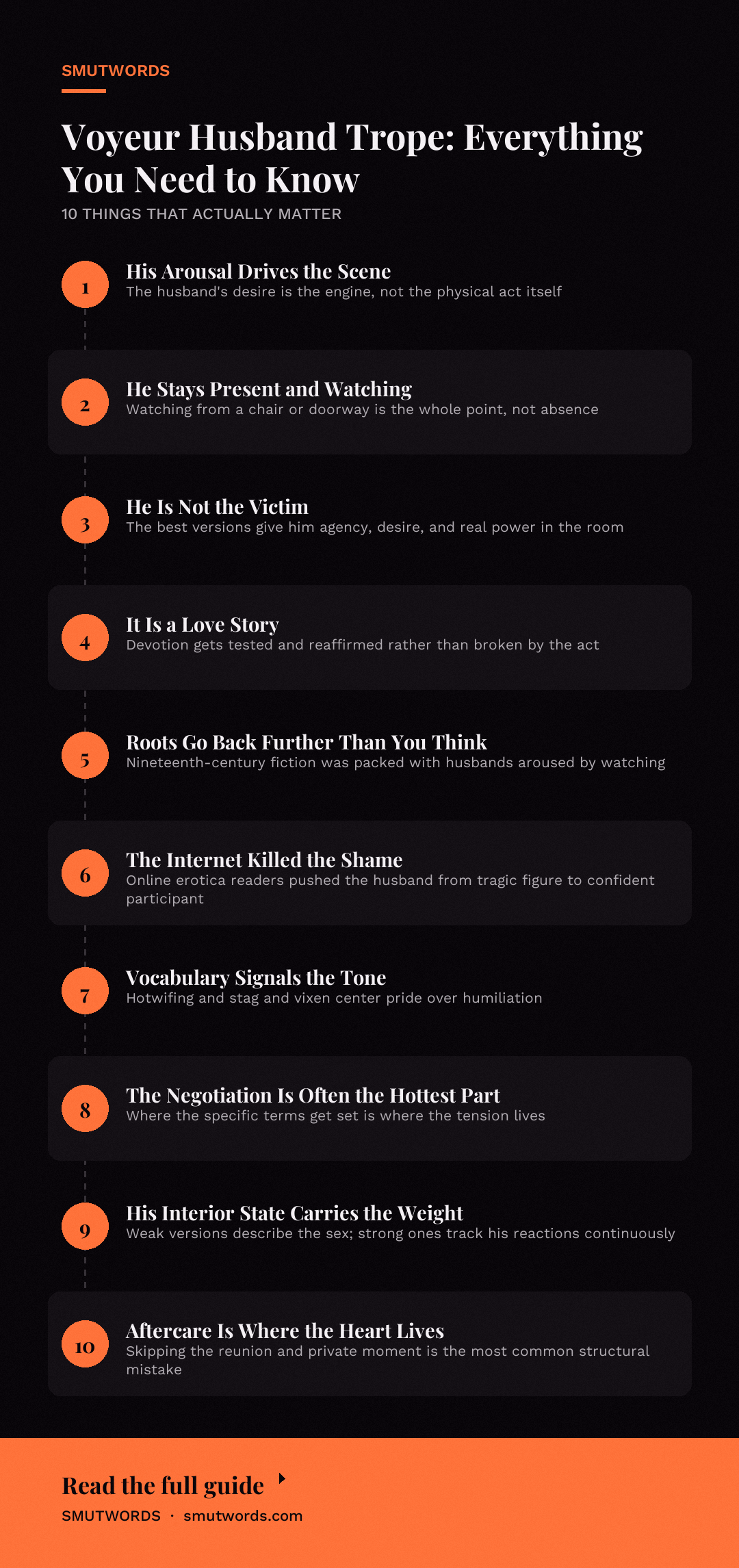
- It counts when the husband's arousal is the engine. His desire drives the scene. He wants it, she agrees to it, and the heat comes from his reaction as much as the physical act.
- It counts when he stays present. Watching from a chair, from the doorway, from across the room. His presence is a feature, and often the other man's awareness of that presence is part of the tension.
- It does not count when he is simply absent. A wife having an affair behind her husband's back is infidelity fiction and a completely separate genre engine, even though the two get shelved near each other.
- It does not count when he is a passive victim of the arrangement. If he is being humiliated against his will with no arousal of his own, that is a different fantasy entirely.
A common misconception is that the husband in these stories is weak, pathetic, or being punished. Plenty of lazy writing leans on that reading, and it is the fastest way to make the trope boring. The versions readers return to again and again give the husband agency, desire, and often a startling amount of power in the room.
He is not less of a man for watching. The stories that understand the trope know he is running the show.
Another misconception: that this is only about sex. The strongest examples are love stories. The husband's devotion to his wife gets tested, deepened, and reaffirmed through the act of sharing her, and the emotional arc often matters more than the mechanics of who is inside whom at any given moment.
Where Voyeur Husband Trope Comes From
The roots go back further than most readers assume. Nineteenth-century fiction is packed with husbands who are aroused and tormented by watching their wives be desired by other men. The layer of repression made the dynamic indirect, but the charge was there.
As a recognizable engine in erotic publishing, the trope has been a mainstay of adult fiction since at least the mid-twentieth century, when pulp publishers figured out that a husband's willingness to share his wife sold copies. Early versions leaned heavily on shame. The husband was often portrayed as pathetic, the wife as either coerced or punished, and the whole thing carried a strong moralizing undertone. The sex was there to titillate, but the story usually ended with consequences.
The internet changed the trope more than any single author did. As online erotica communities formed in the nineties and 2000s, readers who actually wanted the hot version of this story, where the husband's arousal is celebrated rather than condemned, found each other and started demanding more of it. Writers responded. The husband went from tragic figure to confident participant.
Then romance publishing caught up. Over the past fifteen years, the trope has moved from niche erotica into mainstream romance, often reframed with terms like "hotwifing" and "stag and vixen" that drop the shame entirely. Contemporary versions typically frame the arrangement as something the couple chooses together, with the husband's pleasure in watching treated as a legitimate desire rather than a symptom of failure.
The shift in vocabulary matters too. "Cuckold" carries a historical weight of insult, and it is still used broadly, but "hotwifing" and "stag and vixen" have gained traction specifically because they center the husband's pride instead of his humiliation. Readers who want the sting of degradation and readers who want the warmth of shared pride are often looking for very different books, and the genres have started sorting themselves accordingly.
How It Shows Up in Erotica
On the page, this trope is a machine with several moving parts, and how an author handles each one determines whether the story lands.
The first part is the negotiation. The best versions spend real page time on the conversation where the husband admits what he wants and the wife reacts. That conversation is often hotter than the encounter itself, because it is where the specific terms get set.
Who does he want her to be with? Does he want to be in the room? Does she want him there?
What is she allowed to say to the other man about him? Every answer tightens the tension.
The second part is the build. A weak version skips straight to the bedroom. A strong version lingers.
The husband watching his wife get ready to meet someone else. The wife realizing how much her husband is enjoying this.
The other man being chosen specifically because he is older, or bigger, or more experienced, or simply different in some way that makes the contrast sharper. Anyone bringing a monster cock kink into the mix is working with the same instinct: the other man has to be genuinely imposing or the watching loses its purpose.
The third part is the watching itself. This is where craft separates.
Amateur versions describe the sex from the husband's perspective and then stop. Strong versions track his interior state continuously. What does his chest do when the other man touches her face? When does he have to adjust how he's sitting?
Enjoyed this? Get a free book.
Join the list and we will send a complete free story straight to your inbox, plus new releases every week after that. No credit card, no catch.
What does her eye contact with him across the room mean in that specific moment?
The actual physical action between her and the other man can be almost incidental if the husband's reaction is rendered with enough precision.
Common variations authors use:
- The orchestrator. The husband chose the man, booked the room, and controls every detail. Power fantasy dressed as submission.
- The witness. The husband did not plan it, but he was there, and watching it happen shifted something permanent in the relationship.
- The instruction-giver. The husband whispers directions or texts instructions while watching. This version often overlaps with domination and control dynamics.
- The participant at the edges. The husband holds her hand, kisses her, and stays physically close but out of the main action.
- The rival-lover version. The other man becomes a recurring character, and the husband develops a complicated relationship with him that has its own charge.
What makes these stories land is specificity. Vague possession talk, endless references to "his woman," and generic descriptions of jealousy produce nothing. Specific details do the work: the exact shade of the other man's watch, the moment the wife uses her husband's nickname while another man is inside her, the way the husband's hands shake afterward.
The reader also needs to feel the husband's love for the wife as a load-bearing element. When that is missing, the trope collapses into a weird three-way, which is not what the reader came for.
The best writers also understand the release at the end. The wife coming back to her husband, the private moment afterward, the way the relationship has moved rather than broken. That aftercare sequence is often where the story's heart lives, and skipping it is the most common structural mistake in newer versions of the trope.
Authors who build in a full reunion, sometimes with the charged energy of makeup sex, tend to leave readers with a much stronger impression that the marriage won.
If you want to see how a related structure handles this kind of power exchange, the dynamics in the possessive monster trope are worth comparing directly. The possessiveness runs hot in both, but the resolution lands very differently. The same is true of the power games that drive dubcon stories, where control and surrender trade places constantly and the reader is never quite sure who holds the upper hand.
Voyeur Husband Trope vs Swinging
These two are constantly confused, and the difference matters for readers who want one and keep getting the other.
Swinging is a mutual arrangement where both partners typically participate with other people. Both people are usually active. The arrangement is often social, between couples, and the pleasure is shared across the pairing rather than centered on one person watching.
The voyeur husband trope centers on the watching itself. The husband is present as an observer, and his arousal is the primary engine of the scene. His participation is often minimal by design. That distinction changes the entire emotional texture of the story.
There are overlaps. Some stories blend the two, with the couple swinging socially while the husband's particular kink is watching his wife specifically. That variant works, but it has its own logic and is worth seeking out rather than assuming.
Readers looking for the stripped-down version, where the husband's eyes are the whole point, are usually happiest when the writer commits to the watching and lets the husband stay in his chair.
Frequently Asked Questions
Is the voyeur husband trope the same as cuckolding?
The two overlap heavily, but the tone often differs. Cuckolding traditionally carries humiliation and sometimes degradation elements, while modern voyeur husband stories often frame the husband's desire as proud, intentional, and celebrated. Many readers use the terms interchangeably, and blurbs sometimes do too, so it helps to check reviews for the emotional register before buying.
Why is this trope so popular in romance and erotica?
It combines possessive love with the thrill of surrender, and the tension between those two feelings is very hard to replicate in other setups. The husband's devotion gets tested in a way that feels intense, and the payoff, when it works, reaffirms the marriage rather than damaging it. Readers get both the frisson of infidelity imagery and the safety of a couple who are fully in it together.
Does this dynamic work as a real-world relationship?
Yes, some real couples practice versions of this dynamic, and they do it with explicit, ongoing consent from every person involved, clear agreements about what is and isn't allowed, and aftercare for the emotional intensity that a shared experience like this can bring up. Fiction compresses into a few hours what real people negotiate over weeks, and anyone exploring this in real life should treat the negotiation as its own ongoing process rather than a one-time conversation.
What is the difference between hotwifing and cuckolding in fiction?
Hotwifing typically centers the wife's pleasure and the husband's pride in her, with little or no humiliation. Cuckolding often leans into the husband's humiliation as part of the arousal, sometimes with a strong degradation kink angle. Both fall under the broader voyeur husband umbrella, but they produce very different reading experiences, and readers tend to have strong preferences.
Are there female POV versions of the voyeur husband trope?
Plenty. Many contemporary examples are written from the wife's perspective, tracking her awareness of her husband's arousal as she participates in the encounter. That POV brings its own tension, since the reader sees both her experience with the other man and her read on her husband's reaction, and the layers of awareness add a lot to the scene work.
How much page time should the husband get in these stories?
In strong examples, plenty. Even when he is physically passive in the scene, his interior state carries the emotional weight, and skipping his POV for long stretches usually flattens the story. His reactions, small and specific, are what the reader is actually there for.
Final Thoughts
The voyeur husband trope lives or dies on how much an author commits to the husband's interior life. When that interior life gets rendered with real precision, the watching stops being passive and becomes its own kind of action. The whole arrangement tilts from a scene of sharing into a love story that only makes sense for these two people.
If you want a strong example of how this works when the writer fully invests, look at the voyeur husband and hotwife entries on the SmutWords glossary and follow the reading list that sits below this guide. Start with the book that has the most specific blurb about the husband's role. That specificity is usually a sign the author knows exactly whose POV they are writing, and that is where the trope hits hardest.






Loading comments…