He is the man who walks into the boardroom expecting the room to quiet. The man whose voice drops an octave when he wants something, who says "mine" like it's a legal document. The alpha male hero is that dominant, commanding lead who takes charge in and out of bed, exuding confidence, protectiveness, and a primal intensity that sweeps the heroine into his orbit.
In plain terms, he is the fantasy of being so thoroughly desired that nothing else matters. He is the reason readers buy books, devour them in one sitting, and write reviews in all caps about needing a cold shower.
What the Alpha Male Hero Actually Means
The alpha male hero is a specific type of romantic lead. He's defined by his assertiveness, his physical and emotional dominance, and his refusal to let anything stand between him and what he wants. What he wants, of course, is the heroine.
He is not merely confident in the way a well-adjusted man is confident. He is confident in the way a predator is, calibrated to the knowledge that he can have most things he asks for and has rarely been told no.
This trope sits on a specific spectrum. It is not the same as the anti-hero, who operates outside moral codes and might genuinely pose a threat. It is not the same as the bad boy, who is emotionally damaged and acts out destructively.
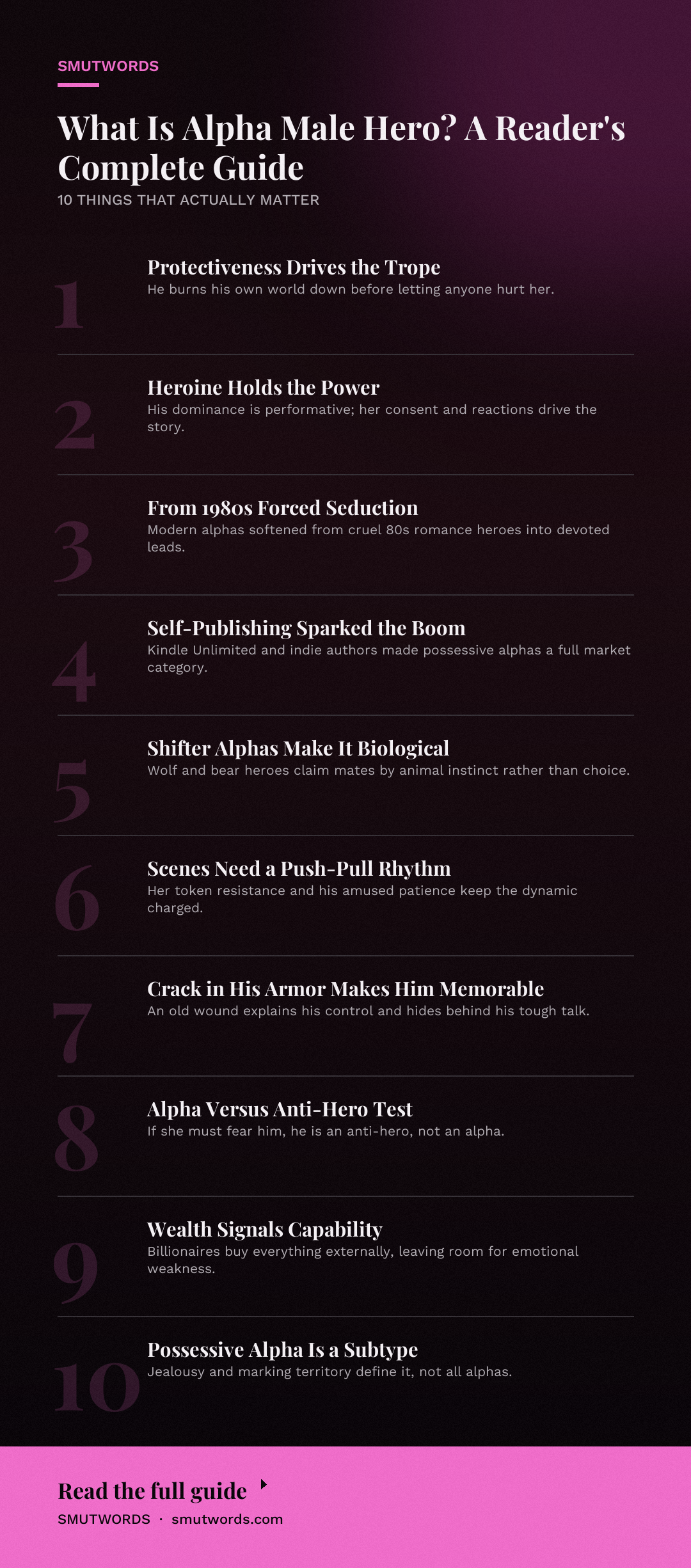
The alpha male hero can be ruthless with the rest of the world, but he draws a hard line when it comes to the heroine. He will burn his own company to the ground before he lets anyone hurt her. That protectiveness is the engine of the trope.
What does and does not count as an alpha male hero is a subject of constant reader debate. A billionaire who orders her around in the bedroom but asks for her opinion on his business decisions qualifies. A dark mafia don who kills without hesitation but shows her tenderness the moment the door closes qualifies. A grumpy small-town farmer who grunts instead of talking and physically puts her in his truck when she is being stubborn absolutely qualifies.
What does not qualify is a man who is simply rude, abusive, or controlling without the undercurrent of devotion. The distinction matters. Readers are not looking for a man who dismisses the heroine's needs. They are looking for a man so obsessed with her that he cannot see straight.
Common misconceptions abound. There is a persistent belief that the alpha male hero is just an excuse to romanticize controlling behavior. That misreads the fiction.
The best versions of this trope make the heroine the true power center of the relationship. His dominance is performative. Her consent, her reactions, and her ultimate ability to bring him to his knees are what actually drive the story. He may growl and posture, but she is the one who decides whether the dynamic continues.
Where the Alpha Male Hero Comes From
The alpha male hero has roots in romance fiction that go back decades, but his recognizable modern form really crystalized in the 1980s and early 1990s. That era of category romance, particularly the lines published by Harlequin and Silhouette, featured the "forced seduction" narrative heavily. These heroes were commanding, sometimes cruel, and they took what they wanted under the logic that the heroine secretly wanted it too.
Raphael, the hero of Johanna Lindsey's 1984 novel Tender Is the Storm, is a classic early example. He kidnaps the heroine, and the book frames it as romantic inevitability.
The trope shifted as reader sensibilities changed. There is a direct line between those 1980s heroes and the modern alpha, but the modern version is softened in crucial ways. The forced seduction element largely moved into darker corners or became the foundation for CNC fiction, which operates with explicit consent mechanics layered over the fantasy of force.
The contemporary alpha male hero is still dominant, but he is increasingly written as emotionally intelligent beneath the gruff exterior. He says "I will destroy anyone who hurts you" more readily than he says "I am taking you against your will."
The real publishing watershed for the modern alpha came with the rise of independently published romance in the early 2010s, particularly through Kindle Unlimited and the broader self-publishing boom. Authors discovered that readers had an almost bottomless appetite for possessive, dominant, wealthy heroes.
The billionaire alpha exploded as a category, alongside the shifter alpha in paranormal romance and the mafia don in organized crime romance. What was once a secondary characterization became a full marketing category. You can now sort entire bookshelves by "possessive alpha" as a search term.
Paranormal romance gave the trope a literalist turn. The shifter alpha made dominance a biological fact rather than a personality trait. In those books, the hero is not the alpha male because of his behavior. He is an alpha wolf, and his instinct to claim a mate is animal in origin.
That version of the trope allowed authors to explore possessiveness and territoriality without the social censure that might attach to a human character acting the same way. The fantasy became more primal, more overtly owned.
How the Alpha Male Hero Shows Up in Erotica
The alpha male hero performs dominance through a limited vocabulary of actions that readers recognize instantly. He issues commands. He makes decisions for both of them without asking. He assumes her compliance rather than negotiating for it.
On the page, this looks like him taking her chin between his thumb and forefinger to force eye contact, or him physically positioning her body where he wants it during a kiss. He says "again" when she stops, and "harder" when she hesitates. The shape of the sex is his to dictate, even when the content of the sex is entirely about her pleasure.
Strong versions of the alpha scene require a specific rhythm. There is the tension-building phase where he asserts his intent. There is the confrontation where she pushes back, usually verbally or with a token resistance. There is the moment when she yields, which has to feel like choice rather than defeat.
Enjoyed this? Get a free book.
Join the list and we will send a complete free story straight to your inbox, plus new releases every week after that. No credit card, no catch.
A flat version of this trope skips the rhythm. If the heroine simply accepts everything without a flicker of resistance, the dynamic loses charge. The push and pull is what makes the fantasy work. She needs to hold her ground just long enough to make his conquest meaningful, and he needs to respond to her pushback with amused patience rather than anger.
Common variations give the alpha male hero different costuming:
- Billionaire alpha: The CEO, the tech mogul, the man who buys the building she works in because he wants her closer. Think Fifty Shades of Grey's Christian Grey lineage, where wealth is the external proof of his capability to protect and provide.
- Mafia don: The criminal whose moral code is inverted, who kills for business but worships her as a personal deity. This crosses most frequently into the darker themes of the anti-hero romance, but the protectiveness stays front and center.
- Shifter alpha: The wolf, bear, or dragon whose dominance is biological. The claiming instinct is literal. The knotting in omegaverse fiction is the physical expression of that instinct, making possessiveness a matter of animal nature.
- Military alpha: The special forces operator or soldier who brings tactical precision to seduction. These often pair naturally with the logistics of a soldier romance, where his deployment creates both the conflict and the opportunity for reunion.
- Grumpy alpha: The lumberjack, the reclusive rancher, the single dad in a small town who grunts instead of talking. The lumberjack romance variant leans heavily on the contrast between his rough exterior and his devotion to her.
- Soft alpha: The caregiver dominant who runs hot and cold, commanding in the bedroom but doting, almost nurturing, when she is hurt or scared.
What separates a memorable alpha male hero from a forgettable one is almost always the crack in his armor. The best versions of this trope give him an interiority that his dialogue hides. He cannot say "I love you" without his voice breaking. He has a single vulnerability, an old wound that explains why he controls everything so fiercely.
Without that crack, he reads as a cardboard cutout with a jawline. With it, he reads as a man who has built walls and is terrified that she will scale them.
The bedroom dynamic in alpha hero erotica leans hard into dominance and submission, but it does not require formal kink. He might simply take control of the pacing, deciding when she comes or how many times. He might issue direct commands about what she is allowed to do. The intensity is the point.
Alpha Male Hero vs. Anti-Hero
The alpha male hero and the anti-hero get tangled in reader discussions constantly, and the confusion is understandable because the characters often occupy the same visual space. Both are dangerous. Both are dominant. Both tend to operate outside normal social rules.
The difference comes down to moral orientation and the target of that danger.
An alpha male hero is dominant within the rules he has set, but his goal is to protect the heroine and build a life with her. He may be ruthless in business, but he is not a threat to her.
The anti-hero, by contrast, is a morally gray figure who may genuinely endanger the heroine at various points in the story. He has done terrible things. He might do terrible things to her or to people she loves before his redemption arc kicks in.
Consider the mafia don. In one book, he is a classic alpha: he has done terrible things professionally, but he treats the heroine like she is made of glass and kills anyone who so much as threatens her. In another book, he is an anti-hero: he uses her, imprisons her, or makes her complicit in his crimes before he realizes he loves her. The same costume, two very different performances.
The line blurs most in the darker end of the alpha spectrum, where protectiveness curdles into possessiveness that reaches an unhealthy degree. The shorthand readers use to distinguish them is simple: does she have to fear him? If the answer is yes, that is an anti-hero. If the answer is no, even when he is furious, that is an alpha male hero operating correctly for the trope.
Frequently Asked Questions
What makes an alpha male hero different from a toxic man in a romance novel?
The key distinction is the heroine's safety and agency. A true alpha male hero is protective of the heroine and ultimately devoted to her well-being, even when his methods are controlling. A toxic hero dismisses her needs, endangers her, or disregards her consent.
The alpha's dominance is designed to read as devotion. The toxic man reads as a threat.
Do alpha male heroes existed in historical romance?
Yes, and they were arguably the default for decades. Historical romance heroes from the 1980s and 1990s, such as the duke or the rake, were often commanding to the point of ruthlessness. The historical setting allows authors to justify more overt dominance under period social rules, which is part of why regency and Victorian romance still lean heavily on the trope.
Can a female character be dominant over an alpha male hero?
Absolutely, and this is where the trope gets its energy. The heroine who gives as good as she gets, who stands her ground against his commands and earns his respect, is the core fantasy for many readers. The alpha male hero is often written to be completely undone by the one woman who refuses to obey him.
Why is the alpha male hero so often a billionaire?
Wealth serves as a shorthand for competence, control, and the ability to protect. The billionaire romance hero operates in a world where money solves most external problems, which leaves room for the internal conflict of his emotional vulnerability. A man who can buy anything is finally faced with something he cannot purchase.
Is the alpha male hero the same as a "possessive alpha"?
Possessive alpha is a subcategory, not a synonym. All possessive alphas are alpha male heroes, but not all alpha male heroes are possessive to the point of that being their defining trait. The possessive alpha goes further into territory marking and jealousy, often to a degree that would be a red flag in real life but reads as devotion in the fiction.
Do alpha male heroes only exist in contemporary or paranormal romance?
No. The trope maps onto any setting where male dominance can be written as compelling. Sci-fi romance has the warrior alien alpha. Fantasy romance has the king or general. Contemporary small-town romance has the protective sheriff or rancher. The setting changes, but the core performance of the commanding, devoted, dominant male remains consistent.
Final Thoughts
The alpha male hero endures because he is the product of a very specific fantasy arithmetic: the safety of absolute protection combined with the thrill of near-danger. He is the man who will burn the world down for you and then spend the night worshipping you.
If you are new to the trope and want the definitive read, start with a billionaire alpha where the wealth and control are dialed to maximum, and the heroine matches him at every turn. The genre's answer to the question of whether strength can yield without breaking is on every page.







Loading comments…