
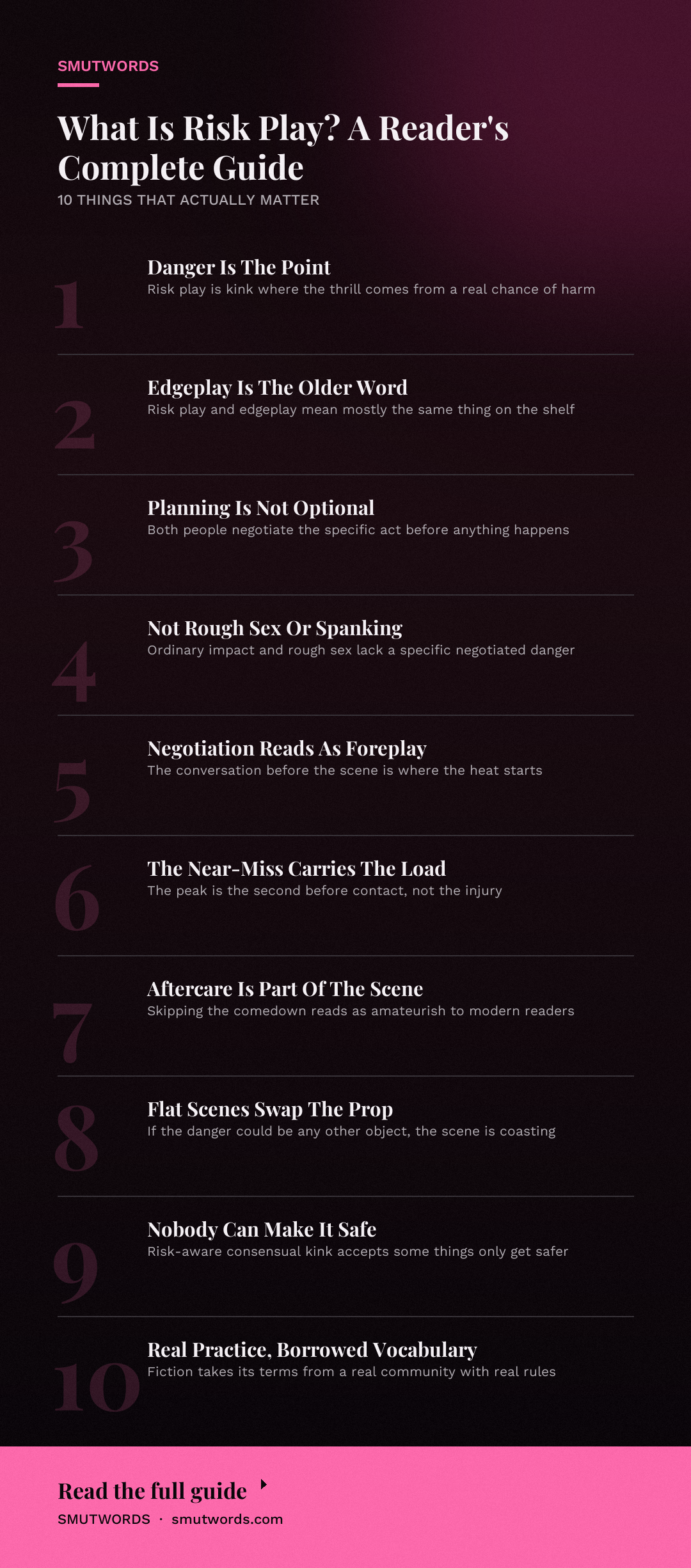
Risk play is a kink where the thrill comes from knowingly doing something with a real chance of harm. Blades, fire, breath control, needles. All of it inside a scene both partners have negotiated in detail beforehand.
The danger is the point. So is the control wrapped around it.
In fiction, risk play is the fastest way an author can show that two people trust each other past the point of common sense, and it produces some of the most charged, intimate scenes in the genre.
If you searched for risk play because a book hit you harder than you expected, or because you write this stuff and want to get it right, this guide covers the whole thing: what the term means in kink and in erotica, where it came from, how skilled authors build these scenes on the page, and what separates a great risk play scene from a cheap thrill dressed up in leather.
It is the deepest piece we publish on the subject, so settle in.
What Risk Play Actually Means
Risk play is an umbrella term for kink activities where the participants accept a measurable chance of physical harm as part of the erotic experience. The harm does not have to happen. In the version practiced well, it usually does not.
The charge comes from the nearness of it: the blade resting against skin, the hand over the throat, the flame passing close enough to feel.
The older and more common umbrella word is edgeplay, from "playing at the edge," and the two terms get used almost interchangeably. Risk play has gained ground in recent years because it says exactly what it means. The activity involves actual risk, taken on purpose, by people who know what they are doing. That clarity matters in a genre where readers want to understand the stakes.
What counts as risk play:
- Knife play: blades against skin, dragging, scratching, sometimes light cutting. The visual and the cold-metal sensation carry most of the charge.
- Fire play: lit torches or alcohol-soaked wands passed over skin, flash cotton, wax that burns hotter than people expect. Heat as a near-miss.
- Breath play: hands, belts, or plastic over the mouth and nose, plus choking in its many fictional forms. The highest-risk item on this list by a wide margin.
- Needle play: temporary piercing, usually in patterns, often as a sensation or ritual experience.
- Blood play: cutting, biting, and anything that draws or uses blood as part of the scene.
- Abandonment and predicament play: leaving someone bound, or engineering a situation where any movement causes some discomfort. The risk is exposure and helplessness rather than a weapon.
What does not count, even though people lump it in: plain rough sex with no element of danger beyond the usual, impact play like spanking done at ordinary intensities, and any scene where nobody has actually consented to the specific thing happening. Risk play requires knowledge on both sides. If the bottom cannot say what they are signing up for, it is not risk play. It is just harm.
The most persistent misconception is that risk play is what happens when kink goes too far. It is the opposite. It is what happens when two people plan extremely carefully, because the margin for error is small and both of them know it.
Where Risk Play Comes From
As a named concept, risk play sits under the edgeplay umbrella that kink communities formalized through the 1980s and 1990s, alongside the emergence of the safe, sane, and consensual framework. Practitioners needed vocabulary for the activities that fell outside the safety consensus of their own scene, and "edgeplay" became the catchall.
If you want the full background on that framework, our guide to SSC (safe, sane, consensual) covers where it came from and why some communities later replaced it with risk-aware consensual kink, a model built specifically because terms like risk play acknowledge that some things cannot be made safe, only made as safe as possible.
On the page, though, the history runs much older than the vocabulary. Erotic fiction has used the nearness of danger as a device for as long as the genre has existed.
The duel that might kill the hero. The pirate captain's blade. The lover who could ruin you with one word to the wrong person.
Nineteenth-century sensation novels and twentieth-century pulp both leaned on this constantly, and what modern readers call risk play is the kink-scene version of a very old narrative engine: danger, deliberately sought, with someone you trust.
The real shift in erotica happened over the last two decades, and it is a shift in framing rather than content. Early explicit kink fiction often treated edgeplay as pure shock value, danger without consequence, because the consequences would slow the scene down.
Contemporary risk play scenes in published romance and erotica inherit the vocabulary of negotiation from the real kink community and put it inside the fiction. Modern readers expect to see the conversation, the safeword, the check-in, and they read that negotiation as part of the eroticism rather than an interruption of it.
That expectation tracks a broader change across the genre. As our piece on the state of erotica publishing right now notes, readers have gotten hungrier for specificity across the board. Generic danger does not do it anymore. Readers want to know what the blade is, where it touches, how the top holds it, and what the bottom feels in the second before it moves.
How It Shows Up in Erotica
A risk play scene lives or dies on precision. Writers who do it well write like someone who has held the implement. They name the object. They track where it is at every moment.
They slow down time right at the point where a film would cut away, because the entire erotic payload is in the second before contact, not after.
Enjoyed this? Get a free book.
Join the list and we will send a complete free story straight to your inbox, plus new releases every week after that. No credit card, no catch.
The strongest scenes in this space share a recognizable architecture, and if you write in the genre at all, it is worth learning it deliberately:
- Negotiation as foreplay. The discussion before the scene carries heat. What are the limits. What happens if something goes wrong. The top stating exactly what they will do is often the first thing that makes the bottom's pulse jump.
- The ritual of preparation. Laying out tools, testing the flame, cleaning a blade. Competence is erotic in this kink in a way few others match. The bottom watches the top get ready and reads every motion as proof of care.
- The near-miss. The peak moment is almost never injury. It is the drag of the flat of the blade, the heat that passes and does not land, the pressure on the throat that eases a breath before panic. Denial of the full consequence is what makes the consequence feel so close.
- The check-in inside the scene. A whispered "color?" or a nod to a prearranged question, and the bottom's honest answer. In the best books, this moment is not a speed bump. It is the most intimate beat in the scene.
- Aftercare and return. Coming down together, tending skin, holding the person whose trust was just spent. Skipping this step reads as amateurish to modern readers.
Common variations authors reach for: the ex-military or security top whose calm competence is the whole appeal; the ice-cold professional who only lets go inside a negotiated scene; the couple who escalated from lighter kinks into risk play as a relationship milestone; and the dark-romance version, where the danger is less negotiated and the story's work is showing how the trust eventually becomes real.
That last version needs care, since the genre's readers include a lot of people who practice this for real, and a scene that ignores consent mechanics entirely now reads as sloppy rather than edgy.
What makes a flat risk play scene is easy to spot. If the danger could be swapped for any other prop and nothing changes, the scene is coasting. A knife that behaves like a feather, a breath restriction that never once slows the dialogue, a fire that never gets described as hot: all signs the author is borrowing the aesthetic of risk play without the substance.
The substance is a specific, believable physical danger matched to a specific, believable level of control.
How risk play blends with other kinks matters too. It pairs naturally with degradation kink, where the danger and the verbal humiliation compound each other; with keyholding, when the top also controls access and release; and with voyeurism, when the scene is watched, which adds a second layer of exposure and raises the stakes further. A risk play scene in a room with an audience hits differently than one behind a locked door, and authors use that.
Risk Play vs Rough Sex
These two get confused constantly, especially in reviews and recommendations, and the difference is fundamental. Rough sex is about intensity: hard and fast, gripping, biting, generally physical. It is a mood and a register, and the participants can be entirely spontaneous. Risk play is about the presence of a specific danger, taken on deliberately, usually after explicit negotiation of that specific thing.
The easiest test is negotiation. If the scene required a conversation about what implement, what body part, and what to do if something goes wrong, it is risk play. If two characters simply fall into bed and it gets forceful, that is rough sex.
A book can absolutely contain both, and the best ones often do, with one escalating into the other. But a reader searching for risk play wants the edge, the planning, and the fear that is welcome. Rough sex at its hottest is still drenched in abandon, while risk play is at its hottest when it is meticulously controlled.
Frequently Asked Questions
Is risk play safe?
No single activity is fully safe, and that is the honest framing the community settled on. Every item under risk play carries real potential for harm, from infection and scarring to, in the case of breath play, death. The standard is risk-aware consensual kink: both people fully informed, sober, prepared, and in agreement about the danger they are accepting.
Fictional risk play can be as dangerous as the story needs. Real risk play demands explicit informed consent, sobriety, clear safewords, and a thorough understanding of the specific risks, with emergency plans in place before any scene.
Is risk play the same as edgeplay?
Mostly, yes, with a slight difference in emphasis. Edgeplay is the older, broader term for anything at the edge of what a person considers safe within kink. Risk play names the shared property of those activities directly: the presence of genuine risk. Plenty of practitioners use the words interchangeably, and in erotica both labels point at the same shelf of books.
Why do people enjoy reading about danger in erotic fiction?
The same reason people love thrillers and horror. The body responds to danger, and fiction gives readers the rush with the safety of knowing it is a story.
In risk play specifically, the submission element intensifies it: the bottom survives not because nothing could hurt them, but because someone they trust is holding the line. That reads as one of the most romantic things a partner can do, and it is why so many readers describe these scenes as the ones they remember years later.
Do risk play scenes always involve pain?
They often do not. Knife play can be entirely about cold metal and pressure. Fire play can be all heat and no pain. The unifying element is the danger, not the pain, which is why some readers who dislike pain-heavy kink still find risk play arousing.
The rush comes from the nearness of harm, and nearness does not have to land.
How should a risk play scene in a novel handle consent?
On the page, negotiation is content. Show the conversation, show the top naming exactly what they will do, show the bottom setting a limit, and show what happens when one of them says the word that stops everything. Modern readers actively look for these beats, and their absence is the most common complaint reviewers level at risk play in romance. A scene with no negotiation reads as a scene that does not understand what it is.
Is risk play a real practice or just a fiction trope?
It is a real practice with a real community, decades of shared safety knowledge, and workshops taught all over the world. Fiction borrows its vocabulary and its aesthetics, sometimes loosely, sometimes carefully. Authors who write it well tend to research the real version, because the details are what make the fictional version land.
Final Thoughts
Read for the near-miss, the held breath, and the person who knows exactly how close they can take you without going over. If you have read this far, start with our complete guide to cosmic horror romance, which lives permanently at the edge of risk and dread, and shares this kink's best trick: making the reader feel watched, endangered, and held at the same time. Then come back and go find a book that earns every second of it.








Loading comments…