
Roommate romance is the subgenre where two people end up sharing a living space and the forced closeness does the work of a hundred candlelit dinners. A lease, a spare room, a broken furnace, a housing crisis: something practical puts them under one roof, and the plot runs on what happens when they keep bumping into each other in the hallway at midnight.
The roommate romance trope turns grocery lists, dish duty, and thin apartment walls into foreplay. Readers eat it up because the setup hands the characters an excuse to be near each other constantly without either of them having to admit they want to be.
What Roommate Romance Actually Means
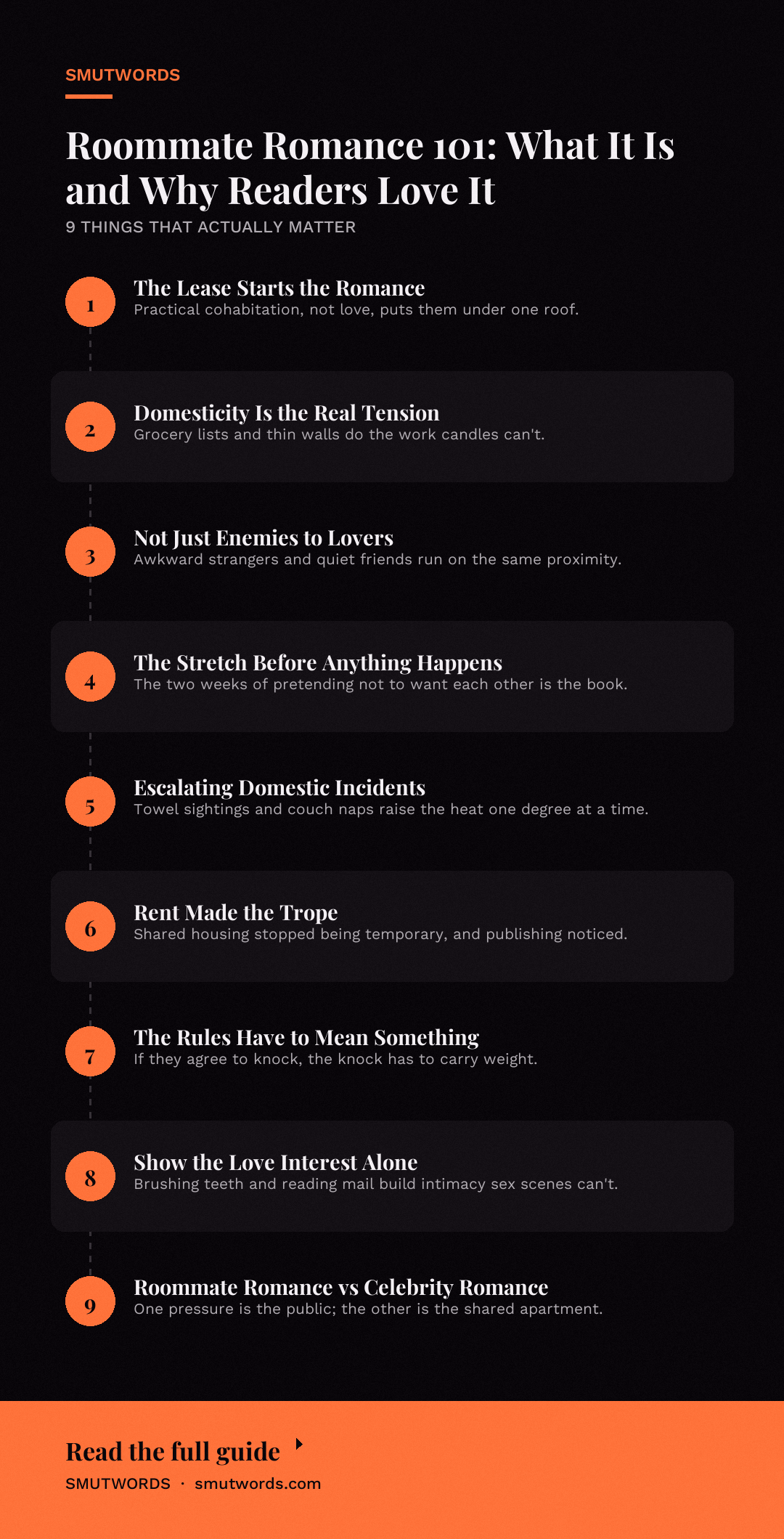
The name describes the arrangement first and the feeling second. Two adults share a home. They did not move in together because they were in love. They moved in because rent is expensive and the alternative was worse.
The sharing is not voluntary in the romantic sense, even if it is voluntary in the legal one. That distinction is the whole point.
What counts as roommate romance is narrower than "two people who live together." A married couple in an established home is not this trope. A couple who move in together after three months of dating is not this trope either, because the choice was romantic from the start. The trope requires the cohabitation to begin as a practical problem, then become a romantic one.
That shift is the whole engine. A roommate romance story is really a story about how a living arrangement stops being just an arrangement. The apartment does not change. The way they move through it does.
What doesn't count
A shared dorm in a college romance can count, but only if the domesticity matters. If the roommate is a background character and the love interest lives across the quad, you're reading a campus romance with a nosy suite-mate. The roommate has to be the love interest, and the home has to be the pressure chamber.
Hotel-room-only settings, vacation flings, and cohabitation that lasts a weekend are usually filed under forced proximity without the domestic layer. The kitchen has to appear more than once. Someone has to do laundry.
Common misconceptions
The biggest one is that roommate romance always means enemies to lovers. Plenty of these books run on awkward strangers, quiet friends, or two people who were perfectly polite to each other for six months before something cracked. Hostility is one version, not the definition.
The second misconception is that the trope is automatically light and funny. Some of the most effective roommate romances are tense, slow, and nearly unbearable in the best way. The comedy is optional. The proximity is not.
The third: readers often assume the sex is the point. It's the payoff. The point is the two weeks before it, when they're both standing in the same kitchen pretending the tension isn't there. Our guide to roleplay scenarios for couples makes a similar argument about anticipation doing most of the work.
Where Roommate Romance Comes From
The trope's publishing history is a story about rent. Roommate romance spread as a recognizable category alongside the rise of urban single living, when shared housing stopped being a temporary stage and became a permanent condition for a huge number of adults. Romance publishing noticed.
In the twentieth century, the shared-apartment setup showed up mostly in screwball comedy and midcentury film: two people, one lease, a lot of slamming doors. Those stories were rarely explicit, but they built the grammar. The closed door, the bathrobe in the hallway, the kitchen conversation at 2 a.m. Every one of those beats is still in the room.
The erotic version gained real traction with the paperback boom of the 1970s and 1980s, when category romance publishers figured out that a shared domestic setting could support far more heat than a formal courtship plot. A heroine with a career and a roommate in a city apartment was a modern, plausible woman. Modernity sold.
The slow shift in how it's written
Early roommate romances leaned on the wrong-first-impression setup almost exclusively: she thinks he's a slob, he thinks she's a snob, they fight over the thermostat, they fall in love. That structure dominated for decades because it gave the author a clean reason for conflict that didn't require either character to be cruel.
The contemporary version has widened a lot. Roommate romance now routinely includes queer pairings, poly arrangements, older characters, and characters whose cohabitation is a genuine economic necessity rather than a cute coincidence. The trope got more honest about money, which made it more honest about class, which made it more interesting.
The other major shift is consent-forward intimacy. Modern roommate romances spend more words on negotiation and mutual checking-in than older ones did, and the genre is better for it. Our breakdown of understanding switch applies here: the hottest version of the trope is usually the one where both characters are actively steering, not just getting swept along.
There's also a growing overlap with adjacent tropes. Celebrity romance often borrows the roommate structure when a public figure needs a discreet place to stay, and the closed-quarters tension plays out the same way. Childhood friends to lovers frequently ends with a cohabitation setup, because the two characters already know each other's habits and the only thing missing was the lease.
How It Shows Up in Erotica
On the page, roommate romance is a machine for generating charged small moments. The author's job is to find the ordinary tasks that become unbearable when they're done by someone you're attracted to and can't avoid. Every scene is built from a chore, and every chore has a skin to it.
Good versions of this trope read like a series of escalating domestic incidents. The first time he sees her in a towel is an incident. The night she falls asleep on his shoulder on the couch is an incident. The day he hears her through the wall is an incident.
Each one raises the temperature by a degree, and none of them are cancellable.
Flat versions skip the escalation. They put the characters in one scene of bickering, one scene of accidental nudity, then straight to the bedroom. The reason that doesn't work is that the whole appeal of the trope is the accumulation, not the event.
Enjoyed this? Get a free book.
Join the list and we will send a complete free story straight to your inbox, plus new releases every week after that. No credit card, no catch.
Variants authors actually use
A few structures show up again and again, and most books are combinations of two or three:
- Strangers sharing a lease: They answer the same ad or get assigned the same dorm. No prior history, so every detail has to be discovered.
- The one-bed trope: A single bed, two people, and no good alternative. Often the highest-tension version because the physical arrangement itself is the drama.
- The fake roommate: Someone pretends to be a roommate to enter a home or a life, often for a reason that comes out later and costs them. The deception has to be paid off, usually with a redemption arc romance beat where the liar has to earn back trust.
- Landlord and tenant: The lease is held by one person, which adds a power differential the author has to handle with care. Strong versions negotiate that imbalance explicitly on the page.
- Cohabitation contract: A formal agreement, often short-term, always with a rule that both characters eventually break.
- The rebound roommate: One character is fresh out of another relationship and the roommate is the first person they see every morning. Slow, painful, very effective.
What makes a strong version work
Strong roommate romances get the sensory details right. The apartment has a specific smell. The bathroom mirror fogs in a specific way. One roommate hums in the shower and the other can't stop noticing it. Specificity is the whole craft.
They also allow the characters to be genuinely unguarded. That's the erotic engine of the trope. You see a person at 6 a.m. in a t-shirt with yesterday's mascara on, and that version is more intimate than the dressed-up version.
Authors who understand this write a lot of small unguarded scenes before they write a single sex scene.
Strong versions also respect the rules the characters set. If they agree to knock before entering, the author makes the reader feel the weight of the knock. If they agree they won't date, that agreement has to be real for long enough that breaking it means something. Our comprehensive guide to caning makes the same point about negotiated limits: the rules are what makes the moment land.
What makes a flat version fail
The most common failure is that the author forgets the home. The characters spend all their page time outside it, and the apartment becomes a background set. If the reader can't picture the couch, the trope is dead.
The second failure is a love interest with no private life. Roommate romance needs the reader to see the love interest alone, or nearly alone, doing something unremarkable. Brushing teeth. Reading the mail. Crying in the kitchen at 1 a.m. when they think no one is up.
Without those moments, the intimacy has nothing to feed on.
The third is instant attraction with no delay. There has to be a stretch where they both know and neither says anything, because that stretch is the book.
Roommate Romance vs Celebrity Romance
These two get confused a lot, mostly because a number of popular books stack them. The distinction is about where the tension comes from.
In celebrity romance, the pressure is external: the public, the tabloids, the industry, the fanbase. The couple's secret is that they're together, and the drama is the cost of going public. In roommate romance, the pressure is internal and architectural. The couple's secret is that they want each other, and the drama is the shared space that keeps the wanting alive.
When a book has both, the best versions use the celebrity angle to threaten the home rather than replace it. A famous character hiding out in a normal person's spare room has to deal with being seen first thing in the morning by someone who doesn't care who they are. That's the roommate romance doing its job.
A related confusion pairs roommate romance with ghostwriter romance, where the intimacy comes from writing rather than living together. If the couple shares a document tracker but not a bathroom, it's not a roommate romance. If they share both, it's both.
Frequently Asked Questions
What is the one bed trope and is it the same as roommate romance?
The one bed trope is a specific device inside the broader roommate romance setup: two characters sharing a single bed because there's no other option. It's the highest-intensity variant, but many roommate romances never use it, and a lot of books use the one bed without any cohabitation. The trope is a tool; the genre is the room.
Do roommate romances always involve enemies to lovers?
No. Enemies to lovers is the most common route, but plenty of roommate romances run on awkward strangers, quiet friendship that catches fire, or two people who were politely ignoring each other for a year. The requirement is proximity. The hostility is optional.
Why is roommate romance so popular in erotica?
Because it solves the genre's biggest structural problem: how to get two people in close physical contact repeatedly without contrivance. A shared apartment is the most plausible repeated-contact machine ever invented, and readers buy it because they've lived it. The domestic settings give the author dozens of small, specific, believable scenes to escalate through.
Is roommate romance the same as forced proximity?
Roommate romance is one type of forced proximity. Forced proximity is the broader category, and it includes shared cabins, snowed-in hotels, fake dating arrangements, and work trips. Roommate romance is specifically the version where the proximity is at home, which changes the flavor of the tension because home is where people are unguarded.
What is a fake roommate romance?
It's a variant where one character claims to be a roommate (or accepts a roommate role) for a reason that isn't the whole truth. The lie usually comes out late in the book and triggers a reckoning. Good versions of this variant commit to the fallout. Bad ones pretend the deception never happened.
What should I look for in a good roommate romance?
Specific domestic detail, a stretch of slow unease before any contact, a love interest with a private life on the page, and rules that the characters set and eventually break. If the book can't tell you what the kitchen looks like, it's probably not a strong version of the trope.
Final Thoughts
Roommate romance earns its popularity because it does what erotica is best at: it takes the most ordinary parts of a life and makes them powerful. The kitchen counter, the shared bathroom, the hallway at midnight. If you want to see the trope in a very different register, our guide to monster breeding romance shows how the same architecture of forced closeness, unguarded seeing, and escalating domestic tension works when the roommate isn't human.








Loading comments…