
A shared wife blog is a first-person serial narrative in which one spouse documents, post by post, the process of watching or arranging for their partner to have sex with other people. Readers get the writer's arousal and their queasy middle-of-the-night second thoughts in the same feed, spread across weeks or months rather than resolved in one scene.
The genre sits where hotwife fiction, cuckold confession, and epistolary erotica overlap, and it borrows its pacing from real internet diaries even when every word of it is invented.
What Shared Wife Blog Actually Means
The term describes both a format and a dynamic. As a dynamic, it covers any arrangement where one partner in a committed couple has sex with others while the other partner knows, consents, and usually gets off on it. As a format, it covers the specific storytelling choice to deliver that arrangement through one person's ongoing written record: blog posts, journal entries, forum updates, a diary with timestamps.
The narrator is almost always the partner staying home, or the partner who arranged the encounter. That person writes in first person, present or recent past tense, and addresses an implied audience directly. "You won't believe what she did last night." The spouse becomes a character in someone else's serialized account of their own marriage.
Three things have to be true for a story to count as this trope rather than just hotwife erotica with a framing device:
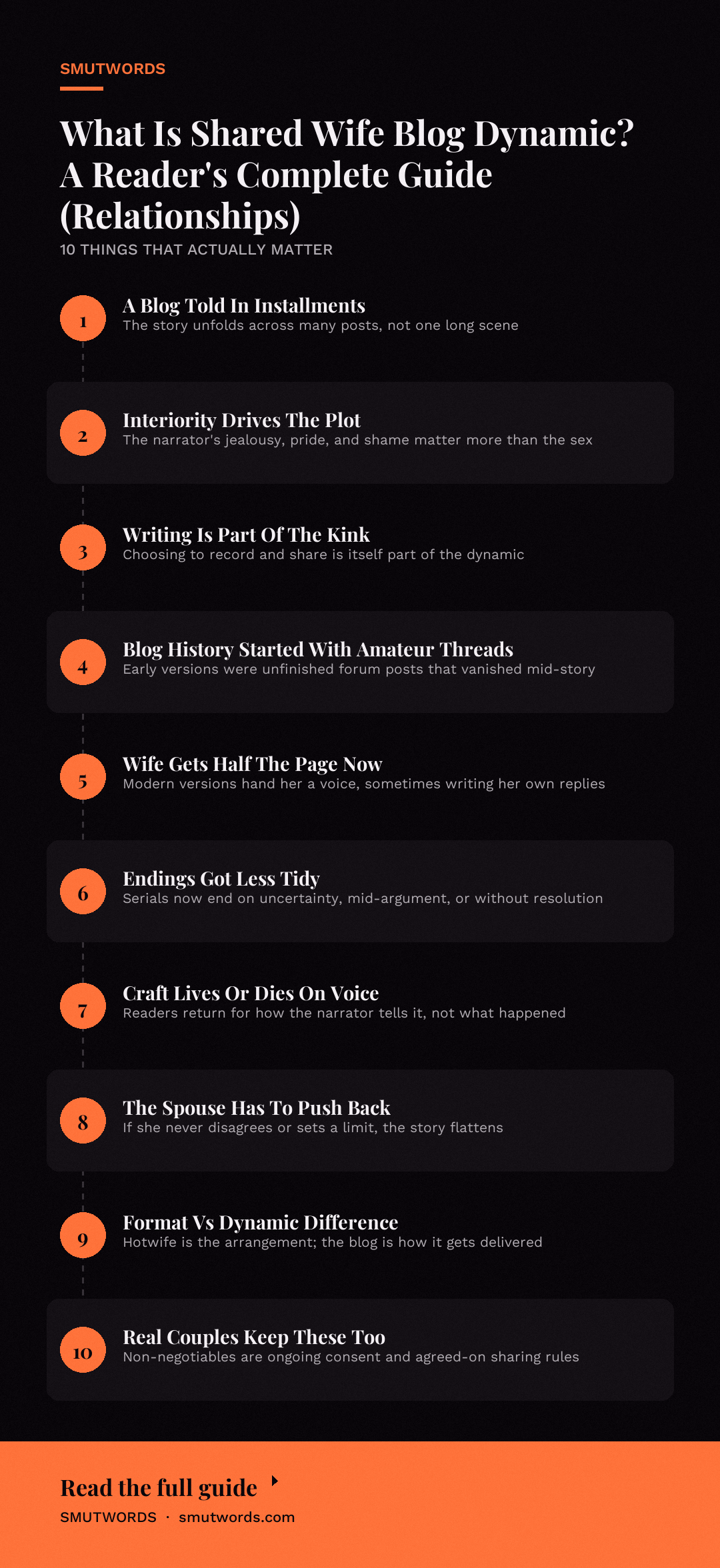
- Serialization. The story unfolds across multiple entries, not one long scene. Gaps between posts carry weight. Readers wait for the next one the way they wait for a chapter.
- The writer's interiority drives the plot. The sex matters, but the narrator's processing of the sex matters more. Jealousy, pride, arousal, shame, and renegotiation are the actual engine.
- Documentation as an act. The writing itself is part of the dynamic. The narrator is choosing to record and share, and that choice often turns the narrator on, unsettles the spouse, or both.
What doesn't count: a third-person story about swingers, a single scene of wife-sharing with a diary entry bolted on as a prologue, or a cuckold story where the narrator is purely a spectator with no emotional arc. The blog has to breathe. If it could be told in one sitting with no loss, it isn't this.
Common misconceptions run in a few directions. People assume the narrator is always humiliated, which is only one flavor; plenty of these narrators are smug, tender, or clinical. People assume the wife is passive, which the best versions thoroughly reject. And people assume the writing is a pretext for the sex scenes, when in strong examples the reverse is often true: the sex scenes are the pretext for the writing.
Where Shared Wife Blog Comes From
The honest history here is a publishing and internet history, not a kink history. Wife-sharing as a fantasy is old. Cuckold themes run through Victorian pornography, Restoration comedy, and roughly every bawdy tradition in the English language. What's new is the container.
Two things collided in the late 1990s and early 2000s. First, personal blogging, which taught a whole generation of writers to narrate their own lives in installments to a semi-anonymous audience. Second, the rise of kink-specific forums and story archives, where confessions found a built-in readership that wanted exactly this and nothing else.
Early versions were genuinely amateur. A husband would start a thread, post a few paragraphs about a party, and disappear. The genre's first recognizable convention wasn't a plot beat; it was the unfinished thread. Readers learned to invest in stories that might never conclude, which trained them to read for texture rather than resolution.
Over the 2010s, the format professionalized. Self-published authors noticed that serialized first-person confession outsold tight third-person hotwife novellas, especially at the length where a single scene feels thin and a full novel feels padded. They started writing blogs on purpose: consistent posting schedules, recurring commenters as characters, mid-serial tonal shifts.
Early versions often kept the wife almost silent, a beautiful event happening to the narrator. Contemporary versions hand her half the page, sometimes literally through "she read my post and wrote a reply" interludes.
The genre also got less tidy about endings. Ten years ago most entries resolved into a stable arrangement the narrator could describe with a satisfied shrug. Now ambiguity is a feature, and a serial can end mid-argument.
There's also a quieter shift in consent framing. Real-world versions of this dynamic depend on ongoing, explicit consent from every person involved and clear agreement about what can be shared publicly, since exposure and shifting feelings can affect the marriage well beyond the fantasy. Modern fiction increasingly writes that negotiation into the story rather than treating it as paperwork happening offstage, and readers respond to it because the negotiation is frequently the hottest part.
How It Shows Up in Erotica
On the page, this trope lives or dies on voice. A reader clicking into post three is there for how the narrator tells it, not for what happened. That means sentence rhythm, self-awareness, and a willingness to be unflattering carry more weight than the physical choreography.
Strong versions tend to share a few craft habits:
- Specific mundane detail. The parking lot, the wine label, the way she left her phone face-down. Concrete texture is what makes the reader believe a real person is typing this at 1 a.m.
- Delayed emotional reporting. The narrator describes the event flatly in one post and only reveals what it did to them two posts later. This mimics real processing and builds tension without contrivance.
- Direct address that shifts. The audience gets warmer, colder, more confessional, or more guarded depending on what the narrator is avoiding.
- Physical stakes kept small. Not every entry is a party. Some of the best ones are about a text message.
- A spouse who pushes back. If she never disagrees, never sets a limit, never changes her mind mid-encounter, the story flattens into wish fulfillment and readers bail.
Common variations authors use:
- The arranged-first version. The narrator sets up the encounter, and the thrill is authorship as much as watching. Control is the kink. This one pairs naturally with Seduction Roleplay structures, where the setup itself carries the heat.
- The reluctant-witness version. The narrator agreed, then discovers they can't handle it, then discovers they can. The arc is the product.
- The two-author version. Alternating posts from each spouse, arguing on the page. Harder to write, enormously effective, and it forces the dynamic to stay genuinely mutual.
- The found-document version. Framed as an archived blog recovered by someone else, which adds unease and lets the ending stay unresolved.
- The professionalized version. A narrator with a following, aware of the audience, performing for it. The performance anxiety becomes its own kink.
What makes a flat version: the narrator is purely a camera, the wife is purely a body, and the posts exist only to deliver sex scenes with a thin veneer of "and then I felt jealous." That version reads like a list of events. It has no weather.
Enjoyed this? Get a free book.
Join the list and we will send a complete free story straight to your inbox, plus new releases every week after that. No credit card, no catch.
Craft note on heat level. Because the format front-loads emotional narration, the explicit scenes can afford to be slower and more sensory than in a standard erotic scene. Readers who got invested in post one are patient by post six. That patience is a gift, and the best writers spend it on small physical specifics rather than escalation for its own sake.
If forced orgasm or impregnation kink appears in this format, it usually works best as an event the narrator is processing rather than a set piece dropped in whole.
One cross-genre observation worth making: writers who come to this trope from paranormal romance often import the wrong instincts. Pack dynamics and pack mate romance work because the compulsion is structural, baked into the world. A shared wife blog works because the compulsion is chosen and re-chosen every post. Swap those engines and both forms fall apart.
The intimacy of the diary is what makes the format feel like being let in on something. That's the entire appeal, and any scene that stops serving the intimacy slows the whole serial down.
Shared Wife Blog vs Hotwife
These two get confused constantly, and the difference is real. Hotwife is the dynamic; shared wife blog is the delivery system. A hotwife story can be told in third person, present tense, in one long night, with a camera-angle narrator who has no inner life. A shared wife blog can't.
The moment you strip out the written record and the narrator's processing across time, you're reading hotwife erotica, which is great, but it's a different shelf.
Practical test: if you removed every reference to writing, posting, or reading the entries, would the story still work? If yes, it was hotwife with a blog costume. If no, the documentation is load-bearing and you're in the right genre.
The confusion is worth respecting rather than correcting, since most readers arrive at this trope through hotwife searches and are happy to find the serialized version. But for tagging, reviews, and recommendations, the distinction matters. It's the difference between a scene and a relationship.
Frequently Asked Questions
Is a shared wife blog always written by the husband?
No, though the husband-as-narrator version is by far the most common. Wife-narrated versions exist and have grown steadily, and they tend to read differently because the wife has to justify her own desire rather than report it. A smaller number are written from a third party's perspective, such as a friend or a recurring partner observing the couple.
How explicit do these stories usually get?
Most include graphic sex, but the ratio of explicit content to emotional narration varies wildly. Some serials are 70 percent reflection and 30 percent scene. Others flip it. Neither ratio is more correct, but the reflective versions tend to build larger, more loyal readerships because the reader is following a person instead of a series of events.
Do these stories have to end with the couple staying together?
No, and modern versions increasingly don't. Early examples almost always resolved into a stable, happy arrangement, partly because readers wanted reassurance and partly because that's what sold. Contemporary serials are more willing to end on uncertainty, separation, or a narrator who genuinely doesn't know what happens next. The ambiguity reads as honest to a lot of readers.
What's the difference between this and a cuckold journal?
Overlap is heavy, and many stories could be tagged either way. Cuckold journal usually implies more emphasis on humiliation, hierarchy, and the narrator's lower status. The broader term covers arrangements with no humiliation element at all, including couples who treat it as a shared hobby with equal footing. If the narrator is enjoying the events without any sting, the broader label fits better.
Can a shared wife blog work as a standalone novel?
Yes, and several do, but the format fights back. Novels want resolution and momentum; blogs want texture and drift. The most successful novel-length versions keep the entry structure intact, with dated sections, and let the plot emerge from accumulated small moments rather than a single escalating arc.
Is there a real-world version of this?
Yes, and it's more common than people assume. Real couples do keep shared journals, private blogs, or invite-only archives of their experiences. The non-negotiables are ongoing consent from every person involved and explicit agreement about what can be published and to whom, since exposure and changing feelings affect a marriage long after any single encounter ends.
Final Thoughts
The shared wife blog earns its place in the genre because it does something a well-built scene can't: it makes the reader complicit in a marriage over time. You watch the narrator talk themselves into something, out of it, and back in, and by the last entry you've been inside their head long enough that the sex lands harder than any single set piece could.
If you want one book that shows the format at full strength, pick something serialized and slow, read the first three entries without skimming, and see whether you're hooked by the voice before anything explicit even happens. That's the test this trope sets for itself, and the best examples pass it easily.






Loading comments…