
Viking romance is historical or fantasy romance set in the Norse world of the eighth through eleventh centuries, built around rugged warriors, shieldmaidens, skalds, jarls, and the women who refuse to be conquered by any of them.
The books run on cold coastlines, longships, mead halls, blood feuds, and the specific heat of two stubborn people deciding they belong to each other. If you came here from a glossary entry wondering whether this trope is for you, the short answer is yes. The longer answer: Viking romance has quietly become one of the most reliable subgenres in historical erotic fiction, with a readership that treats new releases like raid season.
What separates it from generic historical romance is the world itself. There is no drawing room, no chaperone, no empire or church to behave for. There is weather, steel, honor, and a heroine who usually has to earn her place twice: once as a captive or outsider, and once as the one person the hero cannot replace.
What Viking Romance Actually Means
The term covers any romance where the central love story plays out inside Norse culture or Viking Age Scandinavia. That includes historically grounded novels set in the ninth century, fantasy romances with Norse gods and rune magic in the background, and modern romances where a present-day heroine gets yanked back in time to a fjord. The label describes the setting and the archetypes, not a single plot beat.
The name itself is a convenience of publishing, not history. "Viking" was a job more than a people: raiding, trading, exploring. The romance genre adopted it as shorthand for a whole package of masculinity and danger, so a book can be tagged Viking romance while the hero is a farmer with a sword, a jarl's son, a berserker, or a sea king.
What counts, broadly:
- A Norse or Viking Age setting, historical or fantasy
- A hero drawn from warrior culture: raider, jarl, mercenary, ship captain, berserker
- A heroine who is a shieldmaiden, a captive, a healer, a spy, an outsider, or a woman with her own authority
- High stakes, often life or death, and a strong element of culture clash
- Explicit or open-door sex as a core part of the appeal, not an afterthought
What does not count: a contemporary romance where the hero happens to be Scandinavian, a book set in medieval England with one brooding side character in a fur cloak, or anything where the Norse element is costume rather than culture.
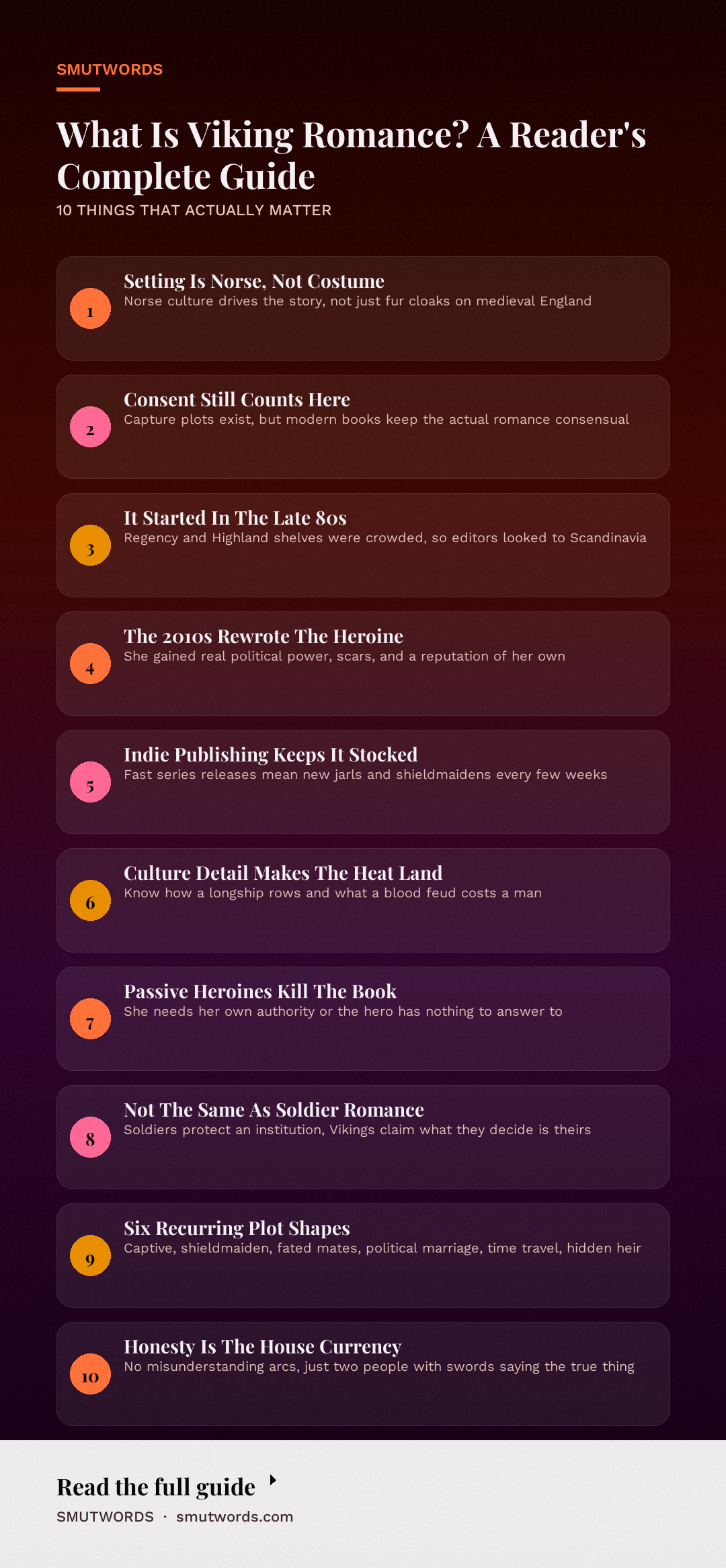
The biggest misconception is that Viking romance has to be brutal or non-consensual to be authentic. Plenty of the best-known books involve capture, forced proximity, and intense power imbalance, and they keep the actual romance consensual once the dynamic settles. Readers who want the danger without the cruelty can find shelves of it, and the trope has matured a great deal on exactly this point.
Where Viking Romance Comes From
The modern Viking romance starts as a publishing phenomenon in the late 1980s and 1990s, when historical romance was booming and editors were hunting for settings nobody had strip-mined yet. Regency England and the Scottish Highlands were already crowded. Norse Scandinavia was wide open, visually distinct, and offered something the Highlander hero could not: longships, exploration, and a pantheon.
Those early books leaned hard on capture plots and cover art that was practically a genre unto itself. The 1990s Viking wave set the template readers still recognize: a raider takes a woman from a raid or a rival holding, she refuses to be a prize, he finds out she is the only person he cannot out-stubborn, and honor binds them before love does.
The 2010s changed the tone more than the setting. Authors started writing heroines with genuine political power, shieldmaidens with scars and reputations of their own, and heroes who were less conquerors than men carrying grief and duty. Paranormal romance pulled Norse mythology into the foreground, complete with Loki, Freya, Valkyries, and fated mates. Independent publishing did the rest.
That last point is the real engine behind the current shape of the subgenre. Authors building long-running series can publish fast, keep a raiding party's worth of installments coming, and go far more explicit than a legacy print imprint usually allows. For a look at how one author scales a series to absurd, wonderful length, see Penny Pepper on building a 65-book free use series. The same serialized instinct runs through Viking romance, just with more salt water.
Meanwhile, a whole cohort of authors learned to write on a punishing daily schedule, and that pace is what keeps a subgenre this specific stocked. How Miss Dolly X writes a chapter a day is a useful window into it. Viking romance readers get the benefit: new jarls and shieldmaidens every few weeks instead of waiting on a traditional publishing calendar.
How It Shows Up in Erotica
On the page, Viking romance runs on two engines. The first is physical: a harsh world where bodies matter, endurance is a virtue, and sex is one more arena where two formidable people test each other. The second is structural: a relationship built on capture, alliance, or a bargain that neither party expects to survive intact.
A strong scene keeps the stakes corporeal. Cold, hunger, injury, the weight of a shield, the smell of rope and smoke. When a Viking romance goes flat, it is almost always because the setting has become wallpaper and the characters are behaving like modern urbanites wearing fur.
Common variations authors reach for:
Enjoyed this? Get a free book.
Join the list and we will send a complete free story straight to your inbox, plus new releases every week after that. No credit card, no catch.
- Captive and captor. The heroine is taken in a raid, an inheritance dispute, or as part of a treaty, and the negotiation over her status becomes the romance.
- Shieldmaiden and enemy warrior. She fights him, loses or draws, and the mutual respect turns into something more. This is the variant that feeds most naturally into enemies to lovers, and the best of them let the hostility stay sharp right up until it doesn't.
- Fated mates with Norse gods. A mortal and a god, a Valkyrie, or a shapeshifter bound by prophecy. Heavy on breeding drives and mythic obligation, light on diplomacy.
- Political marriage. Two jarls, two families, one alliance sealed in a bed neither party chose. The friction here reads a lot like marriage in trouble, except the trouble starts on the wedding night and gets worse before it gets better.
- Time travel. A contemporary heroine lands in the ninth century, and the culture clash does double duty as both comedy and heat.
- Hidden heir. Raid, one night, he sails away, and years later there is a child. The secret baby trope fits the raiding lifestyle almost too neatly.
What makes the strong version work is specificity of culture. The great Viking romances know how a thing works: how a longship is rowed, what a thing is worth in silver, what a blood feud obligates a man to do, how a woman runs a household while the fleet is gone. That texture is what makes the sex land as consequence rather than decoration.
Heroines carry the weight here more than in most subgenres. A Viking romance with a passive heroine dies on arrival, because the hero never shuts up internally about her competence.
She needs her own. This is also why the darker, more obsessive end of the shelf fits the setting so well: a hero who watches her across a mead hall and decides she is his has real stalker romance energy, just relocated to a time when there was no law to appeal to.
Honesty is the house currency. Norse heroes in these books tend to say the true thing out loud, even when it costs them. No long misunderstanding arcs, no drawing-room manners, just two people with swords and no interest in pretending.
Viking Romance vs Soldier Romance
These two get confused constantly, and the confusion is worth settling because they scratch different itches. A soldier romance is built on discipline, hierarchy, and duty to an institution. The hero has a rank, a chain of command, and a war that is happening to him.
A Viking romance hero answers to almost nobody. He has a ship, a crew, a family, and a reputation he defends personally. If he takes orders, it is from a jarl he chose and could leave. Where the soldier romance gives you structure and protocol, Viking romance gives you autonomy, chaos, and a man whose only real law is his own word.
The practical difference for a reader: soldier romance tends to be about protecting something, and Viking romance tends to be about claiming something. Both can be filthy. Only one of them involves a longship.
There is some overlap with prince and princess romance too, since jarls and kings' sons show up regularly. The distinction is that Norse royalty in these books earns status through raid and gift-giving, not bloodline ceremony, so the power dynamic reads as raw rather than courtly.
Frequently Asked Questions
Is Viking romance always dark or non-consensual?
No. The subgenre has a dark tradition, especially in older books with capture plots, but plenty of current releases keep the conflict dangerous while the intimacy stays consensual. If you want the setting without the coercion, look for books tagged shieldmaiden, fated mates, or political alliance.
Do I need to know Norse mythology to enjoy these books?
Not at all. Historical Viking romances may mention the gods the way a Regency novel mentions church, as background. Fantasy and paranormal entries stack on more mythology, but the good ones explain what you need inside the scene rather than assuming prior study.
What is a shieldmaiden romance?
It is a Viking romance where the heroine fights, whether as a sworn warrior, a raider's daughter, or a woman defending her own land. The label is a variant of the larger trope rather than a separate genre, and it usually signals a more equal power dynamic between the leads.
Why is the "captured by the Vikings" plot so common?
Capture creates instant forced proximity, a built-in power imbalance, and a clear path from hostility to respect to love. It is the same machinery behind hate to love and enemies to lovers, wearing a fur cloak and carrying an axe.
Are Viking romances historically accurate?
It varies widely. Some authors research settlement patterns, ship construction, and legal custom in real depth, while others write Norse-flavored fantasy and say so. Check the author's note if accuracy matters to you; most writers in this space are upfront about where they bent history for the plot.
Can Viking romance be a series?
Constantly, and it is one of the subgenre's strengths. A single raiding crew, one extended family, or one jarl's hall can generate a dozen books, each following a different pairing. Readers who like staying in one world will find plenty to binge.
Final Thoughts
Viking romance works because it refuses to soften its own world. The cold is real, the vows are binding, and the people in it say what they mean. If you want to start somewhere specific rather than wander the whole shelf, pick up a shieldmaiden-versus-enemy-warrior book and watch how fast the hostility turns into something that keeps them both awake.






Loading comments…