
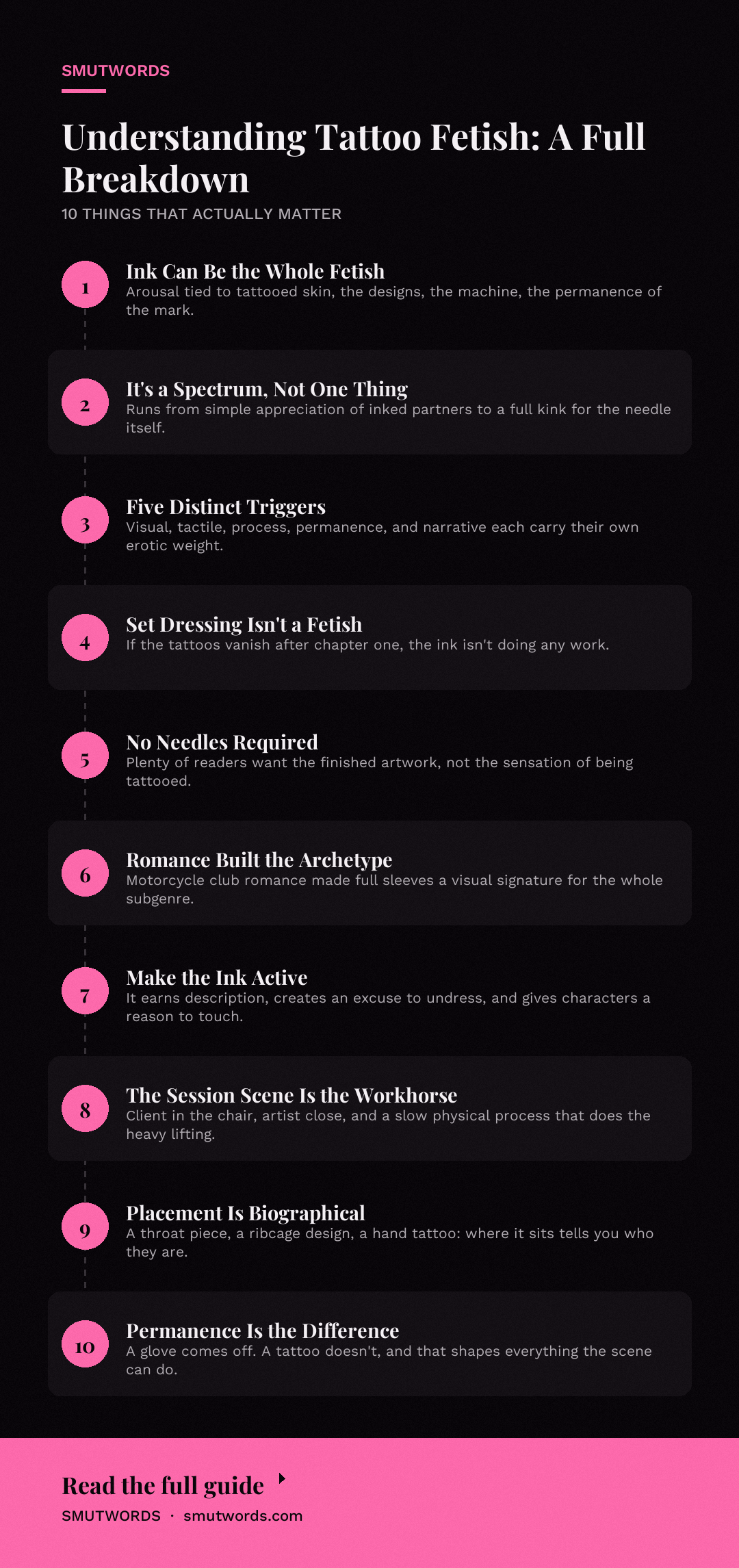
A tattoo fetish is arousal tied to ink: the look of tattooed skin, the specific designs and where they sit on a body, the buzz of the machine, the ritual of the chair, the permanence of a mark someone chose to carry. It runs from simply finding heavily tattooed partners irresistible to a full-blown kink for the process itself, needle included.
In erotica it shows up as a whole cluster of triggers at once, visual, tactile, and psychological. That's what makes it one of the most flexible fetishes a writer can put on the page.
What Tattoo Fetish Actually Means
The plain-language version: a tattoo fetish is a fascination with tattoos and tattooed bodies where the ink, or the act of getting inked, becomes a source of intense arousal. That definition covers a wide spectrum of experience.
At the mild end sits tattoo appreciation, which is mostly aesthetic. You gravitate to inked partners, you notice sleeves and sternum pieces and script along a collarbone, and the ink is part of what makes someone sexually compelling. At the far end sits ink play and permanent mark kink, where the needle, the pain, the decision to be permanently altered, and the ownership implied by a mark all carry erotic weight.
Several distinct elements can turn someone on, and most people with a tattoo fetish respond to some combination rather than all of them:
- Visual: the composition of ink on skin, the contrast against bare skin, the way a design follows a body's lines, a sleeve bared in a rolled-up shirt.
- Tactile: raised scar tissue under a fingertip, the texture of ink over a shoulder blade, tracing a design with a tongue.
- Process: the machine's buzz, the sting, the stillness required of the person being marked, the exchange of trust between artist and client.
- Permanence: the knowledge that a mark stays, that someone chose to alter their body this way and for this reason.
- Narrative: what the ink says about a person, their history, their losses and appetites and affiliations, all catalogued in plain sight.
What doesn't count is equally useful for keeping the definition sharp. A character with one tasteful quote on a wrist who happens to be hot does not make a tattoo fetish novel. The ink has to matter on the page: it should be described, noticed, responded to, used as a hook for desire. When the tattoos vanish after the character introduction and nobody in the story is actively turned on by them, that's set dressing, not a fetish.
The other common misconception is that a tattoo fetish necessarily involves needles or pain. Plenty of readers with this kink have no interest whatsoever in the sensation of being tattooed. They want the finished artwork, the visual and the story attached to it.
Others are drawn almost entirely to the session itself. Both are legitimate versions of the same fetish.
Where Tattoo Fetish Comes From
Ink and desire have been linked for as long as people have been marking their bodies. Sailors, circus performers, and criminals carried tattoos as markers of identity for centuries, and the sexual charge attached to the "dangerous" tattooed body is old. Japanese *irezumi* backs, full-body suits worn by gangsters and laborers, gave the Western imagination a template for the tattooed man as powerful, criminal, and exciting.
As a recognizable topic in erotica and romance, though, tattoo fetish is a publishing phenomenon of the last few decades. The mid-twentieth century was hostile to visible ink, and a tattooed woman in a midcentury novel usually signaled loose morals, and not in a fun way. The countercultural 1970s and the punk and gay leather scenes of the 1980s began reclaiming tattoos as a sign of defiance and sexual autonomy.
The real shift happened in romance publishing. In the 2000s and 2010s, the tattooed love interest became a reliable shorthand for the bad-boy archetype. Motorcycle club romance, in particular, made full sleeves and chest pieces the visual signature of a whole subgenre, and the parlor scene turned into a standard set piece.
TikTok and Instagram reels of ink sessions, with the sound turned up, pushed the fetish into mainstream awareness. A generation grew up watching needles trace lines on skin in high definition, and erotica adjusted accordingly. Modern tattoo fetish scenes are more detailed about the process than the books of ten years ago: they name machines, mention ink cups, describe the wipe of green soap, and treat the whole appointment as an erotic sequence in its own right.
How It Shows Up in Erotica
The best tattoo fetish writing treats ink as active. It does things on the page: it earns a slow, detailed description that functions as foreplay, it creates an excuse for undressing (the shirt comes off to show a back piece, not just to get naked), and it gives characters a pretext for urgent, specific touch. A fingertip tracing the line of a sternum design moves a scene forward in a way that generic "he touched her" never does.
The Session Scene
The tattoo parlor scene is the workhorse set piece of the genre. Someone is in the chair, the artist is close, and the intimacy of the situation carries the erotic charge.
The client holds still while the needle works. The artist studies their skin. The buzz fills the room. Conversation happens at close range and low volume.
What makes a strong version of this scene work is ratio. The physical process is intensely sensory, so writers who slow down and trust the detail get enormous payoff from a page of description: the stencil, the first line, the way skin raises and reddens under the machine. Where the tat can feel like foreplay, the anticipation itself will do the heavy lifting.
The Cataloguing Scene
Another mainstay: one character unwraps another, literally, by asking about each piece of ink. The undressing becomes a narrative tour instead of a striptease, each tattoo prompting a story, and the intimacy ratchets up with every question.
This structure gives you enormous mileage, because it creates legitimate, non-awkward dialogue that gets two characters physically close and emotionally open at the same time. A tattoo on a rib prompts a conversation about why it's there. The answer tells you who this person is. The physical proximity of the question delivers the charge.
Marking and Ownership
A darker variation plays with the permanence angle: a character who wants to be marked, branded, claimed in a way that lasts. This edges toward consensual ownership themes and overlaps with body modification interests. It also dovetails with the slow-burn dread of a character who chose a tattoo in a past life they now regret, or that connects them to a group they want to leave.
Used well, the marking theme can cut through to something genuinely intense: a desire for permanence in a person too used to being left. Writers who use it as a shortcut to possessive dialogue without building that emotional undercurrent will produce something flatter.
Overlaps and Variations
Tattoo fetish plays well with other kinks in fiction. In a mirror play scene, a tattooed character can be made to watch their own ink during the action, which doubles the visual charge.
Anyone writing a high heel fetish scene next to a tattoo fetish scene will notice how similarly they work: both let an object on the body do a lot of narrative lifting, and both reward a writer willing to describe the details precisely instead of in general terms. Hair fetish is another good structural companion, because both involve adornment chosen and worn on the body as an extension of personality.
The dark, edgy quality that readers associate with tattoo fetish pairs equally well with the consensual pushing-and-yielding dynamic in brat play. An inked character who tests limits and teases their partner can be written with all the charged specificity of a good tattoo scene. The same "chosen and permanent" energy also translates into rope work, which has its own tradition of decorating a body with intention; see shibari vs rope bondage.
Enjoyed this? Get a free book.
Join the list and we will send a complete free story straight to your inbox, plus new releases every week after that. No credit card, no catch.
Some writers push the sensory range further with ash kink, using the scent and texture of the parlor itself as a full sensory motif.
Others draw on the tactile, hands-on charge of food play, because both depend on the body as a work surface, something to be read and tasted and traced. The overlap with body fluid kink also comes up in ink sessions: sweat, the sting, the raw physicality of a long session leave a body in a state that can be written quite explicitly.
What Makes It Work vs. What Falls Flat
Flat tattoo fetish writing uses the tattoo as a label and nothing more. The character "has a lot of ink," which is shorthand for dangerous, and the ink is never described, noticed during sex, or offered as anything but costume.
Strong writing gives the tattoo its own personality. The design matters. Where it sits on the body matters. How it feels under a mouth or a thumb matters.
The scene needs to make the ink feel alive, like a character all its own in the room.
The question of who is actually turned on by the ink matters too. Does the inked character enjoy being looked at? Does the observer get to be openly greedy about it?
Once those appetites are established, the scene has somewhere to go. A tattoo you can touch is more interesting narratively than a tattoo you can only see.
The Sensory Details That Earn the Fetish
Good tattoo fetish writing means getting the details right. Use the buzz of a coil machine and the higher whine of a rotary. Describe the smell of green soap and ointment. Aim for the roughness of a fresh tattoo under a sheet, the slight heat of it.
Remember the specificity of placement: a hand tattoo that's a conversation starter at work, a throat piece you'd never spot from across a room, a ribcage tattoo that only shows when someone reaches up. Placements are biographical. Use them.
Freshness matters too. A fresh tattoo moves differently under the skin. It's a temporary vulnerability that can last two weeks.
A healed tattoo has settled into the body. Both are worth writing.
Tattoo Fetish vs Glove Fetish
These get compared because both involve adornment worn on the body as a source of arousal, but the confusion ends there. A glove fetish (see glove fetish) is about a removable object: the charge belongs to the glove, to the way it conceals and transforms the hands, and the whole erotics can be put on a nightstand afterward. Tattoo fetish is about what cannot be removed.
The permanence is the erotic engine. A glove comes off. A tattoo doesn't. That difference shapes everything a scene can do: glove play lives in a single unchanging scene, while ink invites the long reveal, the history, the "who were you when you got this."
Frequently Asked Questions
Is a tattoo fetish the same as a body modification fetish?
They overlap but aren't identical. Body modification covers a broader range of permanent alterations, including piercings, scarification, and more extreme procedures. Tattoo fetish is specifically about ink and the tattoo process.
Can you have a tattoo fetish without liking pain?
Yes, and it's common. Many people with this fetish are drawn to the visual and emotional qualities of tattoos without any interest in the physical sensation of being tattooed. The arousal comes from the art, the mark, and the meaning.
Why do so many romance heroes have tattoos?
Tattoos encode a cluster of attractive traits fast: a dangerous past, physical confidence, chosen identity over inherited respectability. Publishers figured out they signal "bad boy" and "self-authored" in a single visual shorthand, so they became genre furniture.
Is a real tattoo parlor ever a safe space for a hookup?
Real parlors have strict hygiene protocols, and no ethical artist mixes work with sexual contact during a session. The parlor hookup is a fiction convention; write it as fantasy or set the scene outside business hours, and don't confuse the two.
What's the appeal of the tattoo machine sound?
The buzz is the sensory signature of the whole ritual. It signals intensity, closeness, and a chosen pain in one sound. For many people with a tattoo fetish, the sound alone is enough to trigger arousal, before any ink is on skin.
Can you build a tattoo fetish scene without any needle?
Absolutely. Tracing a healed back piece, discovering a hidden tattoo under clothing, or having a character explain each design while undressing makes for an intense scene with no needle anywhere. The ink does the work, whether or not a session is depicted.
Final Thoughts
Tattoo fetish appeals because ink tells a story no other visual can match. It's permanently worn, personally chosen, and physically present in every intimate moment. A character's tattoo is never just decoration.
If you want to read a novel that does the whole thing properly, the ink is in the details. Find one where the parlor scene runs long enough to hurt, and the mark stays visible in the dark.






Loading comments…