
Why the Captor to Protector Romance Works So Well
The appeal sits in a few specific places. Name them, and the whole thing stops feeling weird and starts feeling obvious.
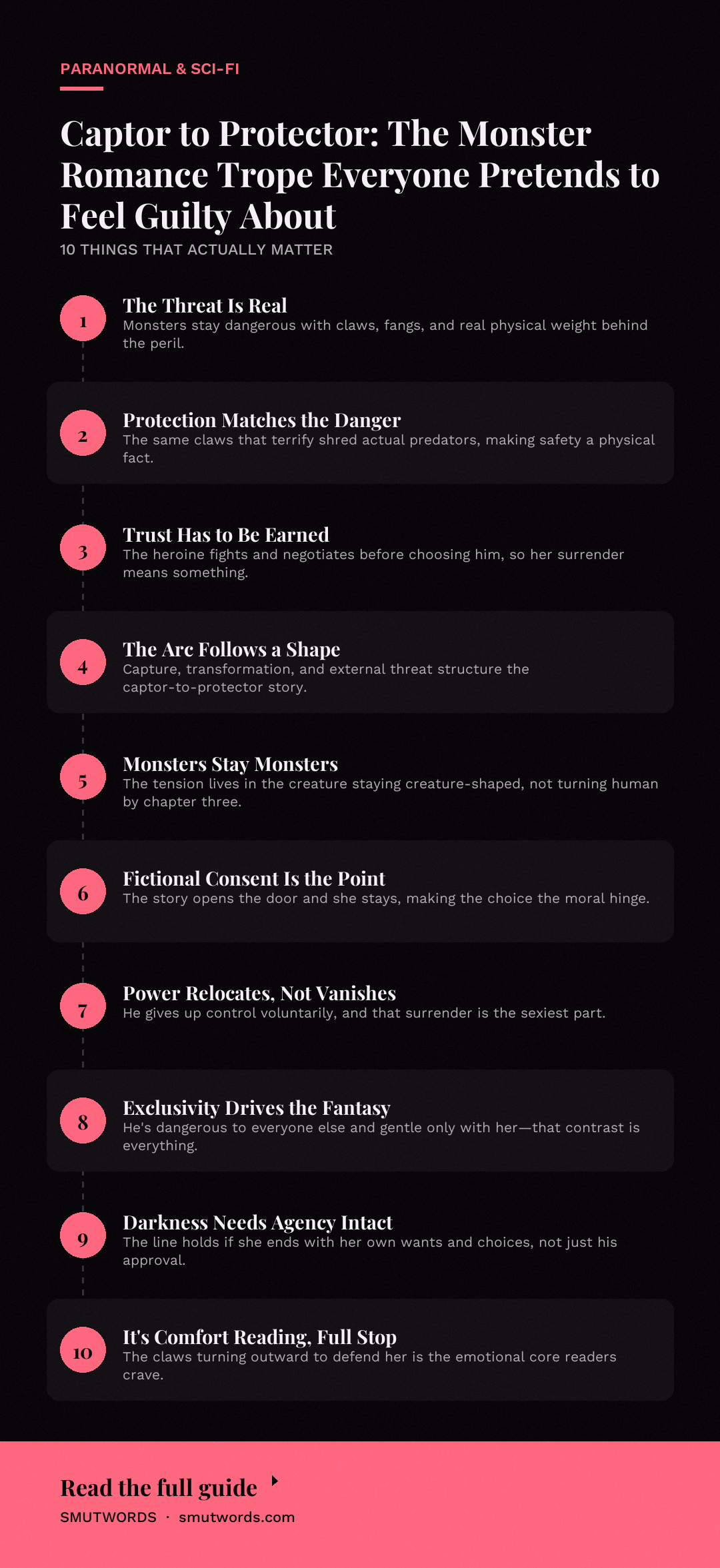
First, the threat is real. The monster is genuinely dangerous. He has claws, fangs, tentacles, a second head, a breeding organ that could split you in half, all of it. The stakes aren't decorative. When he looks at a female and sees a potential mate, the reader believes the danger because the author put real weight behind the creature design. That's what separates this trope from a standard billionaire romance where the "danger" is a contract dispute. The peril is physical and present.
Second, the protection is proportional to the threat. The same claws that terrify you are the ones that shred an actual predator who comes near. The same teeth that could tear out a throat are the ones that groom your hair. This is where the fantasy gets its teeth. Here, nobody can hurt her because she belongs to the biggest monster on the block. The heroine gets to experience safety as a physical fact rather than an emotional aspiration. The size difference romance trope plays a big role here. A creature who towers over you and could crush you with one hand making himself impossibly gentle is the whole ballgame. Our guide to why bigger feels safer covers exactly why readers find that more protective than threatening.
Third, the trust has to be earned. The heroine doesn't fall for her captor on page one. She fights, she panics, she tries to escape, she negotiates, she slowly realizes that the monster who took her is also the only thing standing between her and something worse. That slow burn of earned trust is the emotional engine of the whole genre. The captor to protector romance works because the heroine's eventual surrender means something. She's not giving in because she has no choice. She's giving in because she chose to. That choice lands harder when the alternative was genuine terror.
The Relationship Arc: From Threat to Safe Haven
The structure of these stories tends to follow a recognizable shape. Recognizing the shape is half the fun.
The opening establishes the capture. He takes her for a reason. She's his fated mate, she wandered into his territory, she was offered as a sacrifice, she's the only compatible female in the sector. The reason matters less than the result. She's in his space, and she's scared. Good authors make the fear specific. She notices the size of his hands, the way his eyes track her, the sounds he makes when she moves. The threat is tactile.
The middle is where the transformation happens. He brings her food. He shows her which parts of the cave are safe. He kills something that would have hurt her. He touches her gently and watches her reaction. She starts to sleep through the night. The language shifts from "captive" to "guest" to "mate." This is the section where the best books earn their place. The monster doesn't suddenly become a soft human man. He stays a monster. He just starts using his monstrosity in service of her.
That shift is the entire fantasy.
The climax usually involves an external threat. Someone else wants her, or her extraction team shows up, or the environment turns hostile. The monster fights for her, and she sees what he is when he's protecting rather than capturing. That's the moment the reader has been waiting for. The payoff is almost always worth it.
How to Spot a Well-Written Version
Not every captor to protector romance lands the fantasy. Some books fumble it, and it's worth knowing the difference so you don't waste an evening.
A good version has:
- A monster who stays a monster. If he becomes a handsome human man by chapter three, the trope collapses. The tension lives in the creature staying creature-shaped.
- A heroine with agency. She resists, negotiates, and eventually chooses. A passive heroine who just lies there makes the whole thing hollow.
- A real external threat. The protection needs something to be protective against. If nothing ever threatens her, the protection is just theater.
- Consent that's actually earned. The scenes work when she's asking for it, not when he's taking it. The captivity is the setup; the choice is the payoff.
- An author who understands the difference between fiction and endorsement. The best books never moralize, but they also never pretend the dynamic is simple.
A bad version, by contrast, has a hero who never changes, a heroine who never says no to anything, or a story that can't decide if the captivity is supposed to be sexy or terrifying. When those books fail, they fail spectacularly. Readers correctly call them out for it.
Fictional Consent and Why It's Not a Problem
The elephant in the room deserves a direct answer, because pretending it isn't there makes the discussion dishonest. Consent in a captor to protector romance is fictional. That's the point.
The heroine can't meaningfully consent while she's literally imprisoned. The book knows this, and the reader knows this. The narrative handles it by making the consent happen after the power balance shifts. He releases her. He tells her she can leave. He opens the door. She stays. That moment, when the captivity stops being captivity and becomes an offer, is the moral hinge of the whole trope. A well-written story makes that hinge visible.
Nobody reads these books and thinks real-life kidnapping becomes romance if you wait long enough. Readers are adults. Adults can hold the difference between a fantasy about a tentacled alien who claims a mate and a real-world crime. Fictional consent is a storytelling device. It lets authors explore the texture of trust and submission without the legal and moral weight of an actual violation.
The books themselves handle this with remarkable consistency. The heroine is always an adult. The monster is always clear about his intentions. The sexual encounters, once they start, are mutual in a way that the capture never was. The captivity is the backdrop; the choice is the foreground.
Famous Examples of the Captor to Protector Dynamic
The trope is all over monster romance and alien romance. The variations are worth mapping.
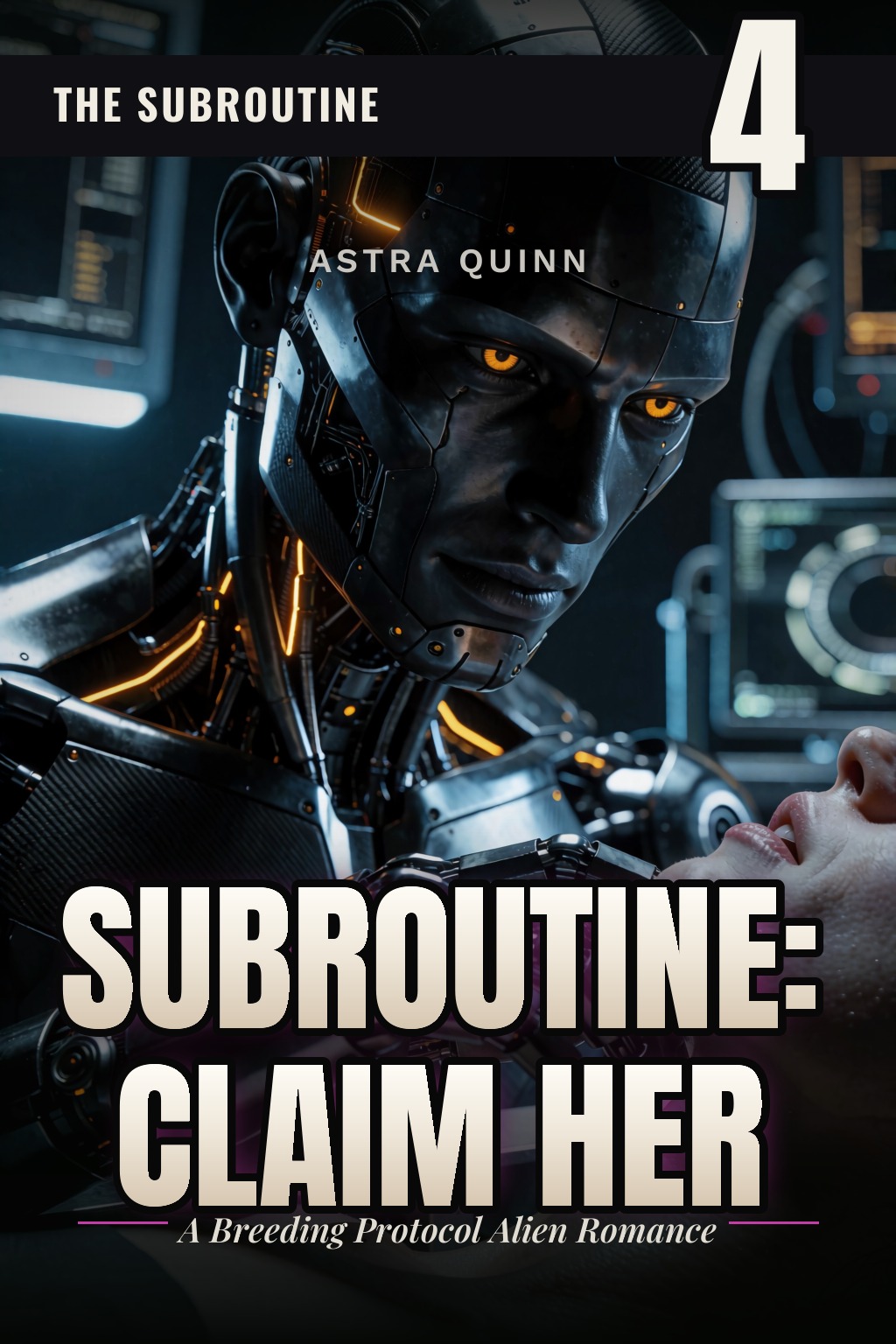
The breeding chamber variant does a lot of heavy lifting here. Books like Star Sower: A Captive in the Tentacle Alien Breeding Chamber and Planet of Orgasms take the captivity and make it explicitly reproductive. The monster doesn't just want her company. He wants to breed her, and the story has to walk the line between coercion and growing affection. The alien breeding romance books subgenre has made this dynamic its entire brand. Our breakdown of why that became so popular gets into the biological urgency that makes the captor's motivation feel fated rather than predatory.
The royal or god-tier variant gives the captor cosmic weight. When the monster is a king or a celestial being, the stakes inflate proportionally. Taken by the Celestial King plays this card beautifully. The captor's protection becomes a matter of cosmic order, and the heroine's acceptance carries weight beyond her own survival. The celestial scale makes the trust feel bigger.
The military or officer variant reframes the dynamic through command structures. Officer's Orders: Breed Her leans into the authority fantasy. The captor is also the one giving orders, and the protection is as much about maintaining control as it is about keeping her safe. The discipline angle adds a different texture to the trust building. This one overlaps with power exchange in a way that readers of organized kink will recognize instantly.
The womb-centric variant is the most overtly reproductive. Worship The Womb treats the heroine's fertility as the treasure the monster protects. That pushes the dynamic toward reverence rather than possession. The captor becomes a guardian of her body's purpose, and the protection reads as worship.
The heat or rut variant gives the monster a biological clock. Extraterrestrial Heat puts the captivity inside a mating cycle. The monster's urgency is hormonal, and the heroine has to decide whether to ride it out or embrace it. The protection here is as much about the monster protecting her from his own instincts as it is about external threats. That's a fun twist on the usual shape.
Power Dynamics and the Appeal of the Dangerous Protector
The captor to protector romance is, at its core, a story about power changing hands. The captor holds all the cards at the start. He has the strength, the position, the control. The heroine has nothing but her wits and her fear.
Enjoyed this? Get a free book.
Join the list and we will send a complete free story straight to your inbox, plus new releases every week after that. No credit card, no catch.
The transformation happens when he gives up some of that power. He listens to her. He changes his behavior to accommodate her. He protects her from things that would never have threatened him. The power doesn't vanish. It relocates. Suddenly, she has influence over him that he gave her voluntarily. That voluntary surrender is the sexiest thing in the genre.
This is why the trope pairs so naturally with the fated mates alien romance framework. When the bond is fated, the power shift feels inevitable rather than earned. That removes some of the consent pressure. Our guide to fated mates and instant bonds covers how that device lets authors skip the "why would she stay" question and jump straight to the "how does she learn to trust him" question. The fate does the setup; the relationship does the work.
The appeal of the dangerous protector specifically lies in the exclusivity. The monster is dangerous to everyone else and gentle with her. That contrast is the entire point. She gets to be the one person who sees the soft interior, who gets the careful touch, who hears the low voice that only rumbles when she's nearby. The rest of the universe gets the claws. She gets the palms.
What Readers Actually Want From This Trope
The captor to protector romance is not a niche curiosity. It's one of the most reliable draws in monster romance because it hits a specific cluster of needs that other tropes can't replicate.
Readers want the adrenaline of the initial threat without the real-world consequences. The fear is a spice, not the main course. They want to feel the danger and then feel the relief when the danger redirects. They want the fantasy of being so valuable to someone that they would burn the world down to keep you safe. They want the trust to be difficult to earn and therefore worth having. They want the monster to remain monstrous while becoming devoted.
The trope also scratches an itch around being seen. The heroine in these books is usually ordinary. She's been overlooked or undervalued. The monster sees her as the most important thing in existence. The captor to protector romance is wish fulfillment about being the center of someone's entire universe. The fact that he happens to be an eight-foot creature with scales doesn't diminish that. It amplifies it.
The Darker Variants and Where the Line Gets Drawn
No honest discussion of this trope skips the darker territory. There's a spectrum here, and where a given book lands on it changes everything.
On the light end, the captivity is almost performative. The monster takes her, but he's immediately gentle, clearly protective, obviously smitten. The threat is theoretical. These books are comfort reads with a kidnapping wrapper.
In the middle, the captivity has real teeth. She's scared, she fights, she genuinely doesn't know if he'll hurt her. The trust has to be built over chapters. This is where the best writing lives, because the author has to hold the tension between the threat and the growing affection without breaking either thread.
On the dark end, the captivity is genuinely brutal. The transformation is slow, painful, and not always complete. These books are for readers who want the full catharsis of watching a monster claw his way toward humanity. They're not for everyone. That's fine. The genre has room for the full spectrum.
The line gets drawn at whether the heroine's agency survives intact. If she ends the book as a person with her own wants, her own choices, her own power, the story works regardless of how dark the start was. If she ends up as a prop, a possession with no interiority left, then readers drop those books fast. They know the difference.
Related Tropes That Orbit the Same Territory
The captor to protector romance doesn't exist in a vacuum. It clusters with a few other dynamics that readers of this genre will already recognize.
The Gothic romance lineage runs parallel at every point. The brooding figure in the isolated castle who might be a monster and might be the only protection you have? That's the original shape of this dynamic, just with less tentacles. The captor to protector is the monster romance's version of the gothic antihero. The structural similarities are hard to miss.
The billionaire romance connection is more about the power imbalance than the physical threat. The billionaire holds financial and social power over the heroine. When he shifts from using that power to protect her, the dynamic mirrors the captor to protector arc almost beat for beat. The monster just makes the threat more literal.
The touch-starved monster trope overlaps heavily, especially in the middle section where the monster is learning how to care for her. That careful, hesitant physicality is a huge part of why the protection reads as genuine. Our piece on why the touch-starved monster works so well is basically a companion essay to this one.
The Psychological Comfort of Being Protected
Let's be honest about what the captor to protector romance actually provides on a psychological level. It's comfort reading, full stop.
The fantasy of protection is one of the most primal fantasies there is. Everyone wants to believe there's someone who would step in front of the danger, who would make the world less frightening, who would be strong enough to handle the bad things so you don't have to. The captor to protector romance hands that fantasy a monster-shaped body and a genuinely threatening world. Then it lets the monster be the shield.
The captivity is the tension device. The protection is the payoff. The reason readers keep coming back isn't the kidnapping. It's the moment when the threat turns outward and the monster becomes a defender. That moment, when the claws that could have hurt her are instead dripping with the blood of something that tried, is the emotional core of the entire trope.
There's also a deep-seated appeal in being desired so completely that someone's entire biological imperative reroutes toward your safety. The monster doesn't protect her because it's the right thing to do. He protects her because she is his. That possessive desire re-coded as protective devotion is the whole fantasy.
Final Thoughts
The captor to protector romance is a genre staple for a simple reason: it works. The danger is real, the trust is earned, and the protection is the point. Readers can hold the difference between fiction and reality without having it spelled out for them. The fantasy of being the one person a dangerous monster chooses to protect is universal, primal, and endlessly repeatable.
If you want to see the trope done right, start with Star Sower. It hits every beat of the captor to protector arc, keeps the monster genuinely monstrous, earns the trust over the course of the story, and lands the protection fantasy hard. It's the kind of book that reminds you why this trope owns the genre.





Loading comments…