
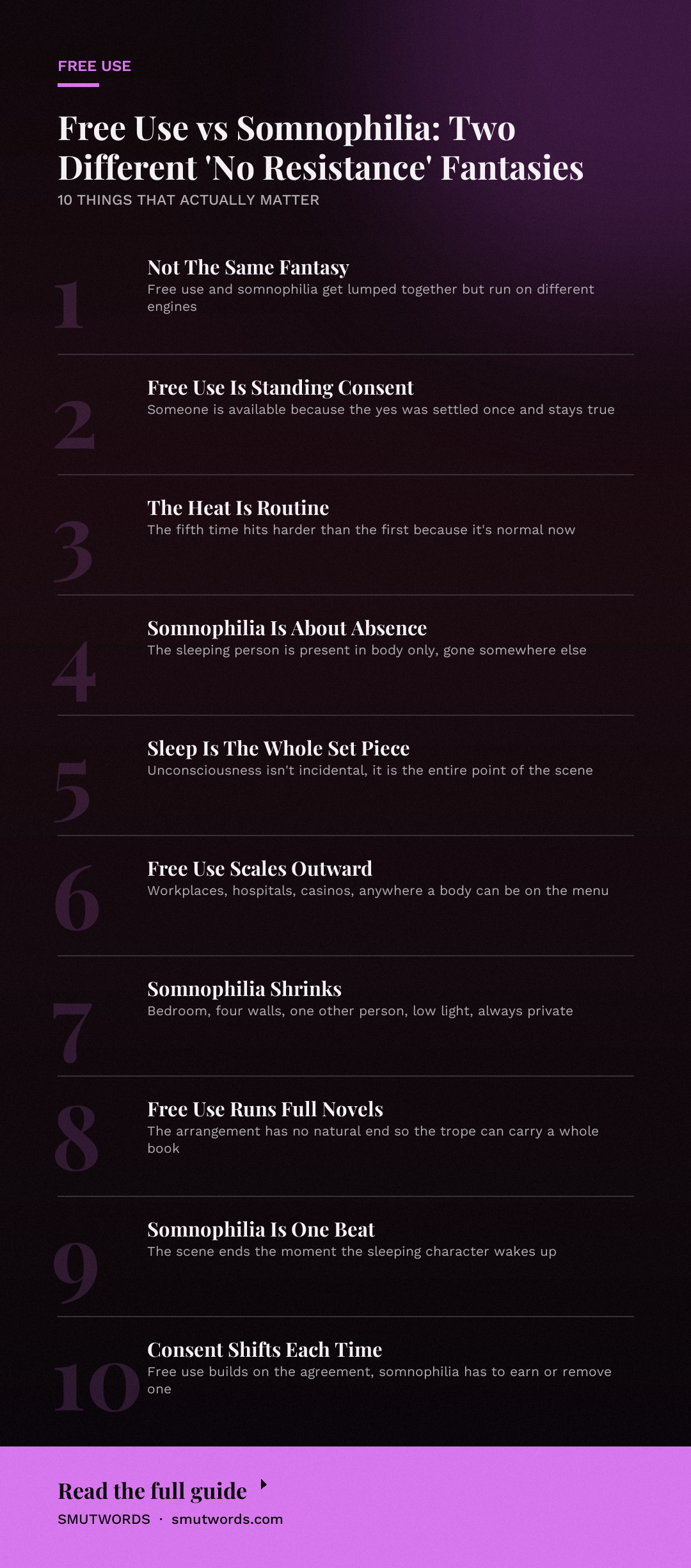
People lump these two together constantly, and it's a category error worth untangling. Free use and somnophilia both get filed under the same lazy shorthand: nobody says no because nobody's being asked. That's where the similarity ends.
One is a fantasy about a standing arrangement, a body available on demand, no negotiation required because the negotiation happened once and never stopped being true. The other is a fantasy about a specific state, unconsciousness, and everything that state implies about who's present and who isn't. The free use somnophilia difference isn't a technicality. Get it wrong and you're writing two scenes that don't actually know what they're doing.
Both sit on the same shelf of "no resistance" stories. Readers who want one often want the other, which is probably why they get conflated. But the mechanics underneath are doing completely different work. If you're picking something to read tonight, knowing which engine you actually want running matters more than the tags suggest.
What Free Use Actually Means
Free use is about standing consent that's been pre-established and doesn't get renegotiated every time. Someone is available.
That's the whole premise. The arousal comes from the arrangement being permanent and unremarkable, the way a kitchen is available, the way a chair is available. Nobody asks. Nobody needs to.
The heat is in the mundane-ness of it. A wife who's simply accessible whenever her husband wants her, mid-conversation, mid-chore, no preamble. A workplace where a specific employee's body is part of the office furniture, so to speak. If that's the version you're after, Workplace Free Use: The Office Version of the Fantasy covers how the trope plays out when the setting is a desk and a lunch break rather than a bedroom.
What makes free use tick isn't the shock of a single event. It's repetition. The fifth time hits harder than the first because by then it's routine, and routine is the actual kink. Free Use Nurse: A Hospital Free-Use Fantasy leans into that: a shift that never ends, a body that's just another piece of equipment on the ward, patients or staff cycling through without ceremony.
Consent in free use is real, just settled in advance. That's the whole architecture. The character said yes once, in a way that keeps saying yes, and the story works because we trust that. If you want the version of this that's messier about the consent question, that's a different trope entirely, and CNC Explained: What Consensual Non-Consent Actually Means in Fiction breaks down where the line sits.
What Somnophilia Actually Means
Somnophilia is narrower and stranger. It's specifically about sex with someone who is asleep, or being the person who's asleep while it happens. The state of unconsciousness isn't incidental to the fantasy. It's the entire point.
That changes what the scene is about. Free use is a story about availability. Somnophilia is a story about absence, the other person being gone somewhere, present in body only, and what that does to both parties.
There's a softness to a lot of it, a slow carefulness, hands moving quietly so nobody wakes up. There's also a colder version where the thrill is exactly that they won't wake up, and the story leans into the wrongness of that on purpose.
Sleep as a state is doing something free use can't do, because in free use the other person is awake, aware, and choosing to stay in the arrangement. In somnophilia they're not choosing anything in the moment. The choosing, if it exists, happened hours earlier, or exists as a blanket permission between partners who trust each other. The unconscious body is the whole set piece.
The Actual Difference, Side by Side
Strip both down and they're solving for different things. Free use asks: what if access never needed asking? Somnophilia asks: what if the other person isn't there to respond at all?
- Free use runs on a standing arrangement. The consent is ongoing and public to the relationship, so to speak. The heat is in the routine.
- Somnophilia runs on a specific physical state. Sleep, unconsciousness, the body limp and unresponsive. The heat is in that unresponsiveness.
- Free use can happen anywhere, in front of anyone, because the arrangement is known. Public Use Fantasy: Why Free Use Works Better in the Open digs into why the trope gets hotter with an audience, and it's a good illustration of how free use scales outward.
- Somnophilia almost always happens in private, usually between two people who know each other. The intimacy is the private room itself, not the fact that others might see.
- Free use implies multiple partners or one persistent partner cycling through, repeatedly, until the arrangement is the story.
- Somnophilia is typically singular. One sleeping person, one other person, one event. The scene ends when they wake or when the act is finished.
Both are "no resistance" fantasies on the surface. Free use gets its charge from permission that doesn't need renewing, and somnophilia gets its charge from the total absence of any response at all.
Where They Overlap and Where They Don't
They cross paths in one specific spot: a free use arrangement where the available person is also asleep. Someone's body is accessible on standing consent, and they happen to be unconscious when it's used.
That's a real overlap, and it's a popular combination because it doubles the fantasy, standing permission plus absence of response. Free Use Vampire Coven: A Dark Paranormal Submission Fantasy plays with something adjacent, an arrangement that spans a household of predators and a human who's basically living furniture. The sleep angle isn't required, but the fantasy next door to it is exactly the "body available while not fully present" thing.
Where they don't overlap is everything else. A free use story with everyone awake isn't somnophilia. A somnophilia scene between two people who've never discussed a standing arrangement isn't free use.
People conflate them because both involve a body that isn't actively objecting, and that's a shallow reading. Objecting and responding aren't the same thing, and the two tropes are built on opposite sides of that distinction.
Why Readers Want One and Not the Other
If you're drawn to free use, you're probably after the surrender of negotiation itself. Not the shock of a single scene, but the comfort of never having to ask again. The characters have already agreed, and the story is about living inside that agreement.
That's why so much free use fiction is domestic or workplace, low-key on the surface, nasty in the specifics. Free Use Households: The Family or Roommate Version of the Trope takes the arrangement and puts it inside a living situation so ordinary that the whole thing reads like a chore chart.
Somnophilia readers are after something else. The scene is quiet, usually one-to-one, and the tension comes from proximity to a waking person, the risk of them surfacing, the fact that they don't. It's a gentler trope on the surface and a heavier one underneath, because the consent question is doing so much more work.
Neither is better. They scratch different itches, and knowing which one you actually want saves you from the disappointment of picking up a "free use somnophilia" recommendation and finding out the book only ever delivers one of them.
Enjoyed this? Get a free book.
Join the list and we will send a complete free story straight to your inbox, plus new releases every week after that. No credit card, no catch.
The Consent Architecture Is Different
In free use, consent is the foundation. The arrangement exists because everyone agreed, and if a free use story works, it's because that agreement is believable and being honored. The kink is the agreement itself, not anything that undermines it.
In somnophilia, consent has to be built into the world in a way that makes the sleeping body make sense. Two partners who've agreed they're fine with being used while asleep. A fantasy universe where sleep sex between established partners is normalized. The somnophilia story has to do a little more work up front because "they're asleep" doesn't include a no by default, which means the story has to earn one, or explicitly remove it as a concern.
Some somnophilia fiction leans into the ambiguity on purpose, playing with the exact territory CNC covers. That's not a problem for readers who know what they're picking up. It's only a problem when the story pretends the ambiguity isn't there, or when a reader comes in expecting free use's clean standing-consent model and gets something that's actually sitting in a murkier register.
Free Use Doesn't Require Unconsciousness
One quick myth to clear: free use has nothing to do with sleep. A free use character can be wide awake, mid-sentence, mid-argument, and that's exactly the fantasy.
The waking awareness is part of the appeal, because the character is choosing to stay available every single time, and that repeated choosing is what the arrangement rests on. Free Use County Fair: A Public Free-Use Exhibition Fantasy is a good example: the subject is fully conscious, fully present, and the whole thing runs on an arrangement that's out in the open.
Somnophilia doesn't require a standing arrangement either. Someone can be asleep without any prior agreement existing between the two people involved, which is why the trope can be much darker than free use tends to run. Free use usually has a floor of established consent. Somnophilia sometimes does, and sometimes the story deliberately doesn't provide one, so the reader knows the terrain they're on.
If you want to sort through the full range of free use titles without the sleep angle muddying the search, 50 Best Free Use Books You Can Read This Year is a decent starting list.
Setting Changes the Trope
Where the story happens tells you which fantasy you're in. Free use scales outward, into public spaces, workplaces, hospitals, casinos, anywhere a body can be on the menu without anyone blinking. Free Use Airport Lounge puts the arrangement in a transient space, strangers cycling through on their way somewhere else, and the trope gets its charge from the setting's coldness.
Free Use Casino does the same thing with money and vice layered on top. Free Use Doctor: A Dark Medical Free-Use Fantasy leans into the authority structure of a medical setting, which is part of why it reads darker than the average free use title. Call it a forced proximity effect if you want the romance-novel term for it: tight spaces and repeated contact making the arrangement feel inevitable.
Somnophilia doesn't scale that way. It shrinks. Bedroom, four walls, one other person, low light. The setting is almost never public because the whole trope depends on privacy and quiet.
Move a somnophilia scene into a crowd and it stops being somnophilia and starts being something else, probably closer to free use with a twist. That's a useful rule of thumb. If the scene could plausibly happen in front of witnesses without anyone objecting, it's free use. If the fantasy collapses the moment someone else walks in, it's somnophilia.
Character Dynamics Play Out Differently Too
Free use tends to build, over multiple scenes, into a shape. A character becomes furniture, or a wife becomes her husband's default, or an employee stops being a person with a cubicle and starts being a fixture. The arc, if there is one, is usually about how normal it's become.
That's why so many free use titles have a slow, domestic quality even when the content is filthy, and why a darker version can pull in a redemption arc romance structure if one of the characters has a reason to end the arrangement.
Somnophilia is a single beat more often than not. One night, one sleeping body, one other person, and the story resolves in the morning or before it. A somnophilia scene can absolutely be the hinge of a larger romance, but it rarely stays somnophilia for a whole book, because the moment the other character wakes, the trope is over.
Free use can run for an entire novel without ever leaving the trope. The arrangement doesn't have a natural end, which is why writers keep finding new settings for it, from the office to the hospital to a county fair that probably doesn't have a policy for this.
How to Tell Which One You're Reading
Scan the setup. If the story opens with an established agreement, a rule, a contract, a spoken understanding, you're in free use territory. The whole engine is already running before you turn the first page.
If the story opens with someone asleep and the other character in the room, you're in somnophilia territory. The setup is physical and immediate, and everything that matters is happening in the next few pages.
If it's both, the writer's usually placing the sleeping body inside a larger arrangement, which is a smart move because it lets the somnophilia scene borrow the free use story's consent scaffolding and get the darker register without losing the safety of a stated agreement. It's the rare case where the two tropes genuinely stack instead of competing.
Final Thoughts
If the free use side is what you actually wanted, start with Free Use Nurse and see how the trope handles a workspace where the arrangement is baked into the job. If you're curious about the overlap instead, Free Use Vampire Coven is the title that comes closest to the "available body, absent mind" territory the two tropes share.
Pick the one that matches the itch, and skip the rest.





Loading comments…