
Why Free Use Fiction Lives or Dies on Its World-Building
Free use world building is the load-bearing wall of the entire subgenre. Most readers can tell within two pages whether an author bothered to build it. The premise is simple on its face: in this world, anyone can use anyone sexually, whenever they want, with no permission required. That's the fantasy.
The problem is that a fantasy with no rules collapses into noise. A world with no reason for its rules reads like the author skipped straight to the good parts and hoped nobody would ask questions.
The authors who write this well understand something the rest don't. The justification isn't throat-clearing you get out of the way before the sex starts. It's what makes the sex land. Get it right and the reader stops wondering why and starts feeling the weight of the why.
The Three Main Justifications Authors Reach For
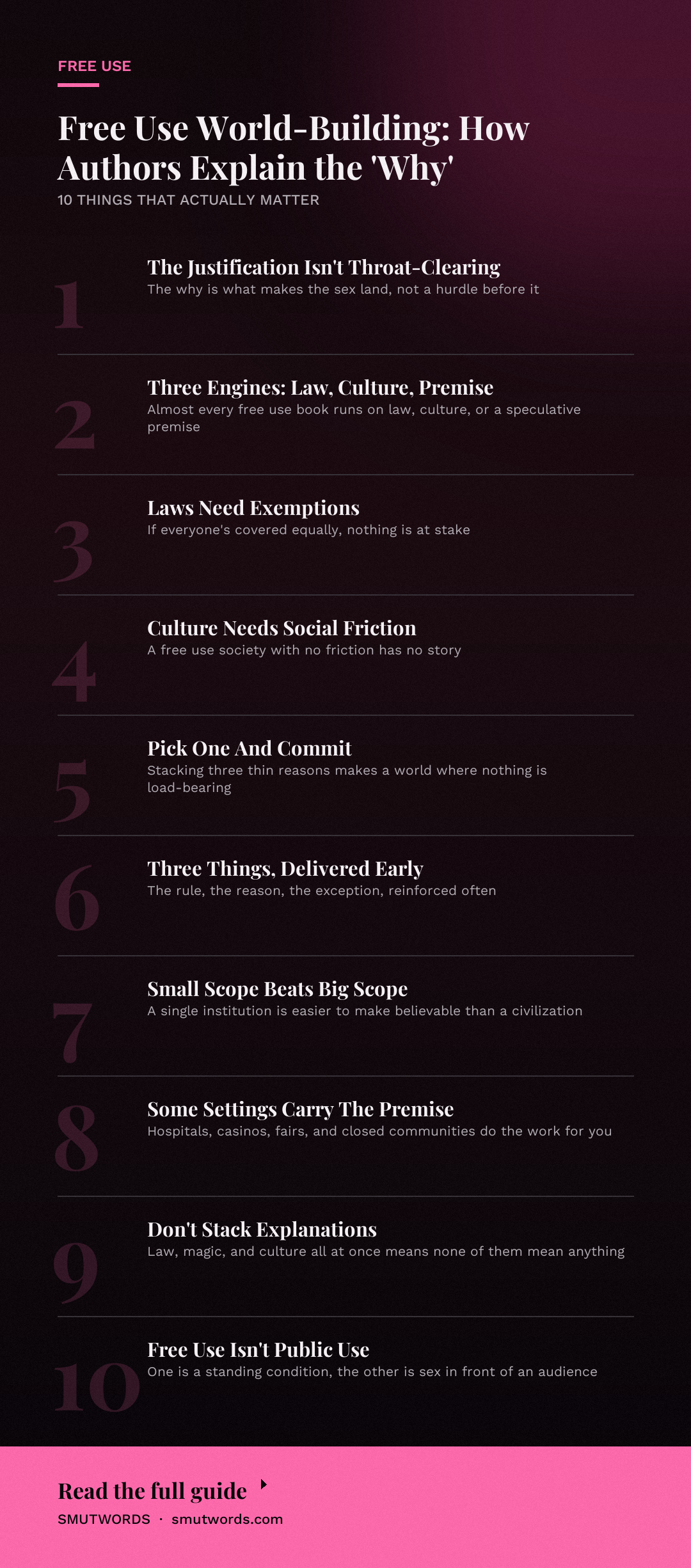
Almost every free use book you'll pick up runs on one of three engines: law, culture, or a speculative premise that makes the arrangement physically or socially necessary. Each one does different work, and the best authors pick one and commit hard instead of stacking all three until the world makes no sense.
1. The Legal Framework
This is the most common and the easiest to get lazy with. A government, a corporation, a dystopian authority passes a statute: free use is now the law, exemptions and all. The world operates under an explicit rulebook, and everyone in it knows the terms.
The strength here is clarity. The reader knows exactly what's permitted, which means the author can start violating expectations right away.
The danger is that a lot of writers treat "it's the law" as a complete explanation when it's barely a premise. A law needs a reason it passed. It needs an enforcement mechanism, and it needs to know who's exempt and why.
The exemptions are where the story lives. If everyone's covered equally, nothing's at stake.
Free Use Airport Lounge handles this well by keeping the scope small. It's a single location governed by its own rules, so the legal justification doesn't have to hold up a whole society, just a departure gate and everyone stuck behind it.
2. The Cultural Norm
No law, no enforcement, just a society that treats free use as ordinary. This is harder to pull off because there's no external authority doing the explaining for you. Everything has to be shown through how characters react, or don't react.
Cultural free use worlds are where the good stuff hides. The heat comes from the casualness. A character walks into a room and nobody looks up. That flat normalcy does more work than any statute, because it tells the reader this isn't a special event, it's a Tuesday.
The friction, when it comes, hits harder against a backdrop of people who genuinely don't think anything's happening. Where this fails is when the culture has no texture beyond "everyone's fine with it." Real cultures have etiquette, awkwardness, exceptions, people who opt out and people who judge. A free use society with no social friction is a free use society with no story.
3. The Speculative Premise
Magic, biology, sci-fi tech, a curse, a species trait. Something about the world makes free use inevitable rather than chosen. The vampires in Free Use Vampire Coven don't need a law to explain themselves. The premise does the work: the feeding, the hierarchy, the thrall dynamics, all of it flows from what these characters fundamentally are.
Speculative premises also open the door to genres that already run on their own internal logic. If the story leans into a parallel universe romance structure, the free use rule can be one of the differences between here and there, and the reader accepts it because they've already agreed to accept everything else about the world.
Why the Best Books Pick One and Commit
The failure mode you see over and over is a book that hedges. The author writes a law into the background, adds a magical explanation in chapter four, and tacks on a cultural justification somewhere in the middle, as if three thin reasons add up to one solid one. They don't. They create a world where nothing is load-bearing.
Picking one justification and committing means every scene gets to reinforce the same foundation. The law version gets courtroom drama, exemptions, corrupt enforcers, people who work the system. The cultural version gets social comedy, taboo-breakers, the one character who refuses. The speculative version gets lore, biology, hierarchy, the specific mechanics of how the premise works.
When you mix them, the reader never learns which rules matter, because every rule has an exception somewhere. The book stops feeling like a world and starts feeling like a vibe.
What Good Free Use World Building Actually Looks Like on the Page
You don't need fifty pages of exposition. You need roughly three things, delivered early and reinforced often.
- The rule itself. What's permitted, exactly. Who can do what to whom, and is there any version of "no."
- The reason. One sentence of history, biology, or decree. You don't need a thesis, you need enough that the reader's brain stops asking.
- The exception. A person, place, or circumstance where the rule bends or breaks. This is the story engine. Without it, you're just writing a description of a setting.
Notice what's not on that list: the moral justification. Free use fiction doesn't need to defend itself. The CNC framework that underpins a lot of this genre is understood by readers going in, and world-building isn't the place to re-litigate consent philosophy. It's the place to build a world where the reader can explore without being pulled out of it by a logic hole.
Small Scope Beats Big Scope
A lot of the strongest entries in this subgenre work because they set the free use rule inside a single institution. A hospital. A fairground. A casino floor.
The rule doesn't have to explain all of human civilization; it just has to explain this building and everyone currently inside it.
Free Use Nurse runs on the logic of a hospital where the clinical setting itself becomes the justification: bodies are already being handled, privacy is already compromised, and the free use rule slides in as an extension of the existing environment. Narrow, believable, and it never has to explain why the rest of the world plays along.
The Settings That Make Free Use Feel Inevitable
Some locations carry their own justification. You barely have to write a premise because the setting does the explaining for you.
Enjoyed this? Get a free book.
Join the list and we will send a complete free story straight to your inbox, plus new releases every week after that. No credit card, no catch.
- Hospital and clinic settings where the body is already the subject of the interaction.
- Casinos and nightlife where money, alcohol, and dim lighting already suspend normal social rules.
- Fairs and festivals where the temporary environment has its own etiquette and everyone's a stranger.
- Workplaces with hierarchy so baked in that the free use rule slots neatly on top of the existing power structure.
- Closed communities (coven, cult, family compound) where the outside world never has to be consulted.
Each of these does most of the world-building work before you write a word of it. The Free Use Casino doesn't need a legal framework because the casino already operates by its own rules. A patron who's already accepted the house edge on money will accept the house edge on everything else.
The same logic applies to Free Use County Fair, where the fairground is a temporary sovereign zone. Nobody goes to a county fair expecting the rules of the office to apply. That's the entire point of a fair, and the author gets to borrow that expectation for free.
Where Free Use World-Building Goes Wrong
The worst version of this genre explains everything and commits to nothing. The author is worried the reader won't buy it, so they keep offering new justifications. Law, check.
Magic, check. Cultural norm, check. By page thirty the world has so many overlapping explanations that none of them mean anything.
The second-most-common failure is the opposite. No justification at all.
The book opens and everyone's already fine with it, and the reader has to do all the work. Some readers don't mind. Most do.
When nothing in the world explains why this is normal, the sex scenes read like someone's scenario notes rather than a story.
There's also the tell of a first-time free use author: the justification arrives mid-scene, as an interruption. "Of course, in this country, the law permits..." inserted between two sex beats is a sign the author built the world backward. Get the rule in early, then let the scenes run.
The Connection Between World-Building and Genre Tropes
Free use overlaps heavily with other erotic subgenres, and how you frame the world determines which tropes fit. A dark medical free use story like Free Use Doctor runs on the same logic as redemption arc romance: the world is hostile, the character is compromised, and the arc is about finding some kind of understanding inside a system that wasn't built for it.
Other times, the free use world is closer to a billionaire romance setup, where one character controls the terms and the world-building is essentially a power structure with a name and a corner office. Same rule, different engine.
How to Tell Good Free Use World-Building From Bad
If you're scanning a new book and want to know within a chapter whether the author built the world properly, here's what to check:
- Is there a single stated reason? One sentence somewhere in the first few chapters that explains why this world works this way.
- Is the reason consistent? Does the story ever accidentally contradict its own premise, or do characters behave as if they forgot the rule?
- Is there a boundary? Even in a free use world, is there anywhere the rule doesn't apply? If not, chances are the story has nowhere to go.
- Do characters react like it's normal? Nothing kills the fantasy faster than a narrator who keeps reminding the reader how shocking this all is.
- Does the world have texture? Etiquette, exceptions, vocabulary, inside jokes. Small details signal the author actually built something.
The workplace version of the fantasy is a good stress test for all five. A corporate setting has hierarchy, rules, paperwork, HR, and a hundred small textures to draw from. If an office free use story reads like the author never thought about what happens on Monday morning, the world wasn't built.
Free Use World-Building vs. Public Use World-Building
These two get collapsed together constantly, and they do different work. Free use means the rule applies everywhere, to anyone, within whatever scope the world has set. Public use means the sex happens in front of an audience, whether or not it's sanctioned.
A world can have one without the other. A private household free use arrangement has no public component at all. A public exhibitionist scene can exist in a world where free use isn't the norm. The overlap is where the strongest stories live, but public use and free use do different work when the author understands the distinction.
The same is true of free use versus gangbang. They're related but not interchangeable. A gangbang is an event; free use is a standing condition.
The world-building for one has a clock and a guest list. The world-building for the other has a rulebook and a culture. The difference matters for how you build the world around them.
Where a Free Use World Actually Starts Feeling Real
The texture is in the small stuff. A character who's used to it and doesn't look up. A new arrival who is and does.
A sign on a wall. A piece of paperwork. A phrase that means something specific in this world and nothing outside it.
Authors who write free use well are usually good at throwaway details, because those details are doing the world-building work that exposition can't. This is also why free use household stories often land harder than expected. The household version of the trope has to build an entire micro-society out of shared routines: who makes coffee, who does the laundry, who's actually in charge. Those details are the world.
Final Thoughts
If you want to see free use world-building done with a real premise underneath it, start with Free Use Vampire Coven. The speculative justification does the explaining in the first chapter, the hierarchy stays consistent throughout, and the story never once stops to remind you how strange it all is.
If you'd rather test your own eye for the trope across a wider range, the best free use books roundup is a decent place to compare how dozens of authors handle the same problem: making the impossible feel like a Tuesday.





Loading comments…