
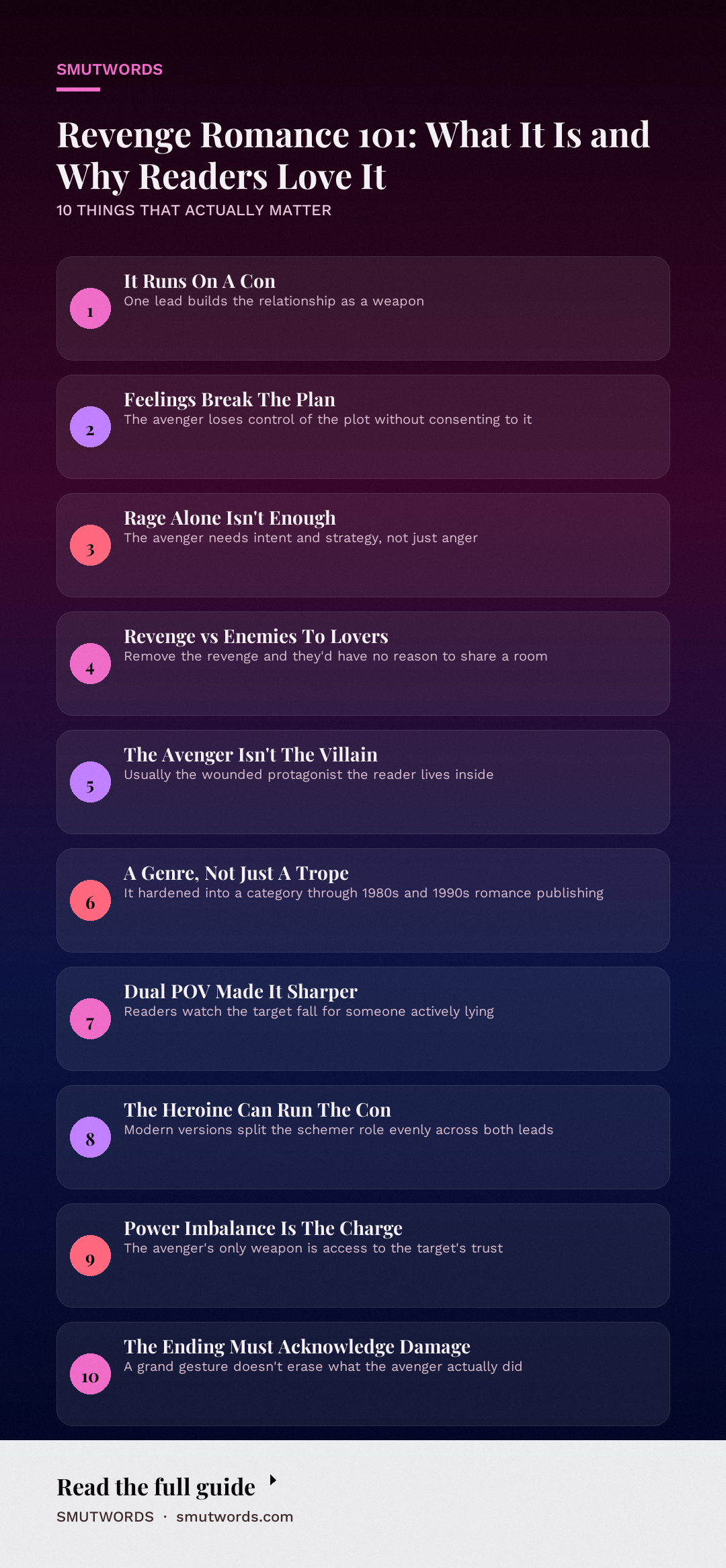
A revenge romance is a love story built on a con. One protagonist deliberately pursues a romantic or sexual relationship with someone as part of a plan to hurt, humiliate, or ruin them, and the scheme works right up until real feelings get in the way. The target stops being a mark and becomes a person.
The avenger stops being in control. That collision between calculated cruelty and involuntary tenderness is the engine of revenge romance, and it is one of the most reliable pressure cookers the genre has ever built.
It shows up across contemporary, historical, mafia, and paranormal romance, and the best versions do not resolve the revenge so much as survive it. What follows is the full breakdown: the definition, the history, the craft, and the questions readers actually ask.
What Revenge Romance Actually Means
The name is literal. Someone has been wronged, and the wronged party builds a relationship as the weapon. The seduction is the plan. The marriage is the plan.
The boyfriend who shows up on the rival's arm at the charity gala is the plan.
Three conditions put a book in this category. First, the avenger enters the relationship with intent, not just anger. Revenge requires strategy, and strategy requires the avenger to be choosing their moves. Second, the target is genuinely in the dark about the goal, or at least about how deep it goes.
Third, the avenger's feelings change without their consent. If they never lose control of the plot, you have a thriller with sex scenes, not a revenge romance.
What does not count: a protagonist who genuinely wants the person and also happens to be angry. That is enemies to lovers with a grudge, and the difference matters. In a true revenge romance, remove the revenge and there is no reason for these two people to be in a room together. That is the tell.
The most common misconception is that the avenger is a villain. Usually they are the protagonist, sympathetic, wounded, and written so the reader is inside their head the whole time. Another misconception: that revenge romance is always dark. Some of the lightest, funniest books in the genre use a petty, almost farcical revenge setup (ruin his engagement, embarrass her at the reunion) and let the comedy of the plan collapsing carry the plot.
A third misconception: that the target is a victim the book punishes. In a well-built revenge romance, the target is not innocent either, or is innocent in a way that forces the avenger to confront what they are actually doing. Either way, the target gets agency by the second act.
Where Revenge Romance Comes From
The trope is old, but its erotica lineage is specific. The seduction-for-revenge plot runs through eighteenth and nineteenth century literature, where a wronged character uses sexual or romantic power to bring down a family. Those stories were rarely erotic on the page by modern standards, but the structure was already there: desire as a tool, and the tool turning on its user.
Revenge romance as a recognizable genre category is much newer. It solidified in mass-market romance publishing through the 1980s and 1990s, when historical romance authors built entire plots around a hero who marries the heroine to destroy her father, or a heroine who seduces the man who ruined her brother. The bodice-ripper era made revenge a mainstream romance premise, and the sex was explicit enough that the reader could feel the manipulation in the physical scenes, not just the dialogue.
The 2000s and 2010s shifted the trope into contemporary settings. Office revenge plots, society revenge plots, and eventually the dark romance boom of the late 2010s and 2020s pushed it further. Mafia romance in particular adopted revenge as a default engine: blood feuds, forced marriages, and a spouse who was chosen as a message.
Revenge Romance as a Publishing Phenomenon
Two developments changed how the trope gets written. The first is dual point of view. Once the genre normalized alternating chapters between both leads, the reader could watch the target fall for someone who is actively lying to them, which makes the betrayal sharper and the eventual reveal more devastating. Revenge romance depends on dramatic irony, and dual POV manufactures it on every page.
The second is the shift in who gets to be the avenger. Early revenge romances overwhelmingly cast the hero as the schemer. Modern versions split it evenly, and some of the strongest recent books have the heroine running the con, with a hero who does not realize he is a target until it is far too late.
Kindle Unlimited and the self-publishing boom also matter here. Revenge romance is a high-concept premise, easy to sell in a blurb and easy to series-ify: a family of siblings, each with their own revenge to execute. That made the trope a staple of indie dark romance and kept it commercially alive in a way traditional publishing alone would not have.
How It Shows Up in Erotica
On the page, revenge romance runs on leverage. The avenger always knows something the target does not, and every intimate scene carries a second layer: what is this costing the avenger to do this? What is the target giving away without knowing it? The strongest scenes in the subgenre are the ones where the avenger's body and their plan disagree, and the reader can see the crack forming before the character admits it.
Craft-wise, the flat version of this trope makes the avenger cold until a switch flips. The strong version gives the avenger a reason to be in proximity that does not feel contrived, and escalating intimacy that forces them to lie in closer and closer quarters.
It also needs a target who is genuinely appealing rather than a cardboard obstacle. Forced proximity does a lot of heavy lifting here, because a shared house, a shared job, or a forced marriage keeps the two leads close enough that the deception has to be maintained daily.
Enjoyed this? Get a free book.
Join the list and we will send a complete free story straight to your inbox, plus new releases every week after that. No credit card, no catch.
The other craft lever is power. Revenge romance often pairs a schemer with someone who holds more institutional, financial, or physical power, which means the avenger's only weapon is access to the target's body and trust. That asymmetry is why the trope overlaps so heavily with possessive and controlling dynamics. If you want the mechanics of that kind of hero done properly, this breakdown of the possessive hero is worth reading alongside this page.
Here are the main variants authors actually use:
- Fake relationship revenge. The avenger dates or gets engaged to the target specifically to wound someone else, often an ex or a rival. The public performance is the weapon.
- Seduction for revenge. The original version. The avenger uses sexual attention as bait, and the intimacy scenes are where the plan starts to rot.
- Revenge against a rival. The target is not the one who caused the harm. They are connected to the person who did, and the avenger uses them to reach the real enemy. This variant produces the sharpest moral crisis, because the target is often blameless.
- Mutual revenge. Both leads are running a con on each other, and neither knows it. Hard to write, extremely satisfying when it lands.
- Revenge via marriage. A forced or arranged marriage as the trap. This overlaps directly with marriage in trouble once the reveal happens, since the couple has to decide whether the marriage survives its own origin.
What separates a great revenge romance from a forgettable one comes down to a few specific choices. The reveal has to land at the right moment, not too early and not in the last ten pages. The target has to get a real reaction, with anger that actually costs the avenger something. And the ending has to acknowledge that the avenger did real damage, rather than waving it away with a grand gesture.
Authors who handle this well also understand that the avenger's competence is part of the erotic charge. Watching someone execute a plan with precision is attractive. Watching that same person start making small, self-sabotaging choices because they cannot stop themselves is the payoff. The moment the avenger does something against their own interests, the trope has done its job.
One more note on the sex. Revenge romance scenes often carry marks of the lie: a hotel room chosen because it is the target's favorite, a nickname the avenger only uses to manipulate, a gift that doubles as evidence. Small details like this let the reader feel the manipulation in the body of the scene rather than being told about it.
It is the same trick that makes orgasm control and denial work in dark romance: the power imbalance is erotic because it is physically demonstrated, not narrated.
Revenge Romance vs Hate to Love
These two get confused constantly, and the confusion is worth clearing up. Hate to love runs on genuine mutual animosity. Both people dislike each other at the start, and the arc is about that hostility softening into something real.
There is no con, no plan, no hidden agenda. The hostility is the honesty.
Revenge romance runs on asymmetry. One person knows something the other does not, and the relationship is a performance with a goal attached. The avenger may feel real hatred toward the target, or may feel nothing at all, which is often worse.
The arc is not about hate turning into love. It is about a lie turning into something the liar cannot control.
You will see books tagged both, and sometimes they overlap: an avenger who genuinely despises the target and also wants to destroy them. When that happens, the revenge element is what makes it more than enemies to lovers. If you stripped the revenge out and they still hate each other, the book is hate to love. If you stripped the revenge out and there is no reason for them to interact, it is revenge romance.
Frequently Asked Questions
Is revenge romance the same as dark romance?
Not exactly, though they overlap heavily. Dark romance is a broader category defined by morally gray leads and content warnings. Revenge romance is a specific plot structure that can be written dark, light, or anything in between. Plenty of revenge romances are dark; plenty of dark romances have nothing to do with a revenge plot.
Do revenge romances usually have a happy ending?
Almost always, if they are shelved as romance rather than romantic suspense. The genre contract requires an emotionally satisfying ending where the couple ends up together. The interesting question is not whether they stay together, but what the reunion costs and how much the avenger has to answer for.
What is a "revenge via marriage" plot?
It is a variant where the avenger marries the target as the act of revenge itself, often to gain control of money, property, or a family name, or to publicly humiliate the target's family. The marriage is the trap, and the couple has to reconcile after the reveal. It sits close to arranged marriage and forced marriage tropes and often slides into marriage in trouble territory by the third act.
Why do readers find the avenger sympathetic?
Because the book gives them a real wound first. The wrong has to be specific and severe enough that the reader understands why someone would go this far. If the revenge is petty or unmotivated, the avenger reads as a bully rather than a protagonist. The best versions also let the avenger recognize, slowly, that they are becoming someone they do not want to be.
Can the target be the one running the con?
Yes, and it is a favorite twist. Sometimes the target figured out the plan early and is running a counter-con. Sometimes both leads are avenging different wrongs against each other. Mutual revenge is trickier to write because the reader has to track two hidden agendas, but it produces some of the sharpest reveals in the subgenre.
How explicit are revenge romances?
It varies widely. Historical revenge romances tend toward closed-door or moderately explicit scenes, while contemporary and dark romance versions are frequently very explicit, with the manipulation folded directly into the sex. If you want heat level information, check the book's tags rather than the trope itself, because the trope tells you nothing about how explicit the scenes are.
Final Thoughts
Revenge romance works because it puts two things readers want in direct conflict: the pleasure of watching someone competent execute a plan, and the pleasure of watching that plan fall apart because the person executing it started to care. What makes the good ones stick is not whether the avenger wins. It is whether they can live with how they got there.






Loading comments…