
Forced proximity is the romance trope where external circumstances trap two characters in the same space with no easy exit: a snowed-in cabin, a broken elevator, one hotel room left in the whole city. The trap removes every polite excuse for distance. No separate bedrooms, no driving home after dinner, no cooling-off period. Whatever is simmering between them has to happen in that room, tonight, with the heat cranked and nowhere to look but each other.
It is one of the oldest, most reliable engines in erotic romance, and it works because it does in fiction what few real situations ever do: it makes avoidance physically impossible.
What Forced Proximity Actually Means
The definition sounds simple, and that simplicity is the point. Two people. A confined space. A reason neither of them can leave.
Every story beat after that grows from the pressure of those three facts.
The term itself is craft language, not a kink label. It came up through romance writing communities and publishing as a way to describe a plot device, and it has stayed useful because it names the mechanism rather than the mood. "Trapped together" tells you the situation. Forced proximity tells you the situation is doing narrative work.
What counts is broader than most readers assume. The trap does not have to be physical. It can be:
- Environmental: a blizzard, a flood, a grounded flight, a lockdown, a broken-down car on a mountain road.
- Logistical: one bed at the inn, a shared tent on a work trip, a cabin with a single working heater.
- Professional: a bodyguard assignment, a co-authored book, a two-person crew on a remote job site.
- Social or familial: a wedding weekend with assigned seating, a family reunion at a lake house, a fake relationship that requires them to share a room.
- Institutional: a boarding school, a military deployment, a residency program, a ship.
- Supernatural: a bonded mate pull, a magical contract, a curse that tethers them. Shifter and monster romance lean hard on this version, often pairing it with mechanics like knotting.
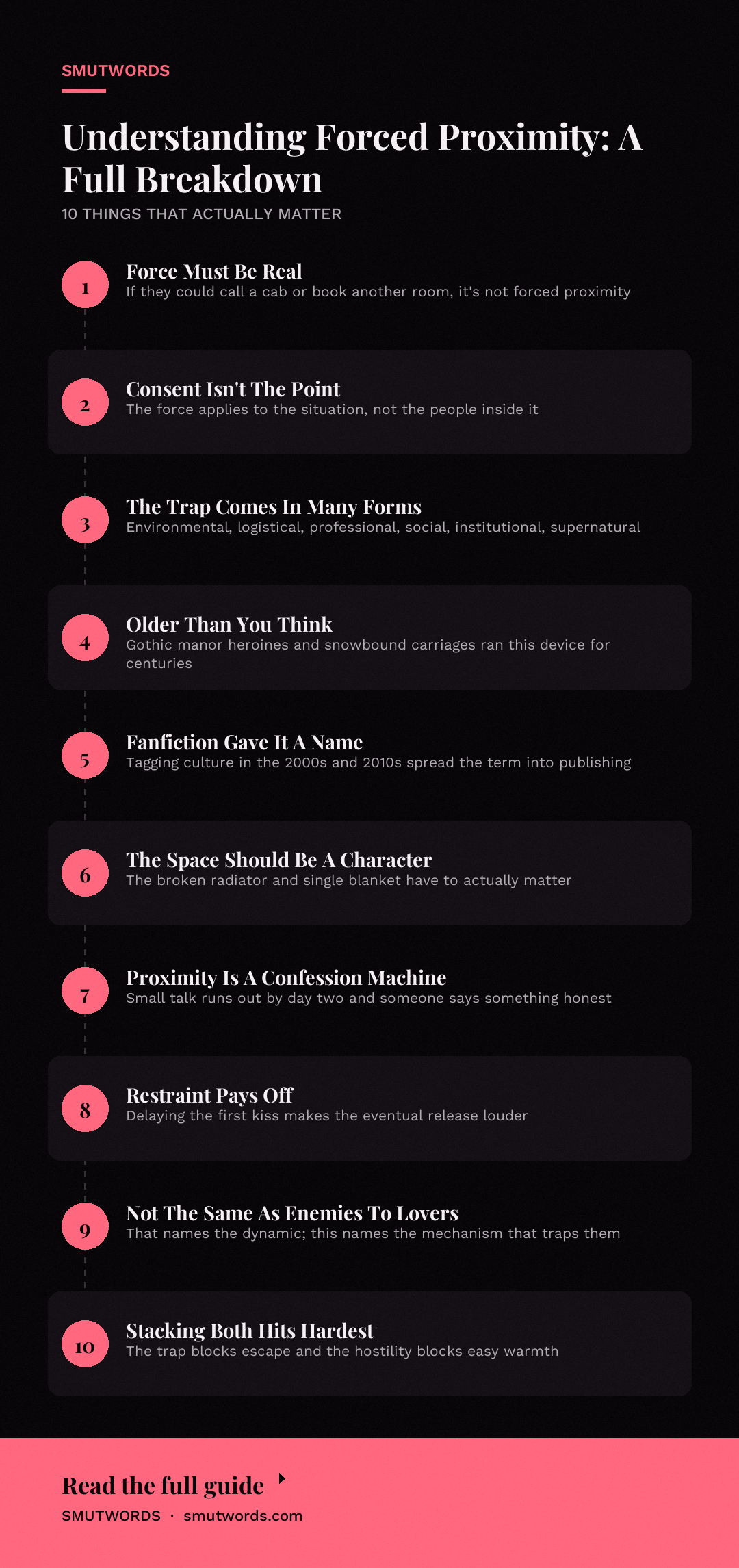
What does not count is a coincidence that characters could shrug off. If they could call a cab, book a different room, or simply walk away and choose to stay anyway, that is mutual pining or a slow burn, not forced proximity. The force has to be real. Their agency has to be genuinely constrained, or the tension leaks out of the premise immediately.
One common misconception: readers sometimes treat forced proximity as a consent problem, assuming the trope means one character pressuring another into sex. It does not. The force applies to the situation, not to the people inside it.
Good forced proximity raises the temperature of a room; it never overrides anyone's no. That distinction matters, and the best authors in the trope are careful about it.
Where Forced Proximity Comes From
The trope's publishing history runs deeper than most readers realize, and its most famous modern shape is younger than they think.
Confined-space romance is old. Gothic fiction put heroines in locked manors with brooding men for two centuries. Historical romance kept the device alive through snowbound carriages, besieged castles, and arranged marriages that dropped two strangers into one bedchamber. The trap was often a plot convenience, a way to get two people alone without scandal.
The twentieth-century shift was category romance. Mid-century series lines needed tight, repeatable story engines, and forced proximity delivered one. A cabin, a storm, a single night. Authors could hit the emotional beats in 55,000 words without inventing an elaborate external plot.
The device became a house tool, and readers learned to recognize it on the cover copy.
The phrase "forced proximity" as a named trope is much newer. It spread through fanfiction tagging culture in the 2000s and 2010s, where writers needed precise labels to describe what a story contained. Tags like "forced proximity" and "there was only one bed" let readers find exactly the pressure they wanted. Romance publishing absorbed that vocabulary, and by the mid-2010s the term was standard in review spaces, trope lists, and marketing copy.
Two evolutions are worth noting. First, "only one bed" split off as its own beloved sub-tag, a joke and a promise at once.
Second, dark romance and monster romance started fusing forced proximity with bond mechanics: fated mates, soul tethers, mating bites. The trap stopped being weather and became biology, which changed what "no escape" could mean. The enemies to lovers glossary entry covers a closely neighboring trope, and the two get combined constantly: nothing forces two people past their hostility faster than a locked door and a single blanket.
How It Shows Up in Erotica
On the page, forced proximity is a pacing device first and a setting second. The confined space does three jobs at once: it compresses the timeline, it forces dialogue that would otherwise be postponed for chapters, and it turns every mundane action into a charged one.
One toothbrush. One bathroom door that does not lock. Two people changing clothes in the same six square feet.
Writers who handle the trope well understand that the trap should escalate. Early chapters use mild friction: awkward sleeping arrangements, shared meals, small irritations. Middle chapters tighten the space: a broken heater pulls them into one bed, or a medical need forces physical contact. Late chapters use the pressure they have built, when proximity has done its work and both characters are aware that when the door finally opens, something has to be decided.
Common variations that show up across the genre:
- Snowed in / cabin fever: weather as the trap, usually with a wood stove, limited food, and long nights. A staple of lumberjack romance.
- Only one bed: the trap is logistical, and the whole subgenre runs on the negotiation of who sleeps where and who ends up in the middle.
- Stranded with the billionaire: the trap is economic as well as physical; the power imbalance is part of the heat.
- Stuck in an elevator: a short-form version, usually a single-scene or single-chapter device, often a meet-cute.
- Fake relationship room-share: the trap is social; they must appear together, which means sharing, which means pretending until it stops being pretend.
- Bonded mates: the trap is supernatural and permanent. Monster and shifter romance use this to make the proximity inescapable on a cellular level.
- Protective detail: a bodyguard or soldier assigned to stay within arm's reach. The clash between professional distance and physical closeness does most of the work.
What separates a strong forced proximity story from a flat one comes down to one question: does the space change them, or does it just hold them?
Enjoyed this? Get a free book.
Join the list and we will send a complete free story straight to your inbox, plus new releases every week after that. No credit card, no catch.
A flat version uses the cabin as a backdrop. The characters could be anywhere; the author just needed them in the same room for a sex scene. The setting is wallpaper. Readers feel the thinness immediately.
A strong version makes the space a character. The broken radiator matters. The single blanket matters.
The rules of the space (who gets the bed, who takes first watch, who cooks) become a small society the two of them have to negotiate. Every negotiation is a revelation about who they are. That is the craft payoff.
Editors also look for what the trap forces the characters to admit. Good forced proximity is a confession machine. The blizzard makes small talk run out by day two. The elevator makes someone say something honest because there is no exit.
If a scene could be cut and pasted into a different setting without changing, the proximity is not pulling its weight.
The heat itself benefits from restraint. The most effective forced proximity scenes delay the first kiss far longer than readers expect, because the longer the trap holds, the louder the eventual release. Authors who rush it waste the device. Authors who stretch it correctly earn a payoff that feels inevitable rather than convenient.
Forced Proximity vs Enemies to Lovers
These two get confused constantly, and the confusion is understandable because they overlap heavily. The enemies to lovers trope names the relationship dynamic: two people who start in opposition and end in love. Forced proximity names the situational mechanism.
They answer different questions. Enemies to lovers answers "why do they resist each other?" Forced proximity answers "why can't they leave?"
Some books are one without the other. A snowed-in cabin with a couple who already like each other is forced proximity without enemies. A workplace rivalry where they can avoid each other all day but must sit through one shared meeting is enemies without meaningful proximity.
The best-loved books in either category use both, and that stacking is why they feel so much stronger: the trap prevents escape and the hostility prevents easy warmth. Every scene has to fight for its ground.
When authors use both, they get a compounding effect. The proximity accelerates contact, the hostility keeps the contact sharp, and the reader gets the tense, deliberate, drawn-out charge that makes this combination one of the most requested in the genre. A number of motorcycle club romance and rockstar romance titles run this exact combination when a tour or a clubhouse keeps two people in each other's orbit.
Frequently Asked Questions
Is forced proximity the same as "only one bed"?
No, though they overlap. Forced proximity is the broader trope covering any situation where characters cannot separate. "Only one bed" is a specific, popular subtype where the trap is the sleeping arrangement. Every only-one-bed story is forced proximity; not every forced proximity story uses only one bed.
Why is the forced proximity trope so popular?
It strips away the standard avoidance behaviors that slow romance down. Characters cannot text instead of talking, cannot go home to cool off, cannot pretend the tension is not there. Readers get faster emotional and physical escalation without it feeling rushed, because the situation justifies it.
Does forced proximity require sex scenes?
Not at all. The trope appears in sweet romance, in suspense, in young adult, and in closed-door stories. What it requires is genuine physical constraint and no easy out. Heat level is a separate choice, and plenty of forced proximity books keep things chaste.
What settings work best for forced proximity?
Any setting that makes leaving impossible or humiliating. The classics hold up: cabins, elevators, motels, ships, tour buses, remote job sites, and storms of all kinds. The best setting is one with its own logistics, because the logistics become scene material.
How do I find forced proximity books?
Search the term directly on retailer and library platforms, check review sites with trope tags, and look at fanfiction tag archives where the term is precisely defined. Cover copy often signals the trope with phrases like "snowed in," "stranded together," or "one room."
Can forced proximity work in a short story?
Yes, and it may work better in short form than long. The confinement already compresses time, so a novella or short story can build the trap, escalate the tension, and release in one tight arc. Elevator scenes are the most obvious short-form version.
Final Thoughts
Forced proximity remains one of the most reliable engines in erotic romance because it does the hardest narrative job for free: it removes avoidance. Every good version of the trope understands that the space is not scenery; it is pressure. When two people cannot leave, everything they say matters, everything they touch matters, and the moment the door finally opens has weight.
If you want a starting point, look for a snowed-in cabin title with an enemies-to-lovers setup. That combination is the trope at full strength: two people who would rather be anywhere else, in a place they cannot leave, with nothing to do but face each other.







Loading comments…