
Orgasm control denial erotica runs on a simple engine: somebody decides when you come, and for a while that somebody decides you don't. The appeal is not complicated once you've read enough of it. It is the gap between wanting and having, stretched thin on purpose, with a person standing in that gap holding all the authority.
Readers who already love the genre know the specific thrill of a scene where the whole plot is one denied climax and the emotional fallout that follows. Newcomers tend to bounce off it because nobody ever explains the mechanics. So here's the breakdown.
The genre covers a wide spread of tones and settings, which is part of why it travels so well across categories. A contemporary with a controlling boyfriend operates on the same core dynamic as a monster romance where the creature decides when his captive is allowed release, or a sci-fi story where the tech enforces it. The kink itself doesn't care about genre. It cares about who holds the permission and who has to ask for it.
What Orgasm Control Actually Means
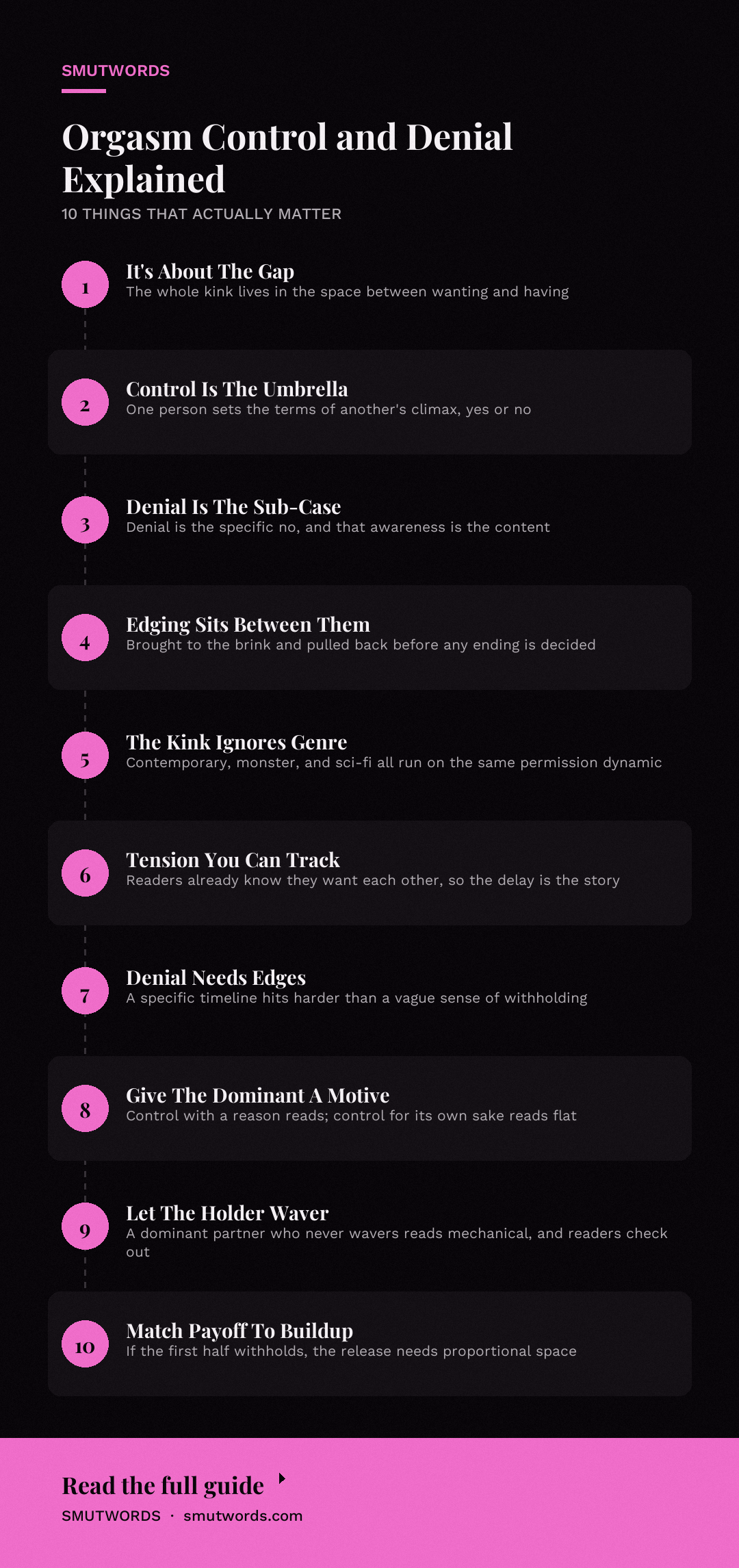
Orgasm control is the umbrella term. One person sets the terms of another person's climax, usually through rules, commands, or physical intervention. That can mean "you don't come until I say so," or it can mean "you come when I tell you to, whether you think you're ready or not." Both directions count.
Denial is the specific sub-case where the answer is no. The dominant partner withholds permission, sometimes for a single scene, sometimes for days. The submissive partner stays aroused, frustrated, and aware of it. That awareness is the content.
Some books frame this as an established dynamic between long-term partners. Others use it as a first-time thing, where one character introduces the rule and the other discovers they want it. Both versions show up constantly in everything from marriage in trouble plots to stories where the arrangement is brand new and neither character fully knows the rules yet.
Why It Works as Erotica
The obvious answer is tension, but that undersells it. Plenty of tropes generate tension. What orgasm control denial does differently is make the tension physical and immediate in a way the reader can track scene by scene.
Readers aren't guessing whether the characters are attracted to each other. That question is already answered. What they're watching is how long the wanting can be stretched before something breaks, and what shape the breaking takes. That's a cleaner engine than most romance plots manage.
There's also the power exchange baked into the premise. Someone has to be willing to hand over control, and someone has to be willing to take it. The negotiation can happen before the scene, during it, or entirely off-page, and how a book handles that negotiation tells you a lot about whether it understands the kink.
The Difference Between Control and Denial
These two get used interchangeably and they aren't the same thing:
- Orgasm control covers the whole authority structure. The dominant partner decides when, how, and whether the submissive comes.
- Orgasm denial is the specific act of withholding. The submissive wants release, is capable of it, and doesn't get it.
- Edging sits between them. The submissive gets brought to the brink and pulled back, sometimes several times, before a decision is made about the ending.
- Orgasm on command flips the pressure. The dominant partner orders the climax, and the submissive has to produce it on cue, which is its own kind of intensity.
A scene can use one of these or cycle through all four. Knowing which one a book is actually doing helps you find more of what you liked. A story built on slow edging across a weekend reads completely differently from one built on a single denied night, even though both get shelved under the same tag.
How It Shows Up Across Genres
Contemporary romance tends to play it as a relationship dynamic. The controlling partner has a reason, usually one connected to trust or jealousy, and the denial becomes a way of proving something to both people. A book like Permission Slip: A Cuckold Erotic Short Story uses permission as its central currency, where who gets to say yes matters as much as what's being allowed.
Paranormal and monster romance push the power imbalance further. When one character isn't human, the denial can be instinctive rather than negotiated, which changes the emotional stakes. Lured by the Lizard Beast and Zorgon's Pet both lean on that dynamic, where the creature's terms aren't up for discussion and the human character has to figure out what they actually want.
Sci-fi and cyberpunk settings add a layer of technology or system rule. Free Use Casino runs on an explicit set of rules governing access, which is its own version of the same permission structure. In a cyberpunk romance, that permission can be coded into a device or a contract, which raises the question of whether consent is still meaningful when it's built into the architecture.
Sharing and hotwife stories use denial in a different direction. The controlling partner isn't withholding from the submissive so much as directing where their arousal goes. Shared Without Shame: A Hotwife Exhibition & Sharing Fantasy plays with that angle, where permission to be watched or shared is its own form of control.
Enjoyed this? Get a free book.
Join the list and we will send a complete free story straight to your inbox, plus new releases every week after that. No credit card, no catch.
Readers who want the full breakdown of how those relationships work should look at the shared wife blog dynamic guide, since the permission structure overlaps a lot with denial dynamics.
What a Good Orgasm Control Scene Needs
Plenty of books get the mechanics right and the emotional arc wrong. Here's what separates a scene that lands from one that just goes through the motions:
- A clear agreement, stated or implied. The reader needs to know both characters are in it, even if the negotiation happened before the scene started. Ambiguity about consent kills the tension instead of raising it.
- A specific timeline. "You don't come tonight" hits harder than a vague sense that someone's being denied. Denial has to have edges.
- A reason the dominant partner wants this. Control for its own sake reads flat. Control with a motive, whether that's possession, patience-testing, or an old grudge, gives the scene somewhere to go.
- Physical detail that tracks the delay. How the submissive's body responds over hours or days matters more than any single description of an orgasm. The buildup is the point.
- An ending that resolves something. The release, or the refusal to release, should change the relationship between the two characters. If nothing shifts, the scene was decoration.
Number three is where most weak entries fail. A dominant partner who denies for no stated reason turns into a flat archetype, close to the worst versions of a possessive hero who's all threat and no interior life. The good ones give you a glimpse of what the control is doing to the person holding it, not just the person under it.
Common Mistakes in Orgasm Control Erotica
Two failure modes show up again and again. The first is a scene that's all denial and no buildup, where the withholding happens immediately and the reader never gets enough arousal established to feel the loss. Denial only works if there's something to deny.
The second is a dominant character who never wavers. Real control dynamics in fiction get more interesting when the person holding the power is affected by using it. A scene where the dominant partner is completely unmoved reads as mechanical, and readers check out. The best versions let you see the cost on both sides, even briefly.
There's also a pacing problem specific to this kink: books that front-load the denial and then rush the payoff. If the entire first half is withholding, the release needs proportional space, or the ending lands like a shrug.
Some writers solve this by not resolving at all, which works when the point is the unresolved state, and fails when the reader was promised a climax that never arrives. Frustrating the reader on purpose is a real technique. Frustrating them because the book ran out of pages is not.
For readers who like their control dynamics with a heavier edge, the guide to sadism covers where denial sits relative to broader pain and power play, since the two overlap more than people expect. Feral and instinct-driven dynamics, explained in the complete guide to feral play, use a different justification for the same withholding behavior, which is worth comparing if you read across both categories.
How to Find Books You'll Actually Like
Tag searches help less than you'd think, since "orgasm denial" gets applied to everything from a single denied scene to a full-length dynamic across an entire relationship. A few things to check before committing:
- Does the blurb mention a timeline? A weekend, a single night, or an ongoing arrangement will tell you the pacing before you open it.
- Is the negotiation on-page or implied? Some readers want to see the agreement being made, others want to start after it's already settled.
- Who initiates? A dynamic introduced by the submissive character reads differently from one imposed by a dominant partner who already has the position.
- Does the ending resolve the tension or hold it open? Decide which you're in the mood for before you start, because a deliberately unresolved ending is a real choice the writer made and it won't feel like one if you weren't expecting it.
Genre still shifts the flavor even when the kink is identical. A historical where the control is bound up in marriage expectations hits differently from a sci-fi story where it's built into a contract.
Both hit differently from a monster romance where the creature's biology does the deciding. If you already know you like monster and shifter dynamics, knotting explained covers the physical mechanics that often pair with denial in that subgenre, since the two frequently show up in the same books.
Short stories tend to use denial as a single sustained beat. Novels stretch it into an arc, sometimes across the whole book, sometimes as one act out of several. Neither format is better, but they satisfy different moods, and knowing which one you're picking up saves you from finishing a book frustrated in the wrong way.
For monster and sci-fi readers who want the denial built into a longer world, there's plenty of that too, and it's usually layered over an existing power structure the story already established. Readers coming from other subgenres like blind date romance or fake marriage will recognize the same tension mechanics at work, just wearing different clothing.
Final Thoughts
Start with shorter work if you're new to the tag, since a single sustained scene is the fastest way to find out whether the withholding-and-release rhythm actually does anything for you. For a monster-romance version that uses denial as part of a broader control dynamic, Zorgon's Pet is a solid place to see how the kink plays when the dominant party isn't human and the rules were never up for negotiation to begin with.







Loading comments…