
Somnophilia gets flattened into a one-line kink description more often than almost anything else in the genre: someone has sex with a sleeping person, the end.
That summary misses why the trope actually works on the page. It also misses why it shows up constantly in dark romance and free use fiction, and why it needs to be handled with more care than a casual throwaway scene allows.
If you've ever finished a somnophilia scene and felt like something was off but couldn't name it, the problem is usually structural, not moral. This is the somnophilia explained version that treats the fantasy as a craft question as much as a kink one.
Before anything else: the line between somnophilia and free use blurs fast for new readers, and it's worth separating them properly. We already did that work in Free Use vs Somnophilia: Two Different 'No Resistance' Fantasies, and this post assumes you've either read it or don't need the primer. What follows goes deeper into how the trope actually functions inside a scene.
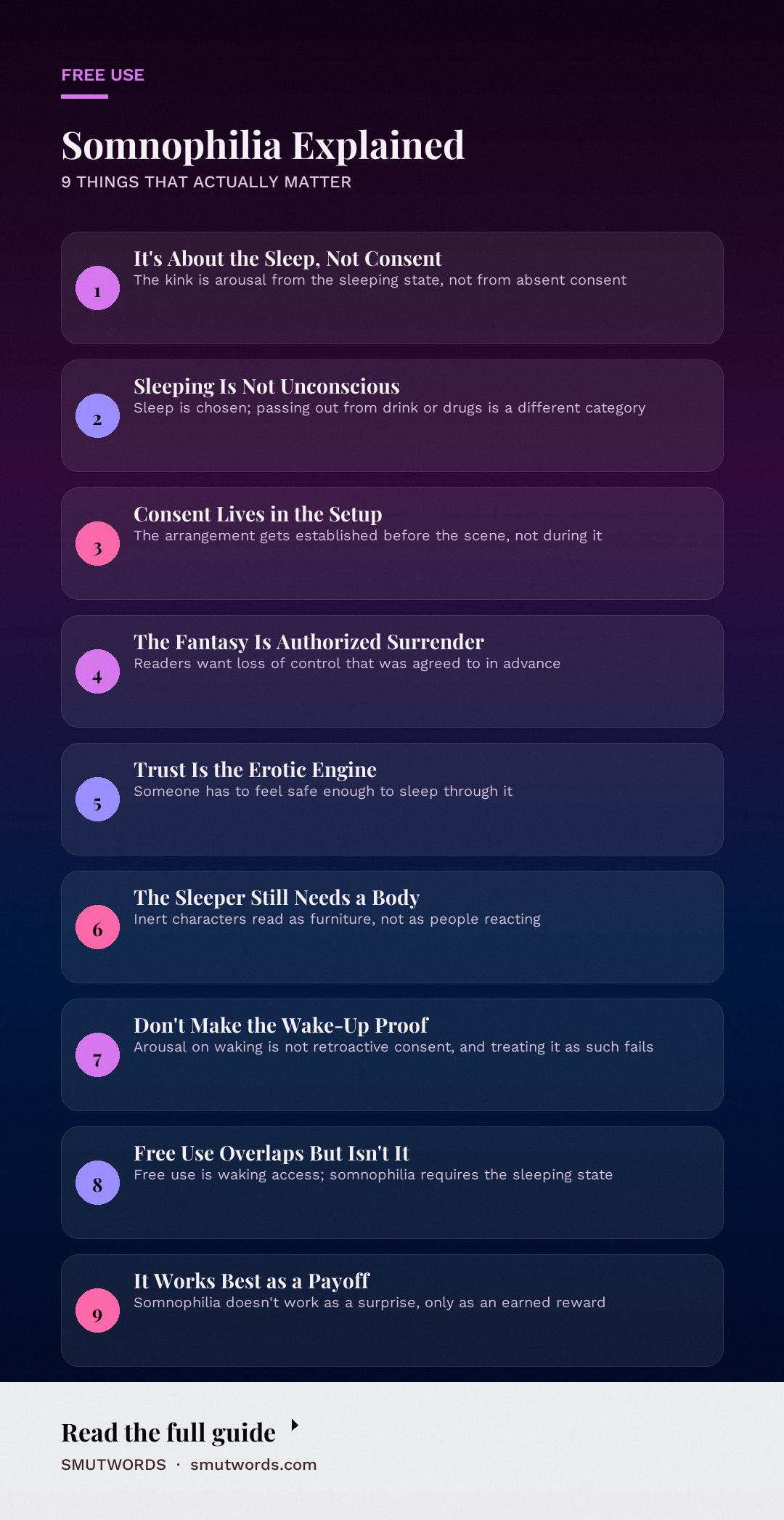
What Somnophilia Actually Means
Somnophilia is attraction to or arousal from sexual contact with a sleeping person. In fiction, it covers a wide range: a partner who wakes up mid-scene and leans into it, a partner who stays asleep the entire time, a partner who was told beforehand it might happen and consented to not knowing when. The kink itself is about the sleeping state, not about the absence of consent, even though those two things can look identical from the outside.
That distinction is the entire ballgame. A well-written somnophilia scene knows exactly which category it's in, and the prose reflects that knowledge. A badly written one doesn't know or doesn't care, and readers can feel the difference within a paragraph.
Sleeping, Not Unconscious
Sleep is a specific physiological state. Unconsciousness is a different one, and so is incapacitation from drink or drugs. The trope lives in the first category. When a scene drifts into the second without acknowledging the shift, it stops being somnophilia and becomes something the reader didn't sign up for.
The best authors stay precise about this. They describe the quality of the sleep: the slow breathing, the weight of a limb, the half-second where the sleeper surfaces and then settles back under. That specificity is what keeps the scene anchored to the actual kink instead of sliding into something vaguer and darker.
How Consent Works When Someone's Asleep
This is the question readers ask most, and it deserves a direct answer rather than a dodge. In fiction, consent for a somnophilia scene almost always lives in the setup, not the scene itself.
The characters agreed to it beforehand. The sleeping partner knows the arrangement. Sometimes there's a standing agreement, sometimes a one-time conversation, sometimes a scene where the terms get negotiated on the page before anything happens.
Readers who like this trope aren't looking for a scene where consent is absent. They're looking for a scene where consent was settled in advance and the sleeping partner's body is doing the reacting without their conscious participation. That's the actual fantasy: a loss of control that's been authorized, which is a completely different thing from a loss of control that hasn't been.
If you want the broader framework for how this works across all "no resistance" scenarios, CNC Explained: What Consensual Non-Consent Actually Means in Fiction covers the consent architecture that somnophilia scenes borrow from. The two tropes overlap heavily, and readers who enjoy one usually enjoy the other for the same underlying reason.
Why the Trope Lands for Readers Who Like It
The appeal isn't mysterious once you name it. Somnophilia hits a specific combination of trust and surrender that most other tropes can only approximate.
- Total trust from the awake partner. Someone has to feel safe enough to sleep through it, or the scene doesn't work. That trust is the actual erotic engine.
- Surrender without performance. A sleeping body doesn't pose, doesn't manage its reactions, doesn't perform arousal for anyone. What shows up is unedited.
- The ambiguity of the wake-up. Does the sleeper surface mid-scene? Do they stay under? Both versions hit differently, and the best scenes know exactly which one they're playing.
- Control that's already been handed over. The awake character isn't taking anything. They're using something they were given.
That last point is what separates somnophilia from a scene where control gets seized. Readers who understand the trope can tell instantly which version they're reading, and the seized version reads as a different kink entirely, often one they didn't ask for.
The Free Use Overlap (And Where It Breaks Down)
Free use and somnophilia share a surface feature: a partner who doesn't actively resist. That's where the similarity ends.
Free use is about access during ordinary life, a standing arrangement that applies whenever the other person wants it. Somnophilia is about the sleeping state specifically. A free use scene can happen at 2pm in a kitchen with both people wide awake. A somnophilia scene requires sleep.
Some books combine them, and when the combination is done well, it's one of the stronger setups in the genre. A character with a standing free use agreement who's also told their partner can use them while they sleep is running two overlapping consent frameworks at once.
That's a lot of trust to establish on the page, and only some authors earn it. The ones who do tend to spend real time on the negotiation before the payoff, which is almost always where the heat actually comes from.
Free Use, Somnophilia, and Everything Between
If you want to see how a free use world gets built so this kind of overlap doesn't feel arbitrary, Free Use World-Building: How Authors Explain the 'Why' walks through how the stronger books justify the arrangement. Somnophilia scenes that sit inside a free use framework need that same justification, or the whole thing reads as an excuse rather than a kink.
The free use catalog itself is a decent place to see the range. Free Use Casino plays the arrangement as a public system with rules and staff. Free Use Airport Lounge drops it into a transit setting where strangers cycle through. And Free Use County Fair: A Public Free-Use Exhibition Fantasy turns the whole thing into a spectacle.
None of those are somnophilia books, but they show how a free use premise gets grounded, and the same grounding work applies when a sleeping-partner scene shows up inside one.
What Bad Somnophilia Writing Gets Wrong
Most failures fall into a few recognizable patterns. None of them are about the kink being wrong. They're about the craft being lazy.
- The consent is never established. The scene opens on a sleeping character with no prior agreement mentioned anywhere, and the reader is left guessing whether they're reading somnophilia or something the book didn't warn them about.
- The sleeper is treated as a prop. No interiority, no reaction, no sense that this is a whole person whose body is doing something. They're furniture with a pulse.
- The wake-up is mishandled. The character surfaces and the scene does nothing with it, or the character surfaces and the book treats the arousal as proof that consent was retroactive. That second one is the tell that the author doesn't understand the trope at all.
- The scene conflates sleep with incapacitation. Sleep is a state a person chose to enter. Passing out from drink is not. Books that blur these two lose readers who know the difference.
The fix for all four is the same thing: slow down and establish the arrangement before the scene starts. Somnophilia doesn't work as a surprise. It works as a payoff.
Enjoyed this? Get a free book.
Join the list and we will send a complete free story straight to your inbox, plus new releases every week after that. No credit card, no catch.
Where It Shows Up in Romance and Erotica
The trope isn't limited to any one subgenre, though some handle it better than others. Dark romance, breeding kink, and free use fiction use it most often, and each brings a slightly different flavor.
Breeding fiction uses it for the obvious reason: a sleeping partner can't perform, so the scene strips the dynamic down to its rawest version. Billionaire's Breeding Toy plays in that territory, and the power imbalance baked into the setup is exactly what makes the sleeping-state angle land harder when it appears.
Medical and caregiver settings use somnophilia differently. The power dynamic is already skewed, so the sleeping element adds a second layer. Free Use Nurse: A Hospital Free-Use Fantasy and Free Use Doctor: A Dark Medical Free-Use Fantasy both work with characters whose whole job is access to other people's bodies, which makes the sleeping-partner version of the trope a natural extension rather than a bolt-on.
Some authors fold it into a broader household arrangement. Free Use Households: The Family or Roommate Version of the Trope covers how those setups get organized, and the sleeping-hours version of a household agreement is one of the more common variations.
Public settings handle it less often, and for good reason: sleep usually happens somewhere private. Public free use erotica tends to skip somnophilia entirely, which is part of why Public Use Fantasy: Why Free Use Works Better in the Open reads as a different beast altogether. The trope wants a bedroom, or a tent, or the back of a car. Somewhere the sleeping person chose to close their eyes.
How to Tell If a Book Handles It Well
There's a quick test. Open to the somnophilia scene and check three things.
First: is there a moment, somewhere before this scene, where the arrangement gets established? It can be a sentence, a memory, a throwaway line in the previous chapter. It just has to exist.
Second: does the sleeping character have a body that reacts on the page? If they're described as completely inert, the scene isn't doing the trope, it's using the sleeping state as a way to avoid writing a character.
Third: when the character wakes up (if they do), what does the scene do with it? The strongest versions treat the wake-up as the emotional climax, not the mechanic one. The character surfaces, realizes what's been happening, and the reaction is the payoff the whole scene was building toward.
Books that pass all three tend to be the ones readers re-read. Books that fail the first one are the ones that generate complaint threads and refund requests.
Somnophilia vs. Adjacent Tropes: A Quick Disambiguation
New readers confuse it with several other kinks, and the confusion is understandable. Here's a short breakdown.
- Free use: standing access during ordinary waking life. Overlaps but is not the same.
- CNC: a broader umbrella that includes consensual non-consent scenarios. Somnophilia often operates inside a CNC framework but isn't defined by it.
- Sleep play: a related but distinct kink that includes things like being woken up by touch without any sexual contact, or hypnosis-adjacent states.
- Incapacitation fantasies: a broader category that includes drink, drugs, and injury. Somnophilia sits inside this category only when the sleep is normal and chosen.
If you find yourself drawn to somnophilia, you'll probably also like CNC and free use, since all three run on pre-negotiated surrender. If the sleeping state itself is what does it for you, you're going to want authors who write the physicality of sleep carefully, and those authors are rarer than the trope's popularity suggests.
The Overlap with Romance Subgenres
The trope shows up across a surprising range of romance subgenres, and each one handles it differently. Military and soldier romance uses it as a homecoming device, where a partner returns from deployment and the sleeping-state scene becomes an expression of relief and reclaiming. Soldier Romance covers that territory, and the sleeping angle works there because exhaustion is baked into the setting.
Marriage-in-trouble stories use it as a repair device. Two characters who've drifted apart find their way back through a scene where one of them is asleep and the other is remembering why they stayed. Marriage in Trouble as a trope is full of these quiet, low-stakes intimacy scenes, and somnophilia is one of the tools that genre reaches for most often.
Motorcycle club romance is a third home for it. Club dynamics are already built on claiming and possession, and the sleeping-state scene fits that atmosphere without much adjustment. Motorcycle Club Romance handles the ownership angle that makes somnophilia work in a way that more conventional contemporary romance often doesn't.
Why the Trope Needs Careful Handling
Everything above comes down to one point. Somnophilia is a consent fantasy, not a consent violation.
Readers who like it are looking for a very specific thing: a scene where two people have already done the work of trusting each other and the scene is the reward. Get that right and the trope is one of the more emotionally loaded setups in the genre. Get it wrong and you've written something the reader didn't agree to read.
The better authors know this. They spend paragraphs on the arrangement before the scene, and they treat the sleeping partner as a full character whose body and reactions matter, even when they're not conscious for the moment in question.
If you're new to the trope and want to see how it looks in a well-built setting, start with a free use book that establishes its rules early. The stronger ones in the catalog do exactly that, and once you see the negotiation on the page, the whole thing clicks into place.
Final Thoughts
If you want a single recommendation to see how the trope blends cleanly into a free use framework, read Free Use Nurse: A Hospital Free-Use Fantasy.
The hospital setting establishes access as a job requirement before anything sexual happens, which gives the sleeping-state scene somewhere legitimate to live, and the power dynamic between caregiver and patient is doing exactly the work somnophilia needs to land.
It's not marketed as a somnophilia book, and that's part of why it works. The trope is a tool, not a banner, and the best books use it that way.





Loading comments…