SPH (small penis humiliation) is a kink built on verbal degradation focused on penis size. One partner teases, mocks, or belittles the other about being small, and the humiliation itself becomes the turn-on. It runs from playful teasing to brutal verbal cruelty depending on the dynamic, and it lives or dies on consent, negotiated limits, and aftercare.
Done well, SPH takes a real insecurity and turns it into a source of intense, wanted attention. Done badly, it is just cruelty with a safeword nobody discussed.
What SPH Actually Means
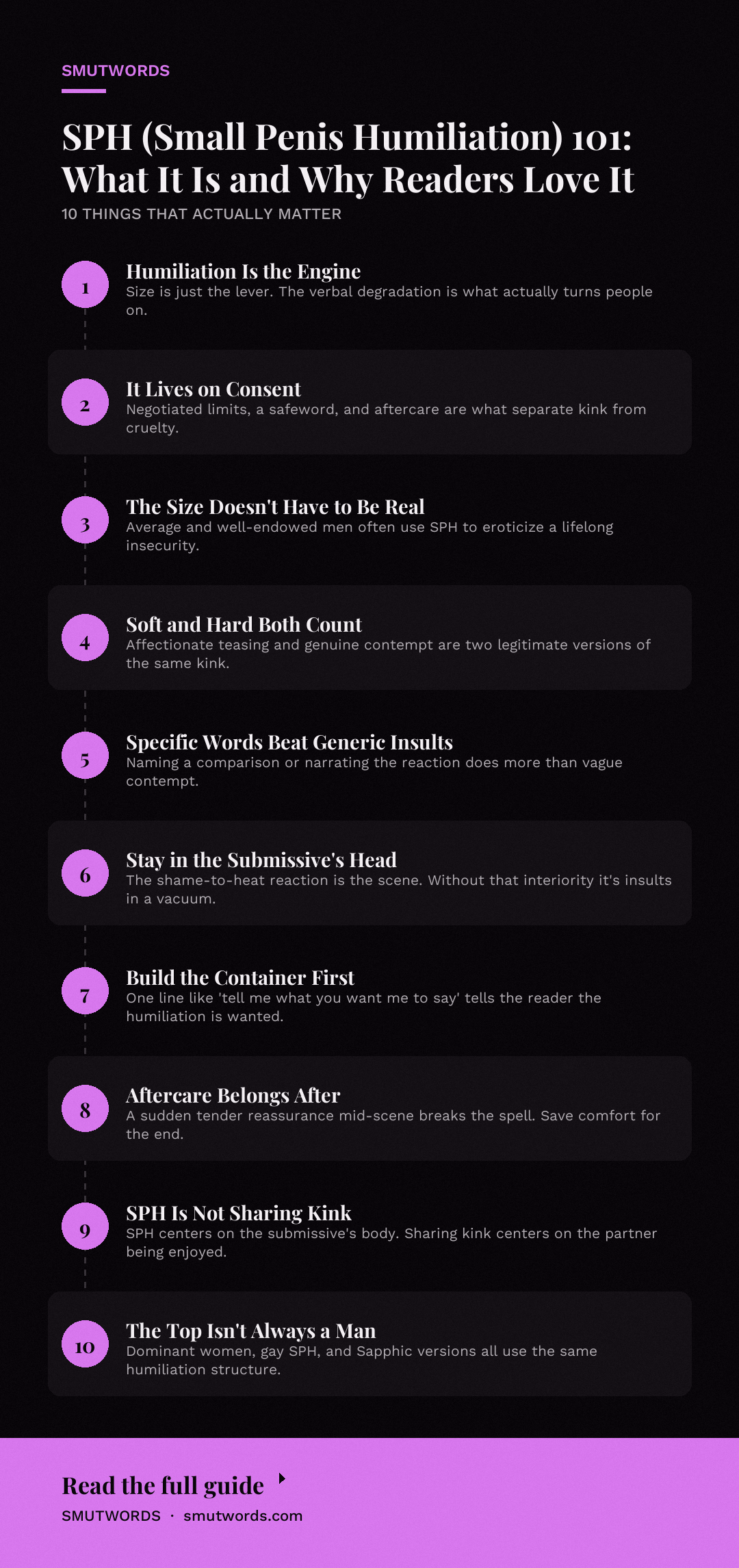
The letters stand for small penis humiliation, and the phrase names the mechanism precisely: humiliation, targeted at penis size, delivered verbally and sometimes physically (measuring, comparing, laughing). The humiliation is the engine. Size is just the specific lever it uses.
What counts as SPH is broader than the name suggests. A scene can run five minutes of dirty talk or an entire relationship dynamic where the submissive partner is permanently framed as inadequate. It can be soft (affectionate teasing, "aw, look at it") or hard (contempt, disgust, comparisons to other men). Both are legitimate versions of the same kink.
What does not count: actual contempt. SPH is a performance of degradation inside a container of trust. If the top partner genuinely looks down on the bottom's body, that is abuse wearing a kink costume. The fantasy only works when both people know it is a scene.
Misconceptions cluster around the audience. People assume SPH is only for men with genuinely small penises. In practice, plenty of well-endowed men get off on being told they are small, and plenty of average-sized men use it to eroticize a lifelong insecurity. The kink is about the humiliation, and the size is the vocabulary.
Another common mistake is assuming the submissive partner is always the man being mocked. In queer and Sapphic versions, the humiliation can target a strap-on, a packer, a lack of anatomy, or a perceived inadequacy of any kind. The structure (one partner verbally diminishes, one partner receives it and gets off) is what makes it SPH-adjacent, even when the anatomy in play is different.
Say it plainly: SPH is a roleplay kink with a real-world vulnerability at its center. That combination demands more negotiation than most, and the best writing in the genre treats that negotiation as part of the story rather than an inconvenience to skip.
Where SPH Comes From
The term as a recognizable kink label is relatively recent, coalescing in online kink and fetish communities in the 1990s and 2000s alongside the rise of forums, chat rooms, and erotic audio. The acronym itself is a message-board artifact, the kind of shorthand that develops when people need to find each other fast.
But the underlying dynamic is older than the label. Verbal humiliation as a kink has a long history in BDSM practice, and size-based teasing shows up in erotic writing well before anyone called it SPH. What changed is specificity. Once the acronym existed, writers could name exactly what they were doing, and the subgenre organized around it.
In erotica and romance publishing, SPH graduated from a niche tag on kink sites to a recognized trope in the 2010s. The cuckold erotic romance boom of that decade pulled size shaming into mainstream indie publishing, where it became a reliable category with its own reader base and its own conventions.
The evolution since has been toward range. Early SPH content leaned hard and contemptuous, often paired with cuckold scenarios. Contemporary writers split the category into soft and hard modes, and the soft version has grown enormously because it lets readers enjoy the humiliation without the cruelty.
There has also been a visible shift in who gets to be the top. Early SPH was overwhelmingly written from a male-submissive perspective. Current publishing includes dominant women written with actual interiority, dominant men in gay SPH, and Sapphic variations that use the humiliation structure without the same anatomy.
The genre's publishing history is thin on critical documentation and thick on reader appetite. What we can track honestly is the volume: SPH has moved from a search term to a shelf, and the books keep coming.
How It Shows Up in Erotica
On the page, SPH is a dialogue-forward kink. The best scenes are mostly what people say to each other, and the physical action is often minimal: a hand, a measuring tape, a laugh. Writers who understand this build scenes around language.
The vocabulary matters. Strong SPH writing uses specific, escalating phrases rather than generic insults. The difference between a flat scene and a good one is usually in the specificity of the mockery: naming a comparison, describing the reaction, letting the dominant partner narrate what she sees. Vague contempt reads as lazy and lands dull.
The second craft element is the reaction. SPH works when the writer stays close to the submissive partner's internal experience: the flush of shame, the way arousal spikes against better judgment, the humiliation converting into heat. Without that interiority, the scene is just insults in a vacuum.
Most published SPH falls into a handful of recognizable shapes. The common ones:
Enjoyed this? Get a free book.
Join the list and we will send a complete free story straight to your inbox, plus new releases every week after that. No credit card, no catch.
- Soft SPH: affectionate teasing, playful condescension, warmth under the mockery. The dominant partner finds the smallness endearing as much as laughable.
- Hard SPH: genuine contempt in the performance, disgust, denial. Often paired with orgasm control or a refusal to let the submissive partner finish.
- Comparative SPH: the humiliation hinges on a comparison, another man, a toy, a memory. Closely related to the monster cock kink as a counterweight.
- Cuckold-adjacent SPH: size shaming folded into a broader sharing scenario. The size is used as the reason the submissive partner watches instead of participates.
- Measurement scenes: the humiliation made literal with a tape or a ruler. Extremely common in audio and video content, and durable in prose because the action is concrete.
- Denial-flavored SPH: the mockery paired with a refusal of satisfaction. Overlaps heavily with orgasm control and the use kink when the submissive partner is kept available without relief.
The cuckold-adjacent version deserves a note because it bleeds into neighboring kinks. When the size shaming becomes the setup for watching a partner with someone else, the scene is doing double duty, and the trust machinery of the sharing kink has to be in place for it to land. Writers who skip that setup produce cruelty instead of heat.
Strong SPH scenes share a structural feature: they establish the container before the degradation begins. A line of dialogue that orients the reader ("tell me what you want me to say") does more work than three pages of insults, because it tells the reader the humiliation is wanted.
Weak SPH scenes make three recurring mistakes. They front-load cruelty without establishing consent, they stay in the dominant partner's head instead of the submissive's, and they undercut the whole thing with a sudden tender reassurance that breaks the scene's spell at the wrong moment. Aftercare belongs after, not in the middle of the humiliation.
There is also a sensory dimension writers underuse. SPH lands harder when the humiliation has texture: the cold of a measuring tape, the weight of a hand, the specific heat of the face. The sensory play guide covers the general craft of pairing physical sensation to emotional beats, and it transfers directly.
Format matters too. SPH is native to audio and instruction-style content, and the JOI game walkthrough is worth reading for the pacing instincts it teaches. Direct address, escalating commands, and a slow build all translate to written SPH scenes.
What separates the best books in the subgenre from the competent ones is how they use the humiliation to reveal character. The mockery becomes a lens into what the submissive partner actually wants, what the dominant partner actually feels, and what the relationship can hold. When that happens, SPH stops being a gimmick and becomes a scene with real stakes.
The romance side of the genre is especially good at this. The relationship arc supplies the safety the humiliation needs. Writers who understand the boss/employee dynamic will recognize the machinery: a power imbalance established, eroticized, and then carefully held so the reader never doubts the underlying care.
SPH vs Sharing Kink
These get confused because the cuckold-adjacent version of SPH involves a third party. The distinction is where the charge lives. In SPH, the humiliation is about the submissive partner's body, and a third party is optional scenery. In the sharing kink, the charge is about the partner being enjoyed by someone else, and size is incidental.
Plenty of scenes do both at once, which is exactly why the two terms get braided together. When they are, the writer has to decide which one is primary, because the reader's attention needs a center. A scene that tries to run both at full intensity usually loses the thread.
SPH is also not the same as primal play or feral play, even when the humiliation has a physical, instinctive flavor. Primal and feral dynamics are about animalistic drive and body-to-body escalation. SPH is about language and shame. The confusion comes from both being raw, but the mechanics are different.
Frequently Asked Questions
Is SPH only for men with small penises?
No. Many people who enjoy the submissive side of SPH are average or even well-endowed and use the humiliation to eroticize an insecurity they have carried for years. The kink is about the verbal degradation and the intimacy of being known, not about anatomical fact.
What is the difference between soft SPH and hard SPH?
Soft SPH keeps an affectionate, playful tone under the mockery; the dominant partner finds the size endearing as much as laughable. Hard SPH leans into contempt, disgust, and denial. They appeal to different readers, and plenty of people enjoy both depending on mood.
Can SPH be part of a healthy relationship?
Yes, with real negotiation. Partners should agree on specific limits, pick a safeword, and treat aftercare and genuine out-of-scene reassurance as part of the experience. The humiliation has to be a performance inside a container of trust, or it stops being a kink and becomes harm.
How do you bring up an SPH kink with a partner?
Outside the bedroom, plainly, and without framing it as a complaint about your body. Ask what they are open to, share what specifically appeals to you (the words, the dynamic, the denial), and agree on limits before any scene. The exhibitionism guide is a useful model for how to negotiate a kink that involves exposure and vulnerability.
What is aftercare in SPH?
Aftercare is what happens after the scene ends: physical comfort, verbal reassurance, and an explicit break from the humiliation frame. For SPH specifically, partners usually need a clear statement that the mockery was wanted and the affection is real, because the scene targets a genuine vulnerability.
Is SPH the same as cuckolding?
No. Cuckolding involves a third party and a viewing or exclusion dynamic. SPH is about size-based verbal humiliation, and a third party is optional. The two often appear together, but the engines are different.
Final Thoughts
SPH lives or dies on dialogue and on staying inside the submissive partner's head. Get those two right and the rest of the genre opens up. The book to read next is the highest-rated SPH title on the shelf below, and it earns that spot the same way every good scene does: the container gets built first, and only then does the humiliation land.





Loading comments…