
Tentacle erotica has a bad reputation problem and a devoted fanbase, sometimes in equal measure. Ask someone on the street what the genre is about, and you will get a joke about anime and squid. Ask someone who actually reads it, and you will get a detailed breakdown of which tentacle configuration works best for which kind of scene. That gap between public joke and private passion is precisely why the genre keeps thriving, and why it solves narrative problems that other creature types simply cannot touch.
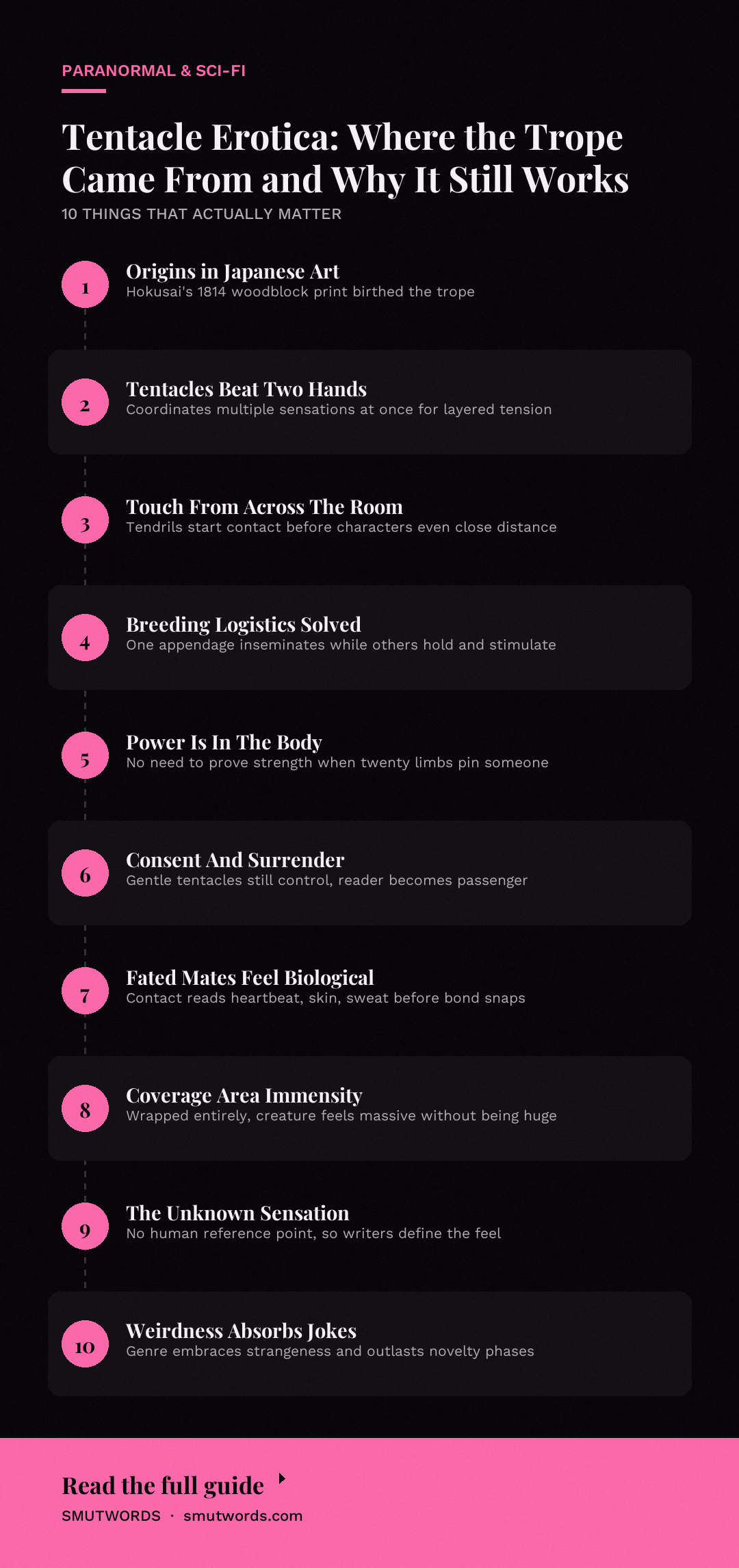
The history of tentacle erotica is often traced back to a specific source. The famous woodblock print The Dream of the Fisherman's Wife by Hokusai, from around 1814, shows a woman entwined with two octopuses. That image was not produced as smut for its own sake, though it has certainly been read that way. It was part of a larger artistic tradition that blurred the line between the mythic, the erotic, and the comedic. But the modern understanding of tentacle erotica owes much more to the late 20th century and to Japanese anime and manga, specifically the hentai genre that grew up alongside it.
The origin story matters less than what the trope does on the page. Tentacles are the ultimate multi-tool in a genre where versatility is everything. They can be gentle, wrapping around a wrist without leaving a mark. They can be demanding, holding a body in place with no escape. They can be everywhere at once, which is the key to the genre's staying power. A humanoid alien with the right anatomy has two hands and one or two other relevant parts. A tentacled creature, on the other hand, operates on a different mathematical scale entirely.
Why Tentacles Solve A Pacing Problem
Think about a standard two-handed sex scene. The writer has to coordinate the action across a limited set of body parts. Hands do the touching, the mouth does the kissing, and the main event happens in one focused location. That is fine, but it creates a linear narrative. Every stroke follows the one before it, and the scene moves in a straight line toward a single climax.
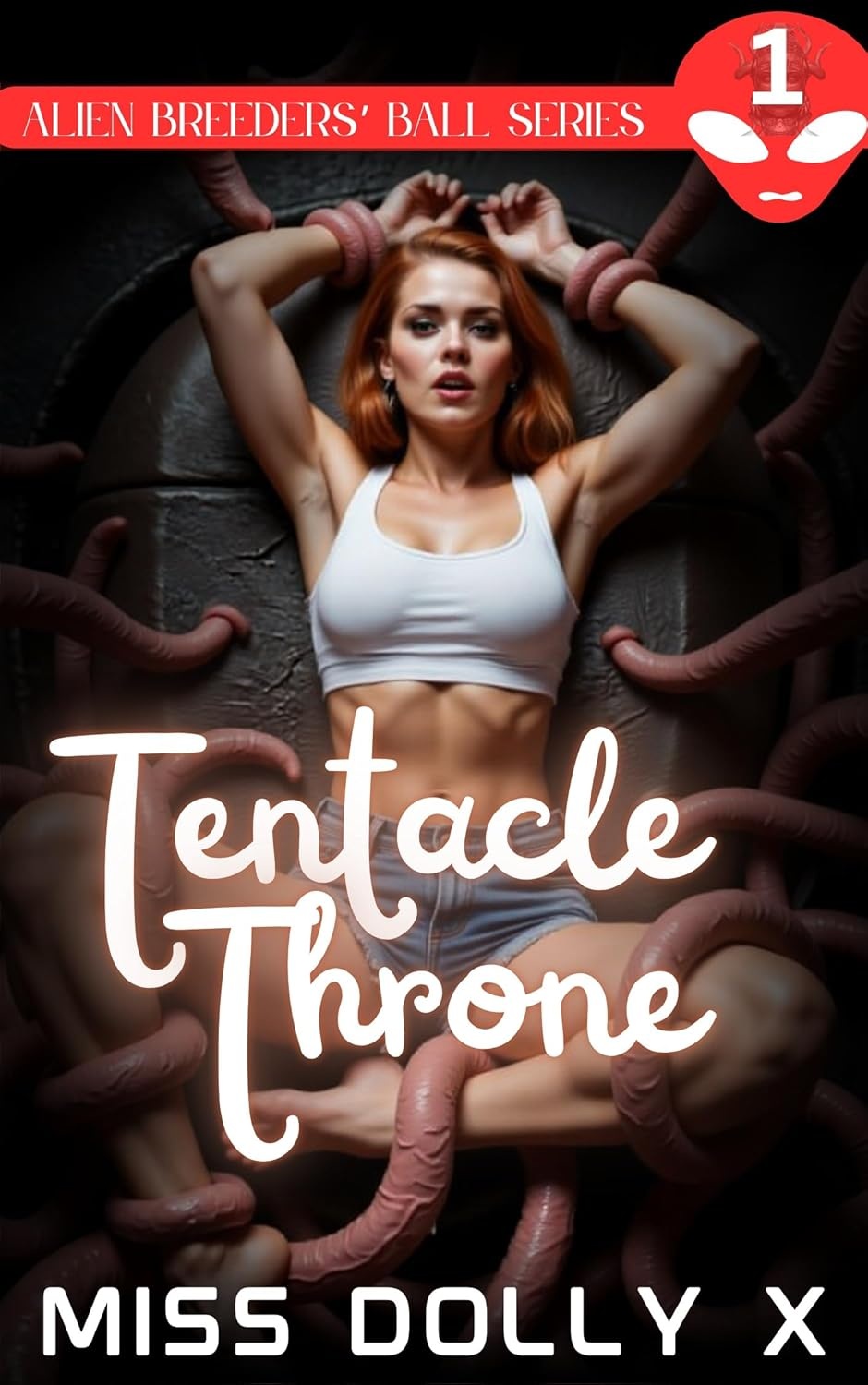
Tentacle erotica throws that linearity out the window. A scene can have a tentacle on each nipple, one between the legs, one wrapped around a thigh, another sliding slowly up the spine, and the whole thing can pulse in different rhythms simultaneously. The writer gets to describe a symphony instead of a solo. The reader gets to track multiple points of sensation at once, which mimics the actual experience of being overwhelmed by touch. That is a gift. It lets a scene build tension through layering rather than through simple escalation.
The pacing advantage also shows up in the prelude. A tentacled partner can begin touching before the characters have even closed the distance between them. A tendril can brush against an ankle from across the room. Another can tease the back of the neck while the character is still talking. This creates a sense of inescapable intimacy that a two-handed partner cannot replicate without a lot of choreography. The creature is already everywhere, so the reader never doubts what is coming.
This is also why tentacle erotica works so well as a breeding story. The logistics of alien breeding romance often require a lot of setup, sometimes too much. With tentacles, the setup can happen while the main action is already underway. A single appendage can handle the actual insemination while others keep the character suspended, stimulated, or held open. The narrative does not have to pause to move the characters into a new position. The position is a constant, and the tentacles adapt around it. Check out Star Sower: A Captive in the Tentacle Alien Breeding Chamber for a take on this dynamic where the entire environment feels alive.
The Power Dynamic Is Built Into The Anatomy
When a writer pairs a human character with a humanoid alien, the difference in power is an abstraction. The author has to convince you that the alien is stronger or more intimidating. With tentacles, the power dynamic is written directly into the body. There is no faking the fact that a creature with six or eight or twenty appendages can pin a fully grown adult down with zero effort.
That visceral physical superiority feeds into one of the genre's favorite themes: the loss of control. It is one thing to consent to a partner who is slightly broader in the shoulders. It is another thing entirely to be held by a body that covers yours like a net. The tentacles do not need to be rough to be dominant. They can be very gentle and still convey total control, because there are simply too many of them. The character stops being an active participant in the positioning and becomes a passenger in their own orgasm. That surrender is the entire appeal of the trope, and it is worth noting that The Dream of the Fisherman's Wife gets that exact feeling across in a single static image. Hokusai knew the secret back in 1814.
This sits neatly alongside the touch-starved mold. A tentacled partner can offer more contact in one scene than a human partner could provide in a week. Every inch of skin gets covered, sometimes literally. If you have read The Touch-Starved Monster Trope, Explained, you already know where this goes. A character who has been craving contact for years suddenly has more of it than they can process. The overwhelmed response is not just erotic, it is emotional, and the tentacles make that overwhelming quality physically believable.
It Carries The Weight Of Fated Mates Better Than Bipedal Bodies
The fated mates convention in alien and monster romance does a lot of heavy lifting. Two characters meet, an instinct kicks in, and suddenly they are bonded for life. That is a beautiful fantasy, but it can feel unearned when the characters have nothing at stake beyond proximity. Tentacle erotica fixes this by making the bond physical before it is emotional.
The creature does not just sense the character. It reads them through a dozen points of continuous contact. The tendrils learn the rhythm of a heartbeat, the texture of skin, the taste of sweat, all at once. By the time the fated mates bond snaps into place, it feels like the natural result of being thoroughly known on a cellular level. The Fated Mates, Explained article covers the mechanics of the bond itself, but tentacle stories make it feel less like magic and more like biology.
Enjoyed this? Get a free book.
Join the list and we will send a complete free story straight to your inbox, plus new releases every week after that. No credit card, no catch.
There is also a size difference element that gets turbocharged. A humanoid alien can be taller or broader, but the size difference trope operates on visual scale. Tentacles add a different kind of size: coverage area. The creature does not need to be physically massive to feel immense, because it can be wrapped around the character's entire body at once. That sense of being dwarfed by the encounter rather than just the partner is a specific flavor that Size Difference in Monster Romance gets into, and tentacle erotica has its own version of the dynamic that runs parallel to it.
The Aesthetic Is Unapologetically Weird
One reason tentacle erotica still works is that it stopped pretending to be anything other than what it is. The genre has fully embraced its own weirdness. The creatures do not need to be vaguely handsome aliens with interesting hands. They can be genuinely bizarre, translucent, glowing, covered in bioluminescent patterns, with skin that shimmers under alien suns. The audience came for the strangeness, and the strangeness delivers.
That embrace of the weird also excuses a level of experimentation that other monster romance subgenres struggle with. The anatomy can do things that are physically impossible for a humanoid partner. Multiple entrances can be filled at once. A tentacle can shape itself into a curve that hits a spot no human could reach. The creature can change texture mid-scene, going from smooth to ridged to slick. None of this requires the reader to suspend much disbelief, because the entire premise is already impossible. The writer just has to be specific and consistent.
This versatility might be why tentacle erotica shows up so often in spaces like alient breeding romance books, where deeper or more alien interiors are part of the fantasy. The tentacle shapes the internal experience in ways a human body cannot, which lets writers create entirely new sensations for characters who are supposed to be feeling things no human has ever felt. That opens up a surprising amount of emotional range. Scenes can go for complete tenderness in one paragraph and overwhelming intensity in the next, without the transition feeling jarring.
The Element Of The Unknown
There is one advantage tentacle erotica has over every other creature type, and it is the simplest one. Nobody actually knows what a tentacle feels like. This is not true for a furry body or a scaled one or a clawed hand. Those textures have human analogues. But there is nothing in the human physiology that replicates the sensation of a limb that is all muscle, no skeleton, no joints, moving with hydraulic precision.
Because the sensation is unknown, the writer gets to define it. Some describe tentacles as slick and cool. Others lean into the heat of a living appendage, warm and pulsing on the outside. The texture can be suctioned, ridged, smooth, or covered in fine cilia. The writer chooses the rules, and the reader trusts the description because there is no real-world reference to contradict it. That is a rare kind of narrative freedom, and writers who know what they are doing use it to build their own rules for how touch feels in their world.
Why The Trope Outlasts The Novelty
Every new type of monster romance goes through a phase where it feels electric and new, then settles into a niche. Dinosaur romance had its moment. Gothic romance keeps returning in waves. Tentacle erotica never really had a novelty phase, because it has been around so long that it functions as a baseline curiosity. People who like it have always liked it, and people who dislike it tend to have made up their minds without reading it.
The staying power comes from the anatomy doing something no other body type can. A minotaur is a man with a head and a build. A dragon is a creature with wings and a tail. A tentacle monster is an entire topology of sensation, and the genre built an enduring space around exactly that. The versatility, the inherent power dynamic, the freedom from human anatomical limits, and the embrace of pure strangeness combine into a subgenre that keeps finding new readers generation after generation.
If you are new to it, start with a story that leans hard into the fantasy rather than apologizing for it. Planet Of Orgasms is a good place to begin with the environment itself participating in the scene. Taken by the Celestial King offers a version where the tentacled partner is regal and commanding. And for the breeding angle done well with a focus on the physical mechanics, Worship The Womb handles the internal focus that the genre does better than almost anything else.
The trope keeps working because it refuses to be a one-note joke. Plenty of jokes have been written about it, and the genre absorbs them all without flinching. On the page, tentacle erotica remains one of the most flexible, imaginative, and genuinely erotic corners of monster romance, and it has been doing that job for over two hundred years. Some tropes fade because people tire of them. This one never fades because the anatomy keeps giving writers new things to try.
Final Thoughts
The best entry point for a new reader is a story that treats the creature seriously and the pleasure seriously. Extraterrestrial Heat sets up that balance nicely, with an extraterrestrial encounter that builds the world before it dives into the physical details. If you want to understand why the trope has survived this long, read that one, then read a second, then a third. The genre has range, and the range is the point.





Loading comments…