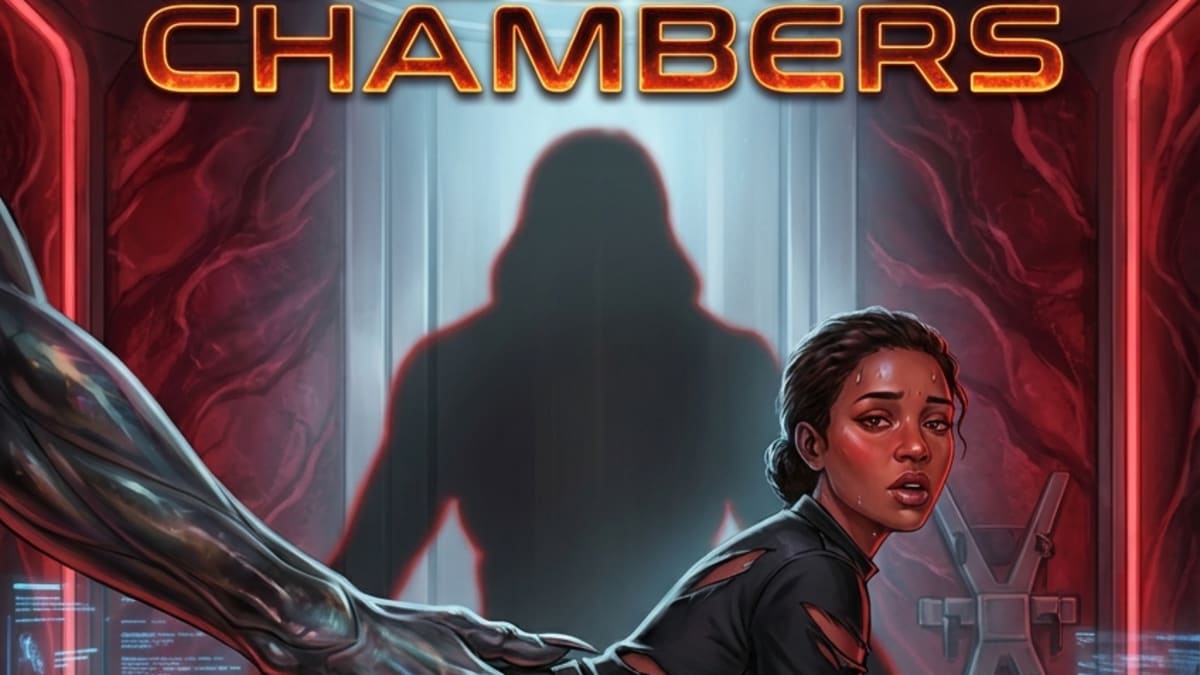
Dystopian romance is a love story built inside a world that has already failed. The government is a boot on the neck, the water is poisoned, the city is a walled cage, and two people find each other anyway. The romance carries the plot, but the collapse shapes everything about it: how they meet, what they're allowed to want, whether wanting it at all is a risk.
A dystopian romance can be a slow burn across a ruined continent. It can also be a filthy, desperate thing that happens in a supply closet while patrol drones hum past the door. The setting isn't decoration. It's the engine.
What Dystopian Romance Actually Means
The term splits cleanly into two halves, and both halves have to be doing real work.
Dystopian means an imagined society organized around control, scarcity, or collapse. Not just a hard world, a designed one. Somebody built the oppression.
There's a faction system, a registry, a wall, a cure that isn't a cure. The misery has an author, even if that author is a council, a corporation, or an algorithm.
Romance means the central relationship resolves into something durable: commitment, partnership, a future together that the reader can actually believe in. The couple doesn't just survive each other. They choose each other on the page, in a way the book treats as a win.
Where the two meet is the part that matters. In a dystopian romance, the love story and the political story are the same story. The couple's desire is either criminal, punished, monitored, or weaponized, and the book knows it.
What Counts, What Doesn't
A romance novel that happens to be set after a war, with a functioning society and a couple who could plausibly meet at a coffee shop, is post-apocalyptic atmosphere with a love story stapled on. It might be great. It's a weak fit for the label.
A romance where the relationship is the direct target of the oppressive system passes. So does one where the couple's intimacy is itself a form of resistance, or where the pair's survival depends on staying hidden from a power that would separate them.
Common Misconceptions
- That it has to be bleak. Plenty of dystopian romance is dark with a hard-won hopeful ending. The genre runs from grim to weirdly cozy, and the cozy end is bigger than people expect.
- That the romance is secondary. If the book kills the couple, separates them permanently, or treats love as a thematic footnote, it's dystopian fiction with a romantic subplot. That's a different shelf.
- That it's all young adult. YA pushed this trope into the mainstream, but the adult end of the category is where the explicit dystopian romance lives, and it goes considerably harder.
- That "dystopian" means "vague and sad." The best versions are specific. Gas rationing. A curfew that starts at 8:40. A wristband that reports arousal spikes to a central server.
The detail is what sells the world, and the world is what sells the stakes.
Where Dystopian Romance Comes From
Political dystopia as a literary form is old. Dystopian romance as a publishing category is young, and its history is almost entirely a story about the romance market discovering that collapse sells.
For most of the twentieth century, the canonical dystopias didn't have romance in them. They had protagonists who wanted to escape or resist, and love was either absent, doomed, or a footnote. Then the 2000s happened to the book trade, and a wave of YA dystopia put a teenage girl at the center of a ruined society, gave her two boys to choose between, and sold tens of millions of copies. That wave is the origin point readers actually recognize.
What the YA boom proved was structural, not just commercial. It proved that the machinery of oppression makes an excellent romance engine: it manufactures forced proximity, it makes every private moment dangerous, and it gives the couple a shared enemy to hate together. Once adult romance publishers saw that, the crossover was inevitable.
How It Moved Into Adult Erotica
The shift into adult territory happened in two stages. First, indie publishing let authors take the same tropes and go explicit, which pulled the couple out of the fade-to-black and into the bedroom, the bunker, the holding cell. Second, the category fragmented into sub-tropes, each with its own readership: captive romance, resistance leader romance, survival romance, dystopian enemies-to-lovers.
That fragmentation is the real story of the last decade. "Dystopian romance" stopped being one shelf and became a set of overlapping shelves. There are readers who will follow a rebel commander to the end of a trilogy, and readers who only want the version where the regime's enforcer is the love interest.
The adult end also absorbed something the YA version couldn't say out loud: that under totalitarian control, desire itself becomes political. Every orgasm is a data point the state would like to have. That's a genuinely adult idea, and it's the one the category has been mining ever since.
If you want the wider publishing context for how fast these sub-tropes metastasize, The State of Erotica Publishing Right Now is a useful place to see the mechanics.
How It Shows Up in Erotica
This is where the trope either earns its page count or falls flat, and the difference is almost always craft, not concept.
A strong dystopian romance does four things at once. It builds the world through the couple's logistics (how they get food, where they sleep, what happens if they're caught). It makes intimacy expensive. It lets the couple's relationship change the world in some measurable way, even a small one.
The fourth thing: it keeps the sex scene embedded in the danger instead of pausing for it. Miss any of the four and the book starts leaking.
The flat version does none of that. The world is a painted backdrop, the couple could be anywhere, and the oppression is a villain the hero punches in the final act.
Enjoyed this? Get a free book.
Join the list and we will send a complete free story straight to your inbox, plus new releases every week after that. No credit card, no catch.
The Core Variants
- Dystopian enemies-to-lovers. The resistance fighter and the regime's officer. This is the most popular version by a wide margin, and it's a direct extension of the enemies to lovers dynamic, accelerated by the fact that the two of them have a moral chasm rather than a personality clash.
- Captive romance. One partner is the other's prisoner, or the pair are prisoners together. The power imbalance is baked in, and readers who want that dynamic will find the dystopian frame provides it more cleanly than almost any other setting.
- Resistance leader romance. One or both partners are fighting the system, and the relationship has to survive the movement's demands. Often where the political and romantic arcs fuse hardest.
- Survival romance. Collapse rather than control. There's no regime, just a ruined world and whatever it takes to eat. Often quieter, more intimate, and often built around a shared shelter or journey.
- Post-apocalyptic romance. The loosest umbrella. Some of it is dystopian, some is just empty-world survival. Overlaps heavily with survival romance.
- Bunker and compound romance. The couple is confined. Forced proximity is the whole point, and the classic secret relationship problem gets a hard deadline attached.
What Makes It Work
Specificity in the world. The best books know exactly how the regime works and drop that knowledge into the couple's choices.
A ration card that limits how often they can be in the same room. A curfew that turns every touch into a time crunch. A tracking implant that makes lying necessary.
Desire as risk. If there's no consequence to the couple being caught, the whole trope is inert. The sex has to feel like something they're choosing against the world's rules, and the book has to keep that pressure on even after the first time.
A real antagonist. Vague oppression doesn't scare anyone. A named enforcer, a specific policy, a visible consequence for violation. The system needs a face at least some of the time.
An ending the world can support. If the couple ends up together but the world stays exactly as broken as it was, the book has to make that feel like a win. Many readers find it unsatisfying. The strongest versions either change something small and real (a rumor spreads, a rule breaks) or earn a genuinely hopeful horizon.
What Makes It Flat
The most common failure is treating the dystopian setting as mood. There's fog, there's rubble, there's a uniformed enforcer who says something cruel, and then the couple retreats into a love story that could happen anywhere. The regime exists to look bad, not to shape behavior.
The second failure is a romance that has nowhere to go. If the couple has instant chemistry, no obstacles inside the relationship, and only external dangers, the love story has nothing to do across three hundred pages. The good versions put a structural conflict inside the couple: one wants to flee, one wants to fight; one works for the regime, one doesn't.
The third failure is forgetting the stakes after the first sex scene. In the strongest books, the danger doesn't lift after intimacy begins. It sharpens. Getting what they want makes them more vulnerable, not less.
Dystopian Romance vs Soldier Romance
These two get mixed up constantly, largely because the cover art overlaps: uniforms, weapons, a gaze aimed at the horizon.
Soldier romance is built around the military as an institution, with a functional society behind it. The hero deploys. He comes home. The conflict is usually internal (PTSD, duty, distance) or circumstantial (long separations, command rules), and the world around the couple is basically working.
Dystopian romance inverts that. The institution is the problem.
The hero isn't a soldier in a military, he's an enforcer in a regime, or a rebel in a movement that no recognized state acknowledges. No command structure is backing anyone up. The couple's safety is theirs to build. If a story has soldiers in an oppressive regime but treats the romance like a soldier romance with a darker color palette, it's usually a weaker dystopian romance and a perfectly serviceable soldier novel.
Coming from that other shelf? Start where the worlds overlap, then go darker. Dystopian romance tends to be a natural next step if you like the military tension without the homecoming.
Frequently Asked Questions
Is dystopian romance the same as post-apocalyptic romance?
They overlap heavily and readers use them almost interchangeably. Strictly, dystopian implies a designed oppressive society, while post-apocalyptic implies collapse without a clear authority running things. In practice, most books draw from both, and lots of authors tag them with either label.
Does dystopian romance always have a happy ending?
If it's shelved as a genre romance, yes, or at least a hopeful one. Most readers expect the couple to survive together, even if the world stays broken. Books that kill the couple or separate them permanently are usually shelved as dystopian fiction with a romantic arc.
Is it always enemies-to-lovers?
No, but that's the most common dynamic. Other frequent pairings include the two of them as allies against a common power, a prisoner and a guard with a moral crisis, or a pair of strangers forced to survive together. The enemies version just packs the most conflict into the fewest pages.
How dark does it get?
As dark as you want. The category includes books that are grim and violent, books that are bleak but hopeful, and books that are surprisingly warm. A dystopian romance can have a genuinely soft core if the couple builds safety inside the collapse.
Can dystopian romance be explicit?
Yes. The adult end of the category is where most of the explicit dystopian romance lives. YA gave the trope visibility, but the on-page end is the one readers search for by name, and it's where the trope's politics of desire get worked out in detail.
Where do I start if I've never read one?
Pick a variant you already like. If you read enemies-to-lovers, start with a dystopian enemies romance. If you like confined settings, start with a bunker or compound book. The dystopian frame is flexible enough to be grafted onto whatever dynamic you already trust.
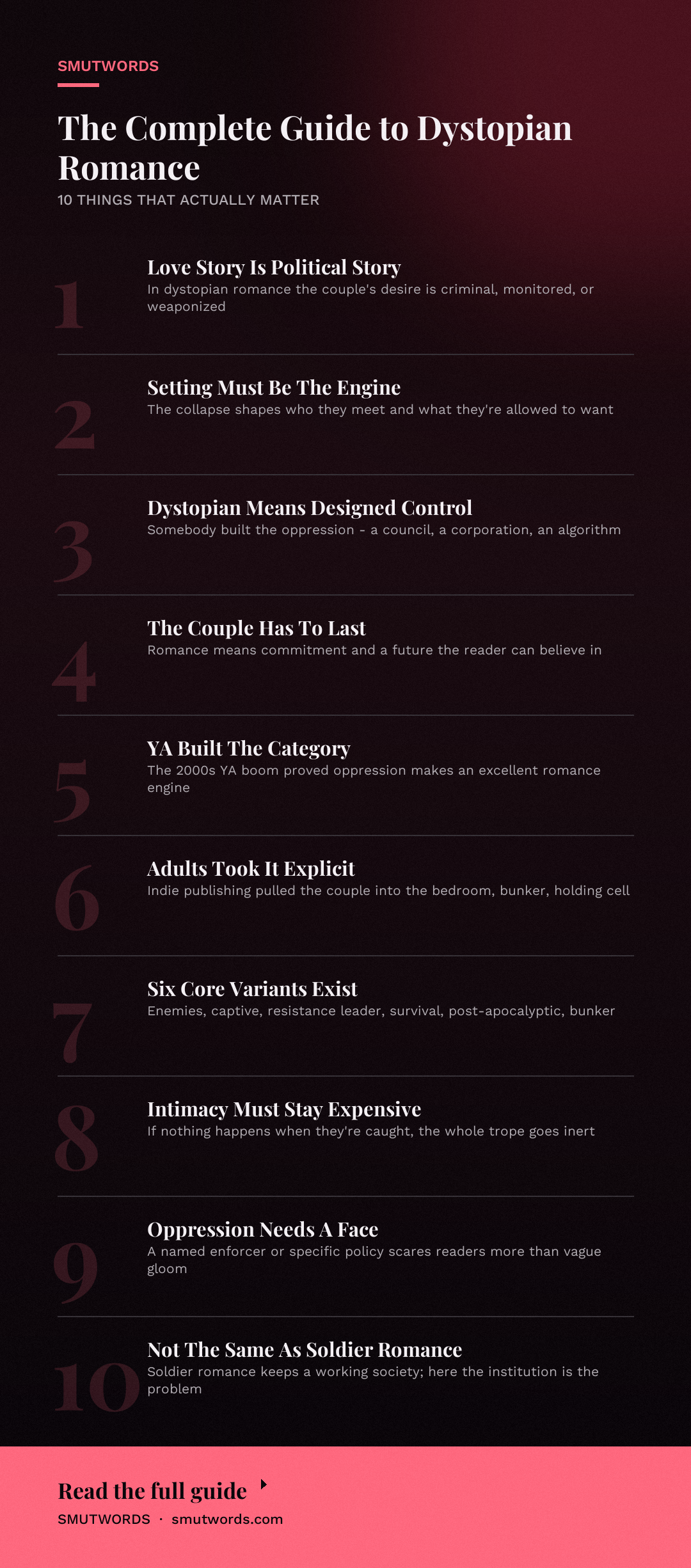
Final Thoughts
Dystopian romance lives or dies on specificity: a particular regime, a particular rule, a particular way the couple's desire runs against it. Read one book that earns the label and you'll know within a page. Start with something that takes its own world seriously, then ask whether the couple's want feels like the most dangerous thing in it. If you want the next shelf over, the cosmic horror romance guide scratches a similar itch from a different angle.





Loading comments…