
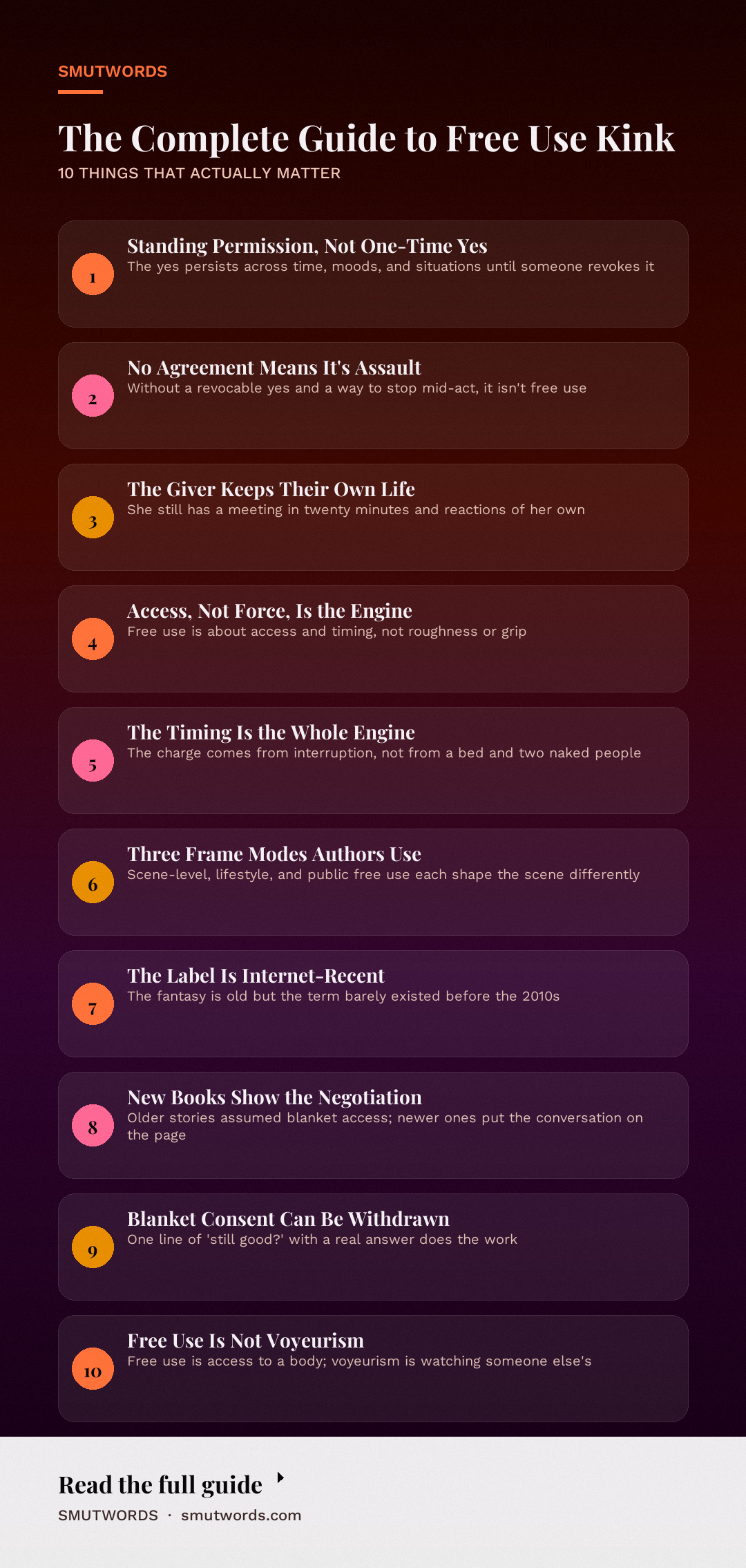
Free use kink is a consensual arrangement in which one person grants another standing permission to initiate sex at any time, without asking first, inside limits both parties set in advance. It's the fantasy of permanent availability: your partner reaches for you mid-conversation, mid-chore, mid-anything, and the answer is already yes.
The free use kink turns an ordinary Tuesday into a loaded proposition. The dishes, the commute, the work call, all of it sits inside a frame where anyone could be bent over the counter with no preamble.
That's the short version. What follows is everything the glossary entry leaves out: where the term came from, how authors actually write it, why some versions land hard and others read flat, and what the fantasy is really doing underneath.
What Free Use Kink Actually Means
The name is literal. "Free use" means your body is available for use, on demand, as a standing condition rather than a per-incident negotiation. The key word in that sentence is "standing." A one-time yes isn't free use. Free use is a yes that persists across time, moods, and situations until someone revokes it.
In practice, the arrangement has a few moving parts worth naming separately.
- The giver offers ongoing access and retains the right to withdraw it at any moment.
- The user acts on desire without requesting permission each time, staying inside the agreed limits.
- The frame is the duration and scope: one scene, one weekend, one room, or the whole relationship.
- The safeword is the escape hatch, and it can belong to either partner.
- The check-in is the scheduled conversation that keeps blanket consent from going stale.
What does not count matters just as much. Free use is not a loophole around consent. If there's no standing agreement, no revocable yes, and no way to stop things mid-act, that isn't free use. That's assault wearing the costume.
The entire erotic charge of the kink depends on the permission being real, deliberate, and current.
The other common misconception is that free use means the giving partner has no preferences of their own. In good writing, the opposite is usually true. She has a meeting in twenty minutes. He's mid-sentence on a phone call.
The friction between what's happening and what's being done to them is where the heat lives. That only works if both people are fully present as people.
Because it sits next to consensual non-consent, free use gets folded into CNC conversations constantly. The overlap is real, but the emphasis differs. CNC typically stages a lack of consent inside a consensual frame. Free use stages the absence of asking, which is a subtly different fantasy about access rather than resistance.
Where Free Use Kink Comes From
Honest answer: the terminology is recent, and the fantasy is not. The phrase "free use" as a distinct kink label barely existed in mainstream erotic vocabulary before the 2010s. It grew out of online kink communities, porn tagging conventions, and forum shorthand, where people needed a compact term for a dynamic that had been written about for decades without a name.
The erotica itself is older. Romance and erotic fiction have leaned on boundless availability since long before anyone tagged it. Historical romance routinely hands its hero a wife who is simply there, in his bed and his house and his orbit, available by the logic of the marriage plot. That's free use in everything but terminology, and it's frequently written as one of the book's chief pleasures.
Two genre shifts made the term necessary. First, the rise of the open-door erotic romance in the 2010s meant more scenes of casual, unhurried access between established partners. Second, omegaverse and fated-mate fiction gave the dynamic a supernatural license, where a bond makes one partner's body permanently responsive to the other. If you want the full mechanics of that version, our breakdown of mate bond and marking covers how the genre codifies permanent access.
The publishing history matters because it explains the term's shape. Free use became a label on the internet, and book blurbs adopted it once readers were already searching for it. That means the trope descriptions you see now are downstream of reader demand, not author invention. Readers asked for it by name, and the market answered.
The last decade has also sharpened the on-page negotiation. Older books tend to present blanket access as a natural feature of a marriage or bond, no discussion required. Newer ones often include a conversation on the page, sometimes explicitly, because the audience wants to see the trust being built rather than assumed. Neither approach is wrong, but the shift is real and worth noticing.
How Free Use Kink Shows Up in Erotica
Craft first. A free use scene lives or dies on the gap between the mundane and the act. The strongest versions put the reader in the middle of something ordinary, then let desire arrive without warning.
She's folding laundry. He's reading. Then a hand on the back of her neck, and the scene has already started before she has time to set anything down.
That timing is the engine. If the scene opens with both characters already naked and willing in a bedroom, you've written an ordinary sex scene with extra steps.
The free use charge comes from interruption.
The three structural modes authors use
Almost every free use scene in the catalog runs on one of these frames. Knowing which one you're writing keeps the scene honest.
- Scene-level free use. The couple agrees that for the next few hours or the length of a party, no one asks. The scene ends when the timeframe does. This is the easiest version to write and the most common in short erotica.
- Lifestyle free use. The arrangement is ongoing and shapes the whole relationship. It shows up in the background of ordinary scenes: an unspoken rule that follows both characters through the book.
- Public or semi-public free use. The dynamic runs in a room with other people in it, everyone aware, nobody intervening. This is where free use overlaps with group settings and staged spectacle, territory our glossary entry on the orgy covers when the crowd itself becomes a character.
Variant names you'll see in blurbs and tags include 24/7 free use, free use agreement, CNC-adjacent free use, scheduled free use, free use party, and "use and be used." Scheduled free use is worth flagging. It sounds like a contradiction, but the version where both partners know Thursday nights are open ends up hotter than the totally spontaneous version for some readers, because the anticipation does the work all day.
What makes the strong versions work
The best free use writing keeps the giving partner's interiority intact. She has reactions. She has a life that was happening before the hand landed on her. Authors who flatten her into a body with no opinions are writing a prop, and readers feel the difference within a paragraph.
Second, strong versions let the user's desire be visible. Free use isn't routine maintenance. The person acting wants this, specifically, right now. If the user reads as bored or mechanical, the scene loses its charge.
Third, the limits stay in the room even when they aren't spoken aloud. A raised eyebrow. A hand pushing back. A safeword that gets used once and respected instantly, then the scene resumes with the dynamic not only intact but reinforced.
That beat does enormous work. It proves the permission is real, and real permission is what makes the fantasy safe to enjoy.
Enjoyed this? Get a free book.
Join the list and we will send a complete free story straight to your inbox, plus new releases every week after that. No credit card, no catch.
Where it goes flat
Most weak free use scenes fail in one of three ways. They skip the negotiation entirely and pretend blanket consent appears from nowhere. They write the giver as passive to the point of absent. Or they confuse free use with rough sex and assume intensity alone carries the scene.
That last error is common. Free use and rough sex are neighbors, not the same address. Roughness is about force and intensity.
Free use is about access and timing. You can write a devastating free use scene that's physically gentle, and it will still land, because what's erotic about it is the standing yes, not the grip.
One more craft note. Praise lands differently in this dynamic than in almost any other. When the giver takes it well, when the user tells them so, the response hits harder than in an ordinary scene, and it's worth understanding why through our guide to praise kink. Being good at being used becomes its own reward structure.
How it interacts with other dynamics
Free use is a flexible frame that authors stack with other tropes. It pairs naturally with possessive characterization, since unlimited access and proprietary feeling share a root. If you want the mechanics of that pairing, our breakdown of the possessive hero covers how ownership gets written on the page without tipping into cruelty.
It also stacks well with forced proximity. Being snowed in with someone who has standing permission changes every scene in the cabin, whether or not sex is happening. The arrangement charges the air in the room.
In monster and paranormal romance, free use often arrives through biology instead of negotiation. A creature's instinct or a bond makes access constant. That version borrows heavily from feral play, where the loss of civilized restraint is the point. Our complete guide to feral play gets into how that instinct-driven framing works when the human rules drop away.
Group settings are another frequent home. Free use parties are their own subgenre, where the standing permission belongs to a room rather than a couple. If you're writing one, the crowd-control problems are the same ones our glossary note on swinging describes: who knows what, who's watching, and who gets to say stop.
The real-world layer
Even in fiction, the practical requirements are the same ones that keep the dynamic healthy in real life. Blanket consent is still consent, which means it can be withdrawn, which means it needs a way to be withdrawn. A safeword for either partner.
Hard limits written down somewhere both people can see. Regular check-ins that ask, out loud, whether this is still what both people want.
Consent given on a Tuesday isn't automatically valid on Friday. That gap is where the fantasy lives in fiction and where the danger hides in real life. The best free use stories gesture at this without turning into a manual. One line of a partner asking "still good?" and getting a real answer does it.
Free Use Kink vs Voyeurism
These two get confused because they both involve being seen or having something done in front of someone. The distinction is clean once you name it. Free use is about access to a body. Voyeurism is about watching someone else's.
The user in free use is a participant. The voyeur is an observer, and the charge in voyeurism comes from the distance, not the contact.
They overlap when a third person watches a free use scene. In that version, the arrangement is free use and the onlooker brings the voyeuristic charge. If the husband is the one watching, you've landed in the voyeur husband trope, which stacks the two kinks by design.
Frequently Asked Questions
Is free use kink the same as CNC?
They're close relatives with different centers of gravity. CNC stages the absence of consent inside an agreed frame.
Free use stages the absence of asking inside an agreed frame. Both require negotiation and a safeword, and plenty of authors write scenes that read as both at once. The label matters less than what the scene is actually doing.
How do you write a free use scene without it feeling like a prop?
Give the receiving partner a life that was mid-sentence when the scene started. Let them have a reaction, a preference, a thing they were doing. Let the initiating partner want this specific person in this specific moment. If both people are present as people, the scene reads as hot rather than hollow.
What's the difference between free use and a free use agreement?
Mostly scope. "Free use agreement" typically refers to the negotiated terms themselves, the explicit conversation about limits and duration. "Free use" describes the dynamic that results. In blurbs the two get used interchangeably, but the agreement is the framework and the dynamic is what happens inside it.
Does free use have to be 24/7 to count?
No. Scheduled free use, scene-level free use, and weekend-only arrangements all count. The defining feature is standing permission inside a defined window, not permanence. Some readers find the scheduled version hotter because the anticipation runs all day before the window opens.
Why do readers find free use so appealing?
It removes the friction of courtship. There's no asking, no rejection risk, no performance of availability. What's left is the raw fantasy of being wanted constantly and belonging to someone completely. Possessiveness and total trust sit on opposite sides of the same coin here.
Can free use work in a scene with other people involved?
Yes, and it's one of the most common variations. A free use party or a couple in a room where others are present lets the standing permission extend to a group. That version requires more explicit rules about who can act and when, since the negotiation has more moving parts.
Final Thoughts
The free use kink is one of the harder dynamics to write badly on purpose, because everything that makes it work is invisible. The permission, the trust, the standing yes, the revocable nature of it all.
When a scene gets those right, the heat comes from something a reader can't quite point to, which is exactly why it keeps landing. If you want a book that handles the arrangement with real weight, our ranked list below is the place to start.







Loading comments…