Play party etiquette is the set of written and unwritten rules that govern behavior at BDSM and kink social events where public scene play happens. It covers who you can touch, how close you can stand, what you can say to a tied-up submissive, and what happens when someone safewords mid-scene.
For anyone who writes or reads kink fiction set in dungeons, clubs, or private play parties, these norms are the scaffolding that makes public exhibitionism, voyeurism, and social dominance read as hot instead of chaotic or violating. Play party etiquette is the difference between a scene that feels like a shared performance and one that feels like an intrusion.
What Play Party Etiquette Actually Means
Play party etiquette is not a single legal code handed down by one governing body. It is a living set of social contracts that vary from venue to venue, city to city, and crowd to crowd. At its core, it is the shared understanding that everyone present has consented to be in a space where intense things happen, but that this consent does not automatically extend to being touched, photographed, spoken to, or included.
The term breaks down into two halves. The "play party" is the event itself: a gathering, usually at a private residence or a rented dungeon space, where attendees are free to engage in BDSM scenes, often in semi-public view.
The "etiquette" is the behavioral code that keeps the event safe and functional. Some of it is written on signs taped to the wall. Some of it is enforced by dungeon monitors (DMs). Much of it is passed along by word of mouth and absorbed by watching what other people do.
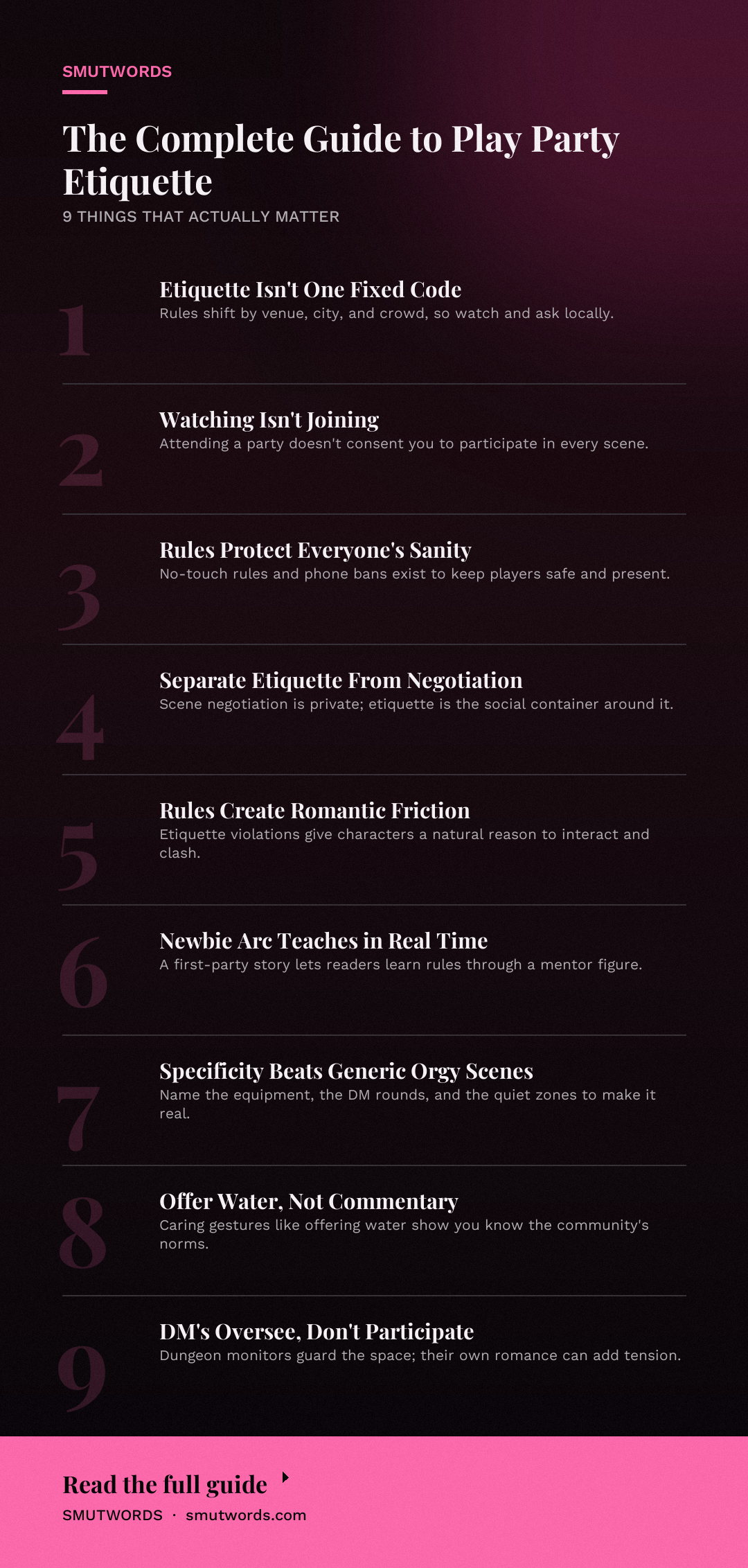
What does not count as play party etiquette is individual scene negotiation. That is a separate, more intimate process handled between the people actually playing together, usually before the party or in the moments just before a scene begins. Etiquette is the context that surrounds that negotiation: the rules that make it possible for two people to hash out a scene without thirty strangers interfering. For a deeper look at that pre-scene process, see the glossary entry on Kink Negotiation.
Common misconceptions abound. The biggest one is that attending a play party means you are consenting to participate in everything you see. It does not. Watching is not the same as joining.
Another misconception is that fetish events are lawless spaces where anything goes. The reality is that reputable parties have more explicit, enforced rules than most vanilla social gatherings, precisely because the stakes are higher.
Where Play Party Etiquette Comes From
Organized BDSM social events have existed in recognizable form since at least the mid-twentieth century, but the genre of etiquette writing around them really crystallized in the 1990s and 2000s with the rise of the internet and the mainstreaming of kink education. The early leather bars and private clubs of the 1970s operated on a mix of bar rules and community norms, much of it communicated through a knowing glance or a sharp word from a regular.
As BDSM moved out of the shadows and into rented community centers and educational conferences, the need for codified, teachable rules grew.
The publication of foundational BDSM safety texts, alongside the growth of organizations dedicated to education and outreach, gave rising generations a shared vocabulary. Terms like SSC (Safe, Sane, Consensual) became shorthand for an entire philosophy of risk-aware play.
That principle anchors much of modern party etiquette: every rule, from "don't touch a player without asking" to "leave your cell phone in your bag," exists to protect the safety and sanity of the people playing and the consent of everyone in the room.
What is fascinating for writers is how these norms have shifted in fiction over the same period. Erotica from the 1980s and early 1990s often depicted dungeon scenes as chaotic, dangerous, or decadent spaces where anything could happen. The dominant was frequently portrayed as a charismatic outlaw operating outside social constraints.
Modern kink fiction, by contrast, increasingly treats the play party as a structured social world with its own politics, friendships, rivalries, and quiet rules. The dungeon is no longer a lawless underworld; it is a community center with a coat check and a consent policy.
This shift mirrors the real-world growth of kink education, and it's worth noting how much of that change was driven by online platforms. Readers who had never set foot in a real dungeon wanted the texture of that world, and authors responded by building scenes that showcased the rules as part of the appeal.
The term itself, "play party etiquette," became a recognizable publishing phenomenon in the 2010s as "kink-positive" romance and erotic romance grew on platforms like SmutWords. Understanding Tentacle Play shows a similar pattern of niche kinks getting mainstream literary treatment. The etiquette stopped being a dry informational insert and became a plot device: a way to create tension, demonstrate a character's experience, or provide a safe framework for an otherwise transgressive fantasy.
How It Shows Up in Erotica
In erotic fiction, play party etiquette functions as both world-building and plot machinery. A well-written scene uses the rules of the party to generate anticipation, establish character, and create meaningful obstacles. The etiquette is rarely the point of a sex scene on its own, but it is frequently the engine that makes the sex scene possible or impossible.
Consider a common scenario: a protagonist attends a party as a voyeur, which for many venues is a completely acceptable role. She stands at the edge of the room, watching a scene between two people she does not know. The etiquette rules govern her behavior: she does not crowd them, she does not make loud comments, she does not touch anyone, and she does not presume that eye contact with the dominant is an invitation.
The tension in such a scene comes from her desire to cross those lines and her knowledge that doing so would violate the social contract. A skilled author stretches that moment of Anticipation Play, letting the reader feel the protagonist's hunger while respecting the rules that keep her in place.
The romantic arc often hinges on etiquette violations and their consequences. A character who has never been to a party might breach a rule unwittingly, maybe by touching a submissive's hair without asking.
Another character, often a seasoned dominant or a dungeon monitor, corrects them. That correction is a natural entry point for dialogue, friction, or an unexpected spark of chemistry. The rules create a reason for the characters to interact that does not feel forced.
Several common variations of the trope recur across the genre.
Enjoyed this? Get a free book.
Join the list and we will send a complete free story straight to your inbox, plus new releases every week after that. No credit card, no catch.
- The "newbie learns the ropes" story, where a character's first party is narrated through their eyes, and the etiquette is taught in real time, often by a patient or stern mentor figure.
- The "veteran and the newcomer" dynamic, where one character knows every rule and the other keeps breaking them, providing recurring tension and opportunities for correction and punishment.
- The "private scene in a public space" fantasy, where the established players ignore the audience entirely, and the etiquette simply creates a respectful bubble of space around them.
- The "etiquette as foreplay" variation, where one character deliberately uses the venue's rules to get closer, such as asking for explicit permission to watch, or proactively offering to kneel at a dominant's side.
- The "breaking the rules for love" arc, where two characters who have been dancing around each other finally abandon propriety and stage a semi-public scene that technically violates venue policy, often because the emotional stakes have become too high.
What separates a strong version of a play party scene from a flat one is specificity. Lazy writing treats the party as an undifferentiated orgy. Compelling writing understands the textures of the space: the cordoned-off areas, the types of equipment, the role of the dungeon monitor who walks by every few minutes, the murmur of conversation near the bar, the faint smell of leather and cleaning solution.
When a character asks the top, "May I offer your submissive some water?" the line lands differently if the reader knows that offering water to a bottom or submissive is a recognized, caring gesture at many events.
The strongest scenes also integrate the venue's emotional reality. Play can be loud, intense, and disorienting. Etiquette dictates that observers keep conversation low and do not interrupt, precisely because a person in subspace can be profoundly altered.
A scene that shows a dominant noticing a roommate across the space, nodding, and redirecting their attention fully back to their partner is showing mastery of both craft and etiquette.
A scene that shows a former partner watching with a complicated expression, and the current player politely ignoring them, uses the social rules to create rich subtext. For stories that lean into the darker edges of power exchange, the CNC erotica explained guide covers how consent protocols shift when play crosses into consensual non-consent territory.
Play Party Etiquette vs Scene Play
Readers and writers sometimes confuse play party etiquette with Scene Play itself. Scene Play is the actual BDSM interaction: the time when one person is tied up, flogged, or teased while the other directs the action. Play party etiquette is everything that surrounds that interaction: arriving, mingling, watching, respecting space, managing the aftermath.
They are sequential rather than identical. Etiquette gets you to the scene, gives you a container for it, and helps you exit it with dignity.
The distinction matters in fiction because it defines where the tension lives. A story focused heavily on etiquette is a story about social navigation, desire deferred, and the charge of watching. A story focused on scene play is usually about the internal experience of being dominated or dominating.
The best party stories interleave both: the strict social rules create the friction and anticipation that makes the scene itself feel earned, and the scene, in turn, demonstrates the trust that the etiquette was designed to protect.
Understanding the difference also clarifies character roles. Dungeon monitors and event hosts are caretakers of etiquette, not usually participants in the scenes they oversee. A story that gives the DM their own romantic arc often explores the tension between maintaining the space and wanting to step into it. For more on the psychological state of the person wielding the flogger, see the glossary entry on Domspace.
Frequently Asked Questions
What happens if someone breaks a rule at a play party?
Dungeon monitors or event hosts will usually issue a warning for minor infractions, like standing too close or talking loudly. Repeated or serious violations, such as touching someone without permission or ignoring a safeword, can result in being ejected from the party or banned from the venue permanently. The community takes consent violations seriously to protect everyone present.
Is it rude to leave right after your scene?
Not rude at all, though most etiquette guides encourage you to check in with your partner first. Aftercare is a critical part of the post-scene process, and leaving someone alone when they are still coming down from subspace can be harmful. Once your partner is grounded and comfortable, stepping away for a drink or a quiet corner is completely normal. Read the glossary entry on Aftercare for the full picture.
Can you talk to people who are playing in a scene?
Only if they speak to you first, and even then, keep it minimal and respectful. People in a scene are often in an altered headspace and should not be expected to make small talk. If you have a genuine concern that someone is in trouble or a safeword was missed, find a dungeon monitor or event host rather than approaching the players yourself.
What does "don't touch the toys" mean?
It means never pick up, handle, or adjust someone else's equipment without their explicit permission. This includes floggers, paddles, rope, and the furniture in the play space. Equipment can be personal, expensive, and adjusted to a specific owner's preferences.
Handling leather implements can be linked to Bondage Safety practices that keep the equipment itself in safe condition. Touching without asking is considered a violation of personal space and can end a play session.
Do you need a partner to attend a play party?
Many people attend solo. As long as you understand the venue's rules and respect the scenes around you, being alone is completely fine. Some events even have specific areas or social hours for singles to mingle and find scene partners or just casual conversation. If you are new, many parties encourage newcomers to attend a Munch (Kink Social) first to meet people in a lower-pressure environment.
Are photos and phones allowed?
Almost always prohibited in play areas. Most venues ban phones entirely on the play floor to protect attendee privacy and to keep people present in the moment. Never assume a scene is a performance for your camera. If a venue does allow photography, it is almost always restricted to staged, consensual shoots where every person visible has signed a release or given verbal permission.
Final Thoughts
Play party etiquette gives fiction a framework that elevates public scenes from mere spectacle to charged, meaningful theater. When characters know the rules and choose to honor or break them, the stakes of every glance and every touch go up.
The best party stories treat the rules as a character in their own right. The tension comes from watching someone learn exactly where the line is, and how good it feels to cross it with permission.
The free use workplace romance guide shows a similar dynamic in a completely different setting: structured rules creating the container for transgressive desire. Whether the space is an office or a dungeon, the etiquette is what makes the fantasy feel real, and the violation is what makes it worth reading.








Loading comments…