A love triangle is a romantic plot built on three points of desire: one character pulled between two people who want them, or two people competing for a third who can't decide. That's the machinery. It undersells the ride.
The love triangle is one of the oldest tension engines in erotica and romance, and it runs cleaner than almost anything else. Every kiss becomes a decision. Every decision becomes a loss. Somebody is always about to get hurt, the reader knows it, and that's exactly why they keep turning pages.
If you landed here from a search, you probably want a real answer and not a two-sentence summary. This is the full breakdown: what counts, where the trope came from, how authors build one that works, why so many collapse into a soggy middle, and the variations that have spun off from the basic three-body problem.
What Love Triangle Actually Means
Strip away the drama and a love triangle is a geometric problem. Point A wants Point B. Point B is also wanted by Point C. The tension lives in the refusal to pick a line, because the moment B chooses, the triangle collapses into a couple and a casualty.
That geometry can be arranged in a few distinct ways, and authors pick their shape deliberately.
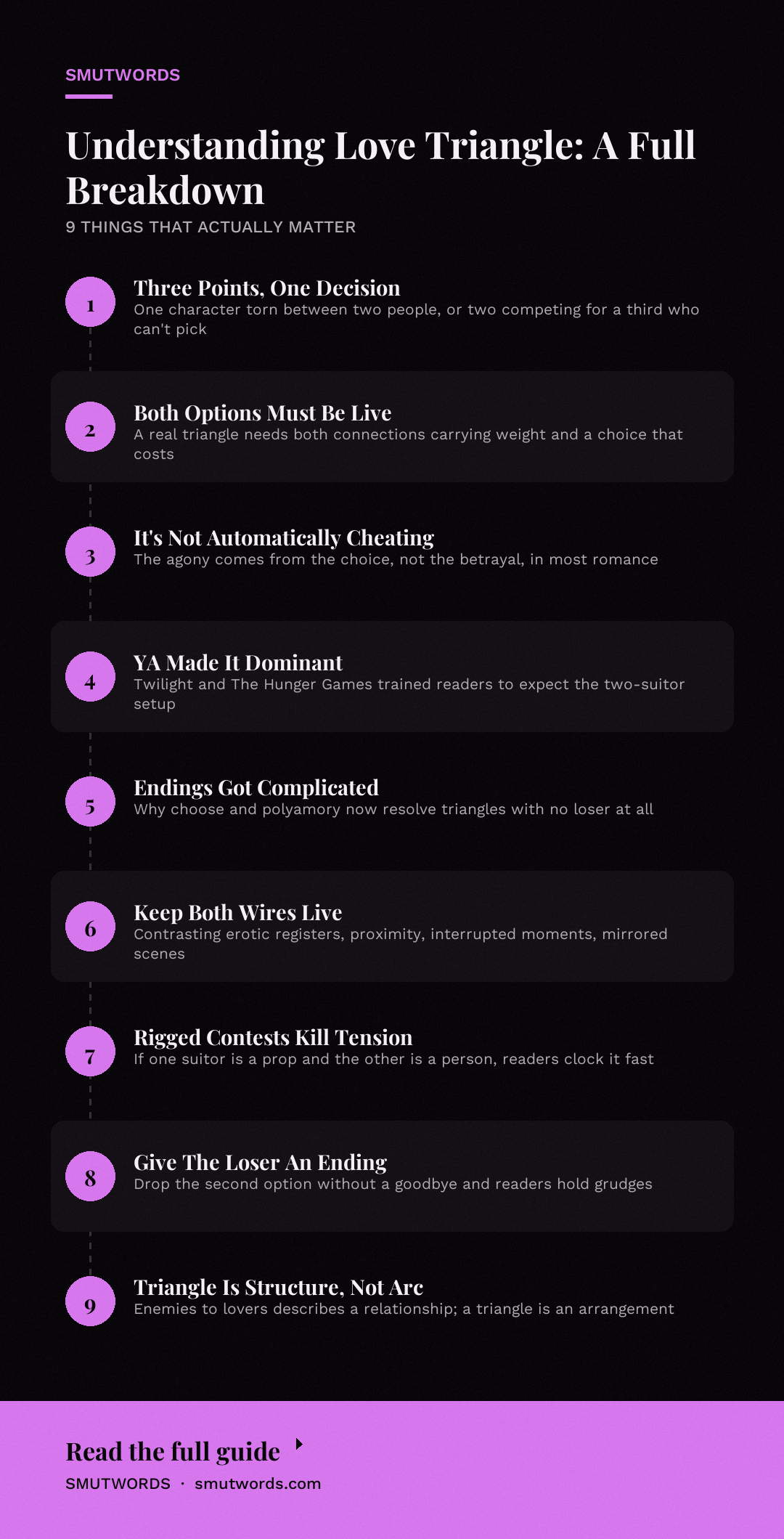
- The classic fork: one protagonist, two suitors, both viable. The reader genuinely doesn't know who wins until late.
- The one-sided triangle: one person is torn, but the second suitor's feelings are unrequited or only half-returned. This is closer to pining than genuine competition.
- The contested triangle: two people actively fight for the third, sometimes with each other rather than against each other. Rivalry, sabotage, and occasionally an alliance that goes sideways.
- The series triangle: the choice stretches across multiple books, with the author dangling both options for volumes at a time. The most commercially potent version and the most dangerous one to write.
What doesn't count is worth being clear about, because the term gets thrown around loosely. A character with an ex who lingers in the background is not a triangle. A crush that never gets reciprocated or dramatized is not a triangle. Two people who both find the protagonist attractive, but only one of whom is ever actually in contention, is not a triangle either.
A real love triangle requires that both connections be live, that both carry real weight, and that choosing one costs the protagonist something they wanted.
The other misconception: people assume a love triangle is automatically about cheating. Often it isn't. In most romance, the triangle resolves before anyone crosses a line, or the third party is a legitimate option the protagonist is free to take.
The agony comes from the choice, not the betrayal, though plenty of authors lean into the betrayal version on purpose.
Where Love Triangle Comes From
The love triangle is older than the novel. It's in Greek myth, in Arthurian legend, in every ballad where a sailor comes home to find his sweetheart promised to another man. But its history as a publishing phenomenon is shorter and more specific than the mythic roots suggest.
For most of the twentieth century, the love triangle was a mainstream literary and film staple more than a romance-genre one. Think of the classic Hollywood setup: two men, one woman, a war or a social divide forcing a choice, and the audience waiting for the verdict. The throbbing ambiguity was the product.
The genre's conventions around it hardened in the mid-century category romance boom, where the triangle became a reliable structural device: the heroine must choose between the safe, respectable man and the dangerous one, and the safe one rarely wins.
The seventies and eighties moved the trope toward the explicitly sexual. Longer historical sagas and the rise of the modern romance paperback let authors spend real page count on both suitors, giving each a full erotic charge rather than treating one as a prop. The triangle became a way to explore two different kinds of desire on the page: the comfort of the known versus the thrill of the uncontrolled.
The biggest shift came with the young adult boom of the 2000s, which pushed the love triangle into its most commercially dominant era. Series like Twilight and The Hunger Games trained a generation of readers to expect a two-suitor setup as the default, and to argue about it online with real conviction. Team Edward versus Team Jacob became a cultural shorthand, and publishers took notes.
Then the 2010s and 2020s complicated the ending. As reverse harem, why choose, and polyamorous romance grew into their own thriving categories, the love triangle started getting resolutions that would have been unthinkable in a 1995 paperback: the protagonist keeps both, or the two suitors discover they want each other, or the triangle was never really a triangle because the author was playing a longer game.
The trope's entire emotional contract changed. The question stopped being "who does she pick" and started being "what does picking even mean here."
How It Shows Up in Erotica
On the page, a love triangle is a tension-delivery mechanism, and everything about how it's written serves that. The craft question is simple: does the reader feel genuine pull in two directions, or do they see the ending coming from chapter three and get bored?
The strongest versions make both options actually win-worthy, which is harder than it sounds. A flat triangle is usually a rigged one. One suitor gets all the heat, all the screen time, all the character development, and the other gets a nice smile and a couple of scenes.
Readers clock this immediately, and the "tension" turns into a countdown. The good ones give the doomed option something real to lose.
Look at the erotica-specific tools authors use to keep both wires live:
- Contrasting erotic registers: one connection is slow, tender, deliberate; the other is rough, immediate, a little dangerous. The reader isn't just choosing a person, they're choosing a kind of sex.
- Physical geography: who the protagonist is alone with, and where. A shared apartment, a road trip, a locked room. Proximity is the trope's engine, and authors manipulate it constantly.
- Interrupted moments: the almost-kiss, the almost-confession, the phone call that lands at the worst possible time. This is the trope's bread and butter.
- Mirrored scenes: the same act with two different people, written so the reader feels the difference in their body. A strong author will echo a scene from twenty pages earlier and let the contrast do the work.
- The delay: how long the protagonist is allowed to genuinely not know. Too short and the triangle never blooms. Too long and it sours into stalling.
The failure mode that kills most love triangles is the held-out verdict. An author decides the ending is suspense, so she withholds it, but she withholds it with filler: repetitive jealousy, contrived miscommunication, a suitor who abruptly turns cartoonish so the other one can win cleanly.
Readers can smell the manipulation, and the emotional stakes deflate. A working triangle needs the protagonist's ambivalence to be explored, not just prolonged. Every chapter should be adding information to the choice, not just delaying it.
There's also the villain version, and this is where the trope gets genuinely nasty in the best way. A enemies to lovers dynamic folded into a triangle gives you a suitor the protagonist shouldn't want and does, competing against someone safe and right. The erotic charge of choosing the "wrong" option is the whole point. That overlap is why so many revenge-driven plots use a triangle as their weapon: the choice becomes an act of war against someone.
Genre shapes the triangle heavily too. In motorcycle club romance, the triangle is often a brotherhood problem, where two men in the same club want the same woman and the club itself becomes the pressure cooker.
Enjoyed this? Get a free book.
Join the list and we will send a complete free story straight to your inbox, plus new releases every week after that. No credit card, no catch.
In celebrity romance, the second suitor is frequently public, a costar or rival who exists in the tabloids, and the choice has reputational weight. In rockstar romance, the road keeps the two options geographically apart, and the protagonist is essentially choosing between two lives, not two men.
The other thing serious authors do that beginners skip: give the losing suitor an ending. Not always a new love interest, not always a tidy redemption, but a final scene that pays off what the reader invested. When a triangle drops its second option without a goodbye, it reads as abandonment, and readers hold grudges across an entire series.
Love Triangle vs Enemies to Lovers
These two get folded together constantly because so many books use both at once, but they aren't the same trope and confusing them will make your plotting sloppy.
Enemies to lovers is a relationship arc. It describes the emotional trajectory between two people: hostility, forced proximity, grudging respect, desire, surrender. It needs two people and a reason they shouldn't work.
A love triangle is a structural arrangement. It needs three people and a genuine decision. You can write a love triangle where nobody is anyone's enemy. You can write enemies to lovers with no third party at all.
Where they overlap, and where it gets fun, is the villain-suitor version: the protagonist is torn between the antagonist they've been fighting and someone safe, and the erotic charge lives in the taboo of wanting the enemy.
That's a love triangle with an enemies-to-lovers spine bolted through it, and it's one of the most commercially satisfying combinations in dark romance, because it doubles the tension. The protagonist isn't just choosing a man; she's choosing a side, and possibly betraying the other one.
If you love the triangle specifically for the dangerous option, it's worth reading around the edges of the trope. Plenty of mafia romance runs on a triangle where the wrong choice is the one with the blood on his hands, and the choice is explicitly a choice about what kind of life the protagonist wants to live.
The Variants Worth Knowing
The basic shape has spun off a bunch of recognizable mutations, and readers search for them by name, so it's worth being fluent.
- Love triangle with a twist: the author subverts the expected resolution. The "safe" choice loses. The villain wins. The second suitor was the villain all along. The protagonist picks nobody.
- Love triangle resolved by polyamory: the third point stops being a competing option and becomes a second partner. The whole emotional logic of the trope gets rewritten, because there's no loser and no sacrifice. This is the version that has grown fastest in the last decade.
- Love triangle with a villain: one suitor is objectively dangerous, and the protagonist wants him anyway. Leans hard on taboo and the dread of what choosing him will cost.
- Love rectangle: four points, four desires, deliberately tangled. Common in small-town and ensemble series where the whole friend group is interwoven. If you like this shape, the social pressure of a small town romance setting is the natural habitat for it, because everyone knows everyone and every choice is public.
- Love dodecahedron: the joke name for a genuinely unmanageable ensemble of overlapping desires. Sometimes used seriously, often used affectionately to describe a series that has gotten out of hand.
- One-sided triangle: only one person is actually torn. The tension comes from the unreciprocated point, not a real competition.
There's overlap between the polyamorous resolution and the broader why-choose category, and readers new to both sometimes can't tell the difference in structure. The distinction matters if you're shopping for a specific reading experience: why choose vs reverse harem covers exactly where these cousins diverge.
Two more adjacent categories worth flagging. If a triangle resolves through a pregnancy the protagonist hides, you're reading the trope crossed with secret baby, which sharpens the stakes considerably because the choice now materially affects a child. And in darker corners of erotic romance, a suitor can be a monster breeding romance lead, where the "wrong" choice is literally nonhuman and the triangle becomes a choice between species, not just men.
What Makes a Love Triangle Fail
Since this is the section an editor with a red pen would actually write, here's the honest shortlist of why triangles fall apart on the page.
- A rigged contest. One option is written as a real person; the other is written as an obstacle.
- Stalling instead of developing. The protagonist circles the same ambivalence for two hundred pages with no new information feeding the decision.
- Sudden villainy. The losing suitor conveniently becomes cruel in act three so the choice is easy. Readers notice.
- No physical stakes. The triangle lives entirely in the protagonist's head with no scene where the tension manifests in her body.
- No payoff for the loser. The second option vanishes without a scene that honors what the reader built with them.
Fix the first one and most of the others get easier. If both suitors are genuinely compelling, the protagonist's indecision is earned, and the reader is indecisive too, which is the whole point.
If you're writing one yourself, treat the decision like any other high-stakes physical negotiation: know what each character wants, what they'll give, and what happens if the answer goes the wrong way. The yes no maybe list is a genuinely useful tool here, because mapping what each suitor does and doesn't do well is the fastest way to make sure neither is a prop.
Writers who want to see the trope's roughest edge often study how triangles resolve through a breakup scene, since the second option usually exits through one. Breakup sex as a category is closely related to how a losing suitor's final scene gets written, and it's worth reading for the craft if you're drafting one.
Frequently Asked Questions
Is a love triangle always a romance trope?
No, it appears in literary fiction, young adult, and thrillers just as often. What makes it a romance trope is that the resolution centers on who the protagonist ends up with, and the emotional payoff is the relationship rather than the plot. In other genres, the triangle is often a character-development device rather than the main event.
What are the most common love triangle variants?
The classics are the one-sided triangle, the love rectangle, the polyamorous resolution, and the villain-suitor version. More recently, "triangle with a twist" has become a reader-facing label for stories that deliberately subvert the expected ending, often by letting the safe choice lose or by having the protagonist pick neither.
How is a love triangle different from a why choose romance?
A love triangle demands a choice and produces a loser. Why choose, and its close cousin reverse harem, refuses the choice entirely and lets the protagonist keep multiple partners with everyone's consent. The triangle's entire engine is the pain of choosing; why choose removes that pain on purpose and replaces it with a different kind of tension.
Why do readers hate love triangles sometimes?
Usually because the contest is rigged. When one suitor is obviously the author's favorite and the other is written as a placeholder, the tension turns into padding and the reader feels manipulated. The trope works when both options are genuinely viable, and falls apart the moment one of them is a prop.
Can a love triangle end with the protagonist choosing neither?
Yes, and it's become more common. The "no one" ending can be genuinely satisfying if the protagonist grows into wanting something other than either suitor, or if the book reframes the whole story around her choosing herself. Handled badly, it reads as a cop-out, so the ending has to earn it with real character work.
Do love triangles always involve cheating?
No. Most romance triangles resolve before anyone crosses a physical line, or the protagonist is free to date both people openly and the tension is logistical rather than moral. The version that involves cheating is a specific, darker variant, and it's usually advertised as such by the book's tone.
Final Thoughts
The love triangle endures because it's the cleanest way to dramatize one of the oldest and most erotic problems in fiction: wanting two things that can't coexist, and having to choose one with your whole body. A good triangle leaves the reader genuinely split, second-guessing their own preference right up to the final page, and that split is the feeling they came for.
If you want to see the trope executed at full heat, with a dangerous second option and an ending that earns its choice, start with a dark romance built around a villain-suitor dynamic and work outward from there. The books in the list below are a solid entry point, and if you want the mechanics underneath whatever you pick up next, the glossary will get you there.







Loading comments…