
The brother's best friend trope is exactly what it sounds like and considerably more dangerous than it sounds: the heroine falls for the man her older brother has trusted since high school, the one who has a standing invitation to the family dinner table and a loyalty oath that specifically says hands off his sister.
What makes a brother's best friend romance work is that the hero is already inside the family walls. He isn't a stranger she has to introduce; he's the guy who helped her brother move apartments and knows which cabinet the good glasses live in. The barrier is a promise, and the plot engine is how long he can keep it.
What Brother's Best Friend Actually Means
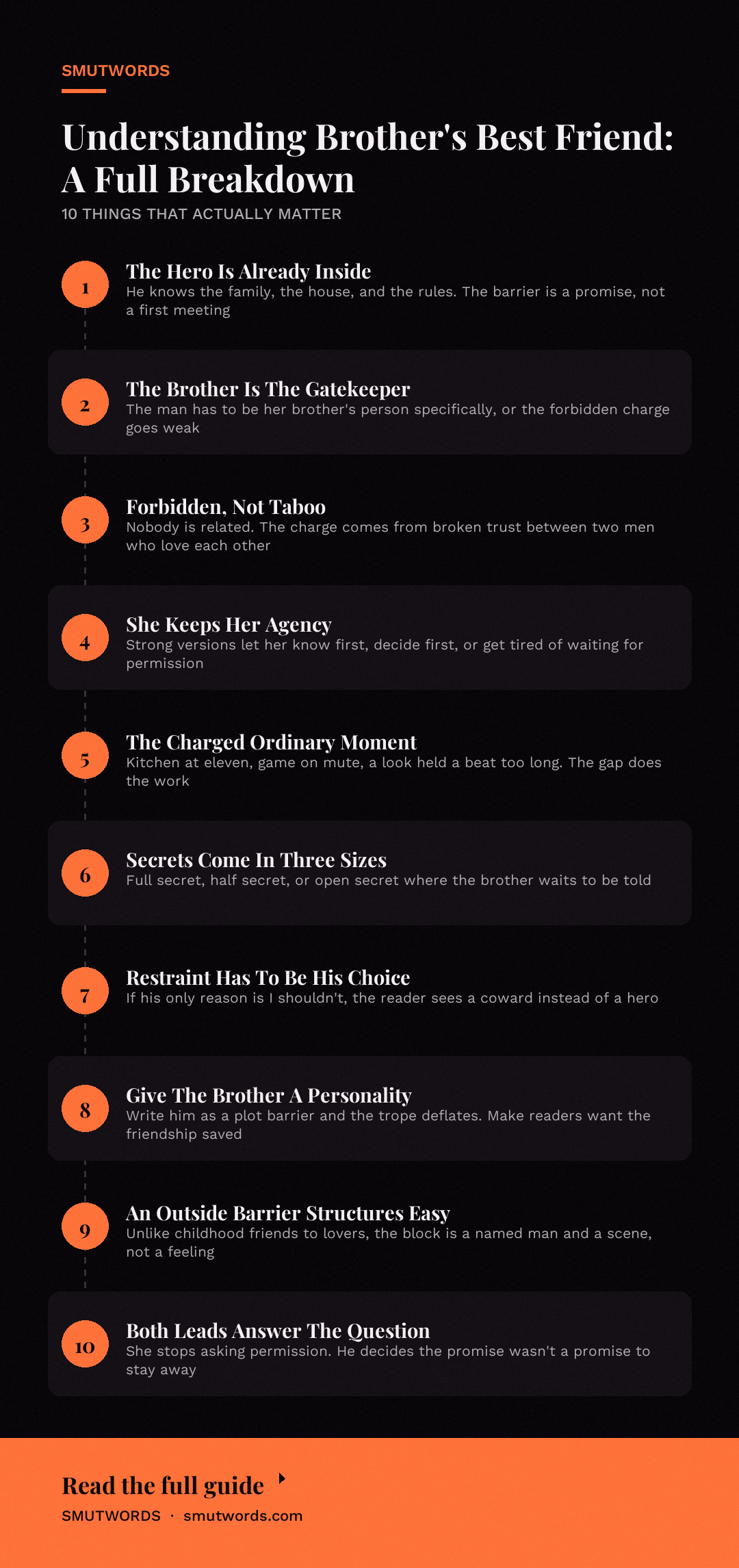
The name is a literal description of the cast: her brother is the connection, and his best friend is the love interest. The brother is the gatekeeper. He is the reason the hero has been in her orbit for years without ever being available, and the reason every step toward her is a small act of betrayal.
That gatekeeper position is the whole term. A close family friend of the parents doesn't count. The son of her mother's bridge partner doesn't count. The man has to be her brother's person specifically, which means the betrayal lands on the sibling relationship, and the sibling is a character with real feelings and a real place in the book.
What counts and what doesn't gets blurry at the edges, so here's the working test:
- Counts: her older brother's best friend from childhood, college, or the military. Her brother's roommate. Her brother's teammate. Any man whose primary route into her life is her brother's trust.
- Counts, with a twist: the brother's best friend who is also a coworker, a boss, or a soldier in the same unit, which layers a second forbidden structure on top of the first.
- Doesn't count: her best friend's brother (there the gatekeeper is her friend's family, not her own). His best friend's sister, which is the same trope with the roles flipped. Both exist as separate entries, and both play differently.
- Doesn't count: a man her brother merely knows. If her brother wouldn't take a bullet for him, the forbidden charge is weak and the book will feel like a generic close-proximity romance wearing this trope's clothes.
The most common misconception is that this is a taboo trope. It isn't. Nobody in the book is related to anybody, and the family in question will almost always come around by the last act. The charge comes from broken trust between two men who love each other, and from a woman deciding her brother's opinion of her love life is not the final word.
The second misconception is that she's a passive prize the men negotiate over. The strongest versions of this trope give her the most agency in the triangle. She's the one who knows first, or decides first, or gets tired of waiting for permission first.
Where Brother's Best Friend Comes From
In romance publishing, this trope is old enough to be considered part of the furniture. It appears throughout the category romances of the 1980s and 1990s, where a line like "my brother's best friend" functioned as shorthand for a trustworthy-but-forbidden hero, and it has stayed in near-constant rotation since.
The recognizable modern era, though, is the indie and digital boom of the 2010s, when serially published romance found that this trope plus a single point of view plus an Amazon category could carry a whole series.
Writers started building entire small-town romance universes around a firehouse, a construction crew, or a hockey team, and then worked through every sibling in the family in sequence. The brother's best friend is the workhorse of that structure, because it starts with the cast already assembled.
Two shifts changed how the trope reads on the page. First, consent and interiority became non-negotiable. Older versions let the hero's protectiveness stand in for communication; current versions make him say the thing out loud, apologize for the controlling parts, and let her set the pace.
He still steps in front of her when it matters. He just also asks first.
Second, the brother got a personality. In earlier category romance he was a plot device with a golf club. Now he's often a fully drawn character with his own arc, sometimes a hero in his own book later in the series. That's a better novel, and it makes the stakes of the secret far harder to shrug off.
There's a publishing-history footnote worth knowing too. This trope is one of the most reliably searched phrases in romance, which means authors, cover designers, and blurb writers now signal it explicitly in titles rather than hoping readers infer it from the back copy. A book called Her Brother's Best Friend is doing keyword work and a promise about the plot in the same breath.
How It Shows Up in Erotica
On the page, a brother's best friend scene typically produces three kinds of heat: the charged ordinary moment, the secret, and the collision.
The charged ordinary moment is the trope's signature beat. She's in the kitchen in an oversized shirt at eleven at night. He's on the couch with a beer and the game on mute. Nothing happens except that he looks at her a beat too long and she notices, and the reader's pulse does the work.
The whole trope lives in the gap between what's being said at the family table and what's happening in the hallway, and strong books extend that gap for chapters.
The secret is where this trope intersects with the broader apparatus of forbidden romance. Authors differ on how much to hide and from whom:
- The full secret. Nobody knows, including friends. Maximum tension, but the author has to earn the drawn-out sneaking without making the heroine feel disrespected.
- The half secret. The friend group knows, the brother doesn't. This gives the couple confidants and dialogue partners, and it makes the eventual reveal feel like a family event rather than a scandal.
- The open secret. The brother suspects, says nothing, and is waiting to be told. Underused and very effective, because it puts the pressure on his silence instead of hers.
The collision is the reveal. A strong version has the brother confront the hero first, one on one, and the reader feels the old friendship strain. A weaker version has the heroine do all the emotional labor of winning her brother over while the hero stands to the side being handsome, which is where these books lose readers.
Here's what separates a version that lands from one that reads flat. First, the hero's restraint has to be its own decision, not fear. He wants to be worthy of his friend's trust and he also wants her, and he makes a real choice under real pressure. If his only motivation is I shouldn't, the reader sees a coward.
Second, the heroine's wanting has to be as loud as his. The best versions flip the script and let her make the first move, or set a boundary around the secrecy that the hero has to respect.
This is where the trope connects to a broader principle about power and permission; if you want to see how that works in a scene where negotiation is the point, the scripts for saying no in kink apply almost word for word when the heroine tells the hero to stop protecting her.
Enjoyed this? Get a free book.
Join the list and we will send a complete free story straight to your inbox, plus new releases every week after that. No credit card, no catch.
Third, the brother has to be treated like a person the reader likes. If the writer makes him a brute or a bore, the secret stops mattering and the whole trope deflates. The best books make you want the friendship saved almost as much as the romance.
Common variations authors use: the reunion version, where she comes home for a wedding or a funeral and finds he's still there and still off limits (the tension in reunion romance works beautifully stacked underneath this one).
The small-town version, where the brother is also the sheriff. The military version, where the two men are in the same unit and the loyalty oath is career-defining (the code in military romance gives you a hard-edged take on it).
And the restaurant version, where she's the new sous chef and he's her brother's best friend and the head chef, which lets the kitchen's heat stand in for the family's (read chef/restaurant romance for how that one runs).
There's an honorable mention for the construction and outdoor-worker corner of the genre, because the hero's competence and his protective streak both land harder up close, and the lumberjack romance flavor works the same muscle.
One more craft note. This trope works best when it leans on the ordinary. The most charged scenes aren't the ones with screaming and door slams. They're the ones where he hands her a carton of eggs in her brother's kitchen and their fingers touch, and the reader can hear the whole family in the next room.
Brother's Best Friend vs Childhood Friends to Lovers
These two get lumped together constantly, and when the hero has been around since the heroine was a kid they genuinely overlap. The difference is who holds the key.
In childhood friends to lovers, the barrier is usually internal: long habit, fear of ruining a good friendship, a misread decade. Nobody has sworn an oath to anybody's brother. In brother's best friend, the barrier is external and named: a specific man, who has a specific promise to keep, and can plausibly punch the hero about it.
That external barrier does two jobs. It gives the author a plot engine (sneaking, lying, near-misses) that the internal barrier doesn't. And it gives the reveal a target, which is why this trope is easier to structure into a three-act novel than the slow-burn interior version. The interior version depends on the reader caring about a feeling; the brother's best friend version depends on the reader caring about a scene, and scenes are easier to write.
In practice, the best books in this trope are also childhood-friends-to-lovers books in disguise. He watched her grow up. The attraction snuck in while he wasn't looking. The brother is the last to know about a feeling that started long before the first kiss.
Frequently Asked Questions
Is brother's best friend a taboo?
No. It's a forbidden romance trope, and the prohibition is social rather than legal or biological. The two leads aren't related and nobody's family ties are compromised. The pressure comes from loyalty, a promise, and the risk of losing a friendship the hero values as much as he values the heroine.
What's the difference between brother's best friend and best friend's brother?
The gatekeeper. In brother's best friend, her own brother is the one whose trust is on the line.
In best friend's brother, her friend is the gatekeeper, which makes the secret feel more like a social-circles problem than a family one. The romance mechanics are similar. The fallout is different, because a friend can walk away more easily than a sibling can.
Why do readers love the older brother's best friend trope so much?
Because he's already family-approved. The hero is a known quantity to her parents, competent, protective, and trusted, and he's breaking a rule with a lot of weight behind it to be with her. Readers get a hero who is both safe and dangerous, which is a hard combination to find anywhere else in the genre.
How does the brother usually react when he finds out?
It varies by writer, but the strongest versions give him a real scene with both of them rather than a single punch. He's furious at the hero for the lie more than the romance, and the reconciliation has to be earned. Some books have him admit he saw it coming, which is often the most satisfying move of all.
What makes a brother's best friend romance fail?
Two things. The hero makes the secret her problem instead of making it his own responsibility, and the brother is written as a cardboard obstacle instead of a person. If the hero never takes a real risk on his own account, and the brother is only ever a plot barrier, the forbidden charge fizzles and the book reads like a bland close-proximity romance.
Is the bro code angle actually a kink?
Loyalty, ownership, and the tension between two people who both have a claim on someone are a genuine kink territory, and they overlap with the framing in our possessive kink vs jealousy kink breakdown. The hero's protectiveness belongs to her, not her brother's wishes, and strong books make that distinction explicit.
Final Thoughts
The brother's best friend trope is a version of a question every good romance asks: how much are you willing to give up for the person you want, and who gets to decide whether that's worth it?
The books that get this right let both leads answer. She decides she's not asking permission. He decides the promise to his friend wasn't the same as a promise to stay out of her life. And the brother, eventually, has to decide whether a friendship with a man who loves his sister is worth keeping.
Start with a book that takes the last decision seriously. Look for the ones that give the brother a scene where he's allowed to be right about something, and the hero a scene where he has to apologize instead of charm his way out. Those are the versions you'll remember, and the ones you'll reread for the hallway scene in the middle.





Loading comments…